
The Book
The Product of Medicine: How Efficiency Made American Health Care
The Author(s)
Caitjan Gainty
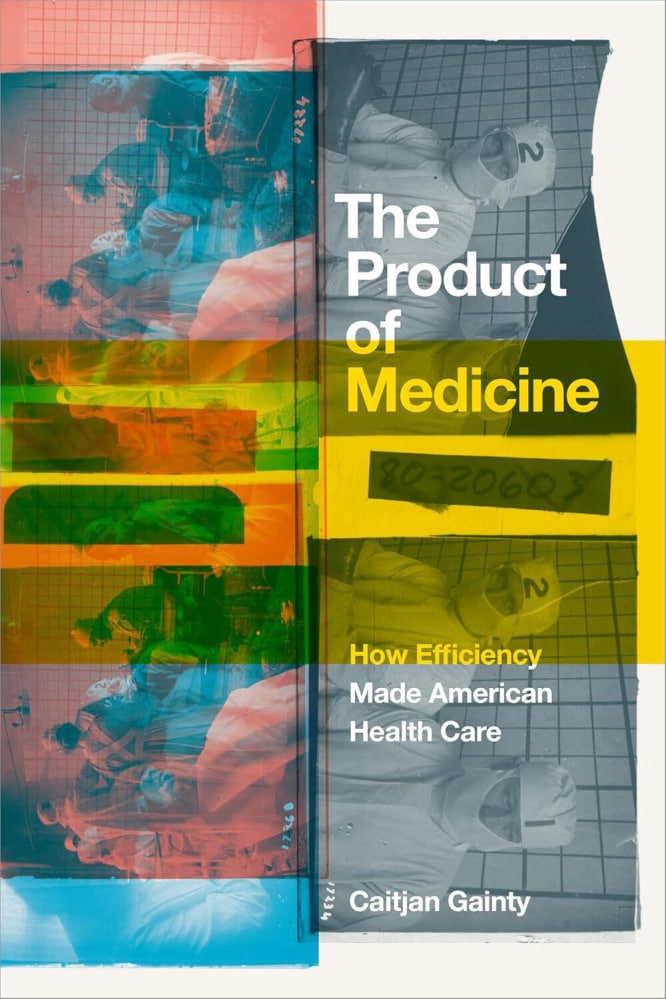
In The Product of Medicine: How Efficiency Made American Health Care, Caitjan Gainty offers an intelligent, well-researched, generally well-written, sometimes incomplete, and occasionally confusing account of efforts to modernize American medicine in the first few decades of the twentieth century. Gainty focuses on the introduction of “efficiency,” “process,” and “standardizing” perspectives to evaluate the “product of medicine” in several institutional, practice, and educational settings. By her examples she suggests that she’s exploring early twentieth century attempts by certain clear-thinking and courageous individuals (most of them physicians) to submit medical practice, institutions, and clinical outcomes to rigorous, objective, data-based effectiveness and efficiency analyses. But she never makes entirely clear exactly what she’s trying to unravel as she glides in six chapters from topic to topic, individual to individual, and institution to institution, from roughly 1900 to the early 1940s. It is only in her “Afterword,” where in a discussion of Archibald Cochrane’s brilliant and provocative analytical work culminating in his 1972 book Effectiveness and Efficiency, that she reveals she’s been illuminating early instances of what we would now call “evidence-based medicine,” “cost-effectiveness analysis,” and “health services research.” I for one would have had a better time with Gainty’s book if she told me sooner and in more straightforward language what she was really exploring in the early twentieth century American context.
To be fair, Gainty tells a complex story and she effectively illuminates several of its major twists and turns. She tells us, among other things, about Amory Codman’s campaign to assess the quality and effectiveness of hospital procedures with objective measures of outcome; the architectural features of the Mayo Clinic that deliberately facilitated the diagnostic methods that were build into its group practice model; the design of Henry Ford’s hospital in Detroit that he intended as a deliberate extension into medicine of the cost-effective principles that undergirded his automobile factory; the enthusiasm for “standardization” promoted by the American College of Surgeons (ACS) and its campaigns to enforce those standards on surgeons and the hospitals they practiced in and to advertise them to the larger American public; Abraham Flexner’s 1910 blueprint report for the reform of American medical education by raising the admission and graduation standards of medical schools, cutting the number of approved schools, and reducing the ratio of America’s practitioners-to-population to bring it closer to that of Germany; and the American Medical Association’s dramatic break with the ACS in the 1930s as it increasingly derided “efficiency” and “standardization” as the methods of big business, big government, and “socialism” while pushing instead for a nostalgic model of the likely inefficient dyad of deeply caring and devoted personal physician and his warmly attended to individual patient. As Gainty nicely sums up: “So critical had this idealized personal relationship become to salvaging organized medicine’s control over the monopoly it had built that it willingly sacrificed, for a time at least, the hard won image of an efficient and thereby effective expert. The efficiency that had been essential in drumming up business in the 1910s had now been replaced by a practiced inefficiency of care.” [Gainty, p. 160]
This is an interesting and persuasive story, well-supported by a sensitive and intelligent reading of primary sources. But Gainty doesn’t always read primary sources as fully and as carefully as she might because she sometimes seems hell-bent on a neatly packaged presentation with no loose ends. Historical reality, however, hasn’t always been so neat, as was the case with Abraham Flexner, his report, and its historical impact. What Gainty writes about Flexner as summarized above is correct as far as it goes but there is a lot more that could and should have been said. Consider, for example, this passage in the first of Flexner’s two chapters on the laboratory branches of medical school study.
Outside of anatomy, the laboratory in medicine is considerably less than a
century old. … The century which has developed medical laboratories has
seen the death-rate reduced by one-half, and the average expectation of
life increased by ten or twelve years. [p. 62]
Flexner is obviously enthusiastic for the positive changes he believes the laboratory has brought to medicine. But in his enthusiasm he trips over the elementary logical fallacy of confusing correlation with causation. The nineteenth century also saw the development of the steam locomotive and the telegraph. Did either of these inventions contribute to halving the death rate or did they just happen to take place at the same time?
In another passage closely following the one quoted above, Flexner extols what he calls “the immense educational importance to the prospective physician” of training in physiology.
[It is a] wholesome discipline for two reasons: it banishes from his mind
metaphysical principles such as vital force, depression, etc.; it tends, in
exhibiting the infinite subtlety and complexity of the physiological
mechanism, to emphasize normal conditions rather than medication as
ultimately responsible for its ordinary working. [p. 63]
Flexner’s point here has nothing to do with enhancing “efficiency” or measuring the “product of medicine.” It is about expunging old-fashioned notions such as “vital force” from medical theory and refocusing in clinal practice on the restoration of normal human physiological functioning rather than on “cure” by the risky prescription of dubious medications.
In a third passage Flexner reveals why his report has been thought by many to have exerted a profoundly dehumanizing influence on medicine. His words speak for themselves:
If … a laboratory is a place constructed for the express purpose of
facilitating the collection of data bearing on definite problems and the
initiation of practical measures looking to their solution, the hospital and
the dispensary are laboratories in the strictest sense of the term. And just
as it makes no difference to science whether usable data be obtained from
a slide beneath a microscope or from a sick man stretched out on a cot, so
the precise nature of the act or experiment is equally immaterial: it matters
not in the slightest, from the standpoint of scientific logic, whether the step
take the form of administering a dose of calomel, operating for
appendicitis, or stimulating a particular convolution of a frog’s
brain with an electric current. … The practicing physician and the
“theoretical” scientist are thus engaged in doing the same sort of thing,
even while one is seeking to correct Mr. Smith’s digestive aberration and
the other to localize the cerebral functions of the frog. [p. 92]
Flexner’s implication here seems frighteningly clear: a “modern” patient should now expect to be treated like a frog on a pithing tray.
Gainty leaves this out and it doesn’t fit comfortably into her historical framework. But many of Flexner’s most respected medical contemporaries and successors understood the worrisome implications of his biases and reacted strongly against them, not often with success. This, too, is part of the story of American medicine in the early twentieth century, indeed a crucial part of it. Gainty doesn’t include it either because it does not fit into her scheme – or, perhaps, because she is unaware of it. In any case, history is about more than neat fits or refulgent schemes. After fireworks brilliantly light up the night sky, they soon fizzle and leave us in the dark. It would be good at such moments to have an experienced guide lead us back to firm and familiar ground.
About the Reviewer
Theodore M. Brown is Professor Emeritus of History in the School of Arts and Sciences and of Public Health Sciences in the School of Medicine and Dentistry at the University of Rochester. During his forty-two years on the active faculty at Rochester, he also taught regularly in the Medical School’s Division of Medical Humanities. His research includes the history of U.S., international, and global medicine and public health; the history of U.S. health policy and politics; the health left and its role in both domestic and international health policy; the influence of organized philanthropy on medicine and public health; and the history of psychosomatic medicine, “stress” research, and biopsychosocial approaches to clinical practice. Professor Brown served as editor of Rochester Studies in Medical History, a book series of the University of Rochester Press, for eighteen years and oversaw the publication during his tenure of forty-five monographs on the history of medicine, public health, and related fields. He has also served from 1997 to 2024 as Associate Editor for History of the American Journal of Public Health and continues to serve as Associate Editor for History Emeritus. In 1997 he co-authored (with Elizabeth Fee) Making Medical History: The Life and Times of Henry E. Sigerist and in 2012 (with Georges Benjamin and Susan Ladwig) The Quest for Health Reform: A Satirical History, a history of health reform in the United States as seen in political cartoons. In 2013 (with Anne-Emanuelle Birn) he published a coedited and coauthored book on American health internationalists in the 20th century. Along with Marcos Cueto and Elizabeth Fee, he completed a history of The World Health Organization: A History, which was published by Cambridge University Press in April 2019. In November 2022, the American Public Health Association published Public Health Then and Now: Landmark Papers from the American Journal of Public Health, an anthology of historical papers which he selected and introduces.
0