
The Book
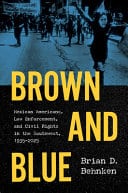
Brown and Blue: Mexican Americans, Law Enforcement, and Civil Rights in the Southwest, 1935-2025
The Author(s)
Brian D. Behnken
“We didn’t cross the border; the border crossed us.”
Anonymous (Chicano Movement)
Brian D. Behnken is Professor of History at Iowa State University, specializing in the history of Mexican Americans and African Americans; he holds a PhD from the University of California, Davis, and has published extensively. His book is the culmination of years of research analyzing important legal cases to examine the connections linking policing in the Southwestern United States to racism against people of Mexican descent. This work builds upon his 2022 book, Borders, Violence, and Justice, 1835–1935, which examined how policing and criminal legislation in the first century of the U.S. occupation of territories formerly belonging to Mexico transformed public perceptions of criminality.
Behnken argues that violence against the population of Mexican descent—involving police harassment, lynchings, and massacres—did not occur outside the law. Institutions charged with maintaining order, such as the local police, the courts, and federal authorities directly instigated violence, or tolerated such actions. The expansion of the United States was a conflict-ridden process. In the aftermath of the Mexican-American War (1846–1848) and the redrawing of the U.S.-Mexico border, there were waves of Anglo Americans settlers migrating into the newly conquered territories, attracted by government policies granting agricultural land, the gold and silver rushes, and, later, the development of the petroleum industry. The legal institutions settlers established during this period associated Mexican identity with criminality, in the process legitimizing practices of repression and racial discrimination against both Mexican migrant labor and the more settled Mexican American population.
The author stresses that, from the very beginning, Mexicans and Mexican Americans developed strategies of political, legal, and community resistance to defend their rights and to assert their belonging to American society. Behnken’s new book focuses on the history of policing in the Southwest from 1935 to the present. The book opens with the story of Simon Rodriguez, a Mexican-American child Texas police killed in 1974 when they forced him to play a game of Russian roulette. Popular response to this tragedy illustrated the struggle of people of Mexican descent to protect their civil rights against unrestrained police abuse. The book’s central argument is that police abuses—characterized by racial prejudice and institutional violence—served as key catalysts for social movements. From the Chicano Movement (Brown Power) of the 1960s and 1970s to popular response to Bill Clinton’s 1994 “War on Crime” legislation, community activists have not stopped demanding law enforcement reform. Using case studies from Texas, California, Arizona, and New Mexico, the author demonstrates how police harassment, arbitrary detentions, and unjustifiable killing of suspects during arrests fueled protests, long-term campaigns for police reform, and demands for greater Mexican-American representation within public safety institutions. Despite the important differences distinguishing the Southwestern U.S. states, the study demonstrates that police violence against people of Mexican descent is one problem they all share.
Behnken acknowledges that the authorities’ responses have not been exclusively repressive. At various times, local and state governments attempted to reform law enforcement institutions, including developing recruitment programs for Mexican-American officers, changes in how police are trained, and initiatives aimed at improving police-community relations. Most of these reforms stemmed from pressure exerted by social movements. This is not a process of steady evolution toward justice and democracy, but rather demonstrate the difficult history for the American Southwest as communities oscillated between democratic progress and institutional regression back to accepting violence as normal.
The first chapter, “Pachucos and Police: Mexican Americans and Law Enforcement at Midcentury,” analyzes the 1930s and 1940s, when the mass media used the pachuco figure to symbolize the alleged rampant juvenile delinquency found in the region’s Mexican communities. Behnken demonstrates how authorities and public institutions constructed a racialized image of this American youth—characterized by non-white cultural styles such as the Zoot suit—as a threat to public safety. One consequence was intense police harassment that culminated in repeated acts of senseless violence.
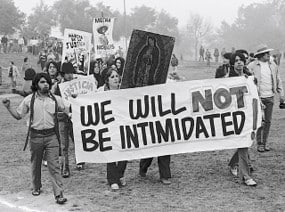
The second chapter, “Like Killing a Dog: The Struggle to End Police Violence against Chicano Movement Participants,” follows the development of social movements to combat police abuses. Behnken mentions how the significant increase in population contributed to the impact produced by social movements. In the 1930s, for example, there were just over a million Mexican-Americans living in the U.S. Southwest. Four decades later, in the 1970s, the Mexican American population had grown to nine million. Today there are more than thirty million. Behnken’s analysis is particularly strong in showing how demands for full citizenship were linked to equal access to justice. Community activists were also fighting to improve education and end racial division, but no other cause attracted as much support as the fight to put an end to police abuses.
In the third chapter, “Blood on Their Hands, The Chicano Response to Police Violence against Non-Moving Mexican Americans,” Behnken examines the political radicalization of the 1960s and 1970s. Cases of unpunished murders of young Mexican-Americans by police officers became catalysts for community mobilizations. Many problems were connected to historical problems, such as the “Ley de Fuga,” which, since the nineteenth century century, authorized police officers to use lethal force to prevent a suspect from escaping, even when the person did not pose an imminent threat to police officers or third parties. The author compares the fight to end police brutality initiated by the Brown Berets with comparable campaigns in the African-American community against police violence. There is no mention in the book of anti-police violence movements in indigenous communities, nor, given the stress on race and class, does the author explore the place of gender in anti-police violence campaigns.
Chapter Four, “Cruel and Unusual: Strange Cases of Abuse, Activism, and Reform,” addresses attempts at institutional reform. Behnken rejects simplistic interpretations suggesting that mere representation would solve structural problems. His analysis demonstrates that many Mexican-American police officers entered the profession motivated by ideals of community service, yet often encountered institutions shaped by historical practices of exclusion and coercion. Chapter Five, “Custodial Situations: Mexican Americans Confront the Carceral State,” discusses how particular achievements—such as the establishment of Miranda rights—represented major victories in the civil rights struggle. In 1963, Ernesto Miranda was arrested in Arizona. He confessed to a crime during police interrogation without first being informed of his rights. His lawyer argued that the confession was invalid because Miranda did not know he could remain silent or request an attorney. In 1966, the Supreme Court ruled in his favor, establishing the Miranda rights, which police must read to a suspect in custody before questioning them. This marked a significant victory for the civil rights movement.
Chapter Six, “A Better Day Coming? The Chicano Movement and Local-level Criminal Justice Reform,” is particularly interesting for its discussion of the limits of institutional transformation within police departments; these institutions have destroyed records to protect their image while simultaneously engaging in educational and recreational community outreach and hiring female officers. The case of Mexican-American police officer Laura Garcia in San Antonio is cited as an example that signaled new opportunities for women in the profession.
In Chapter Seven, “The Hidden Eights: Protest and Retrenchment in a Militant Decade,” the author examines the changes that occurred during the 1980s and 1990s—a period marked simultaneously by community policing initiatives and the strengthening of mass incarceration policies. He draws attention to the ongoing civil rights struggles of the era, which focused on reforming immigration laws, opposing state social spending cuts, and challenging violent police treatment of individuals with serious health issues, such as those with AIDS. Many gains achieved by Mexican-American activists were partially undermined by the dramatic expansion of the penitentiary system as a result of the “War on Drugs” in the 1970s and 1980s and the “War on Crime” in the 1990s. The final chapter, “No Justice, No Peace: The Problem of Policing from the 1990s to Today,” connects the history of the Southwest to contemporary discussions regarding immigration, border patrol, and police violence. The historian argues that current practices of surveillance, incarceration, and the militarization of local law enforcement do not represent a break with the past but rather an exacerbation of long-standing problems. Latinos continue to fear law enforcement. Many crimes remain unsolved. Behnken’s approach offers a critical historical perspective relevant to various facets of public debate in the Southwestern United States. By substantiating the need to abolish qualified immunity for police officers, eliminate unjustifiable patterns of intimidation, reduce increasingly exorbitant military spending, and end the War on Drugs and Crime, he aligns himself with activists working to ensure that racism has no refuge in law enforcement.
Illustration 1: Loose-fitting, brightly colored “Zoot suit” clothing. Photo: Getty Images

Illustration 2: South L.A. youth arrive at Belvedere Park for La Marcha por la Justicia in January 1971. Luis C. Garza / UCLA CSRC
About the Reviewer
Priscila Dorella is an Associate Professor of History of America and History of Latin-america at the Universidade de Viçosa in Brazil. Dorella is the author of Octavio Paz: Estratégias de Reconhecimento, Polémicas Politicas e Debates Midiáticos no México (São Paulo: Alameda, 2013). She wrote the note Susan Sontag uma intelectual pública to the projet Trans Atlantic Culture (2021) and served as a Visiting Scholar at the Department of History at Berkeley (2018) and at Universidade Federal Fluminense and La Rochelle Université (2024). Currently, she coordinates the construction of the first Oral History laboratory at the university where she works.
(translation by Richard Cándida Smith)
0