
The Book
Alex Wellerstein
The Author(s)
The Most Awful Responsibility: Truman and the Secret Struggle for Control of the Atomic Age
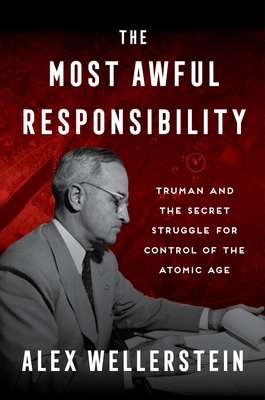
In his second book, The Most Awful Responsibility: Truman and the Secret Struggle for Control of the Atomic Age, Alex Wellerstein offers a major contribution to a question that has long shaped the historiography of the atomic age. While the book is centered on President Truman, Wellerstein stresses that it is not a conventional biography, but rather an effort to trace “how Truman’s own understanding and thinking about the atomic bomb—and the Cold War—evolved over the course of his presidency.”[1] This framing emerges from an attempt to resolve the “apparent paradox” of Truman being both the first atomic president, and the only one to oversee the wartime use of atomic bombs, as well as a figure who “plainly detested” nuclear weapons.[2]
The book advances three interrelated arguments. First, Wellerstein revisits the decision to drop the bomb, offering a novel and compelling intervention in a debate that had grown somewhat stagnant. Second, he examines how Truman’s perceptions of the bombings shaped early postwar struggles over control, custody, and authority over the atomic arsenal. Finally, Wellerstein traces how the intensifying early Cold War geopolitical climate, namely the outbreak of the Korean War, eroded Truman’s earlier optimism and accelerated the momentum toward further atomic escalation.
Wellerstein’s first argument is both his most original and most provocative. He contends that the foundational question of the atomic age, namely what motivated Truman to drop the bomb, is itself a flawed framing. The critical issue, he argues, is not why Truman chose to use nuclear weapons, whether it was a “military necessity,” an instrument of atomic diplomacy, or as an expression of widespread anti-Japanese sentiment, although he acknowledges that each of these explanations plausibly contributed to the constellation of factors that culminated in the bombings.[3] Rather, the primary question, according to Wellerstein, is the extent to which Truman understood the decision before him, and whether he made a decision at all.
When Truman inherited the project, Wellerstein writes, it “was essentially self-sustaining, did not seek nor require his input, and he was comfortable delegating essentially every decision regarding it to his subordinates.”[4] In seeking to carry forward the unknown wishes of Roosevelt, Truman’s principal action regarding the bomb was inaction. No substantive debate occurred over whether the bomb would be dropped, and those who had long been involved in its planning, rather than Truman himself, were the ones who exercised effective oversight.
The one intervention that Truman did make came largely at the urging of Secretary of War Henry Stimson. Stimson pursued a sustained effort to remove Kyoto, a historic cultural capital, from the targeting list, where it had ranked as the top candidate. Wellerstein argues that Stimson, determined to spare Kyoto, exaggerated the contrast between Kyoto and Hiroshima. When Truman concurred with Stimson, he did so under the mistaken belief that they were targeting military infrastructure rather than a civilian city. When he announced the bombing, his description of Hiroshima as “a military base” was therefore not a knowing deception, an attempt to shape the court of public and historical opinion. According to Wellerstein, Truman likely believed this distinction himself.
He also likely did not understand that the U.S. was to drop additional atomic bombs. The bombing of Nagasaki appears to have come as a surprise. The next day, Truman ordered an end to further bombings, marking the moment when his “willingness to allow the military and his advisers to run the atomic bombing operations had ended” and in which he “personally reserved the ability to order further atomic bombing attacks, and cited the horror of killing huge populations of people… as the reason.”[5] This, Wellerstein argues, was not an expression of regret so much as Truman’s first full recognition of what he had authorized, albeit in a highly peripheral manner.
This experience, Wellerstein contends, informed Truman’s personal outlook and the direction of national policy. Contrary to his frequent depiction, Truman did not respond to the bombings with callousness, nor was he as hawkish toward the Soviet Union as historical memory has suggested. Instead, he expressed a cautious optimism that the bomb might never be used again and that neither an arms race nor a Cold War was inevitable. This belief did not arise from any naïve assumption that the Soviets could not develop an atomic bomb so long as the U.S. guarded the so-called secret. Rather, it reflected Truman’s profound revulsion toward nuclear weapons and his corresponding faith in the possibilities of diplomacy.
Yet, as Wellerstein shows, Truman faced substantial pressures, foremost the question of military versus civilian control. Truman resisted the push for military custodianship as much as political constraints allowed. While Wellerstein details a complex set of public and private maneuvers, the overall pattern is clear: Truman sought to keep the bomb under his own authority and did so in hopes that it might prevent its future use. He made notable missteps, appointing Bernard Baruch as UNAEC representative, supporting testing, and authorizing the H-bomb, much of this under considerable domestic anti-communist pressure, yet his broader intentions remained clear.
Ultimately, however, Truman ran up against the frigid winds of the Cold War. The outbreak of the Korean War reignited the question of atomic use. The language and actions displayed by General Douglas MacArthur, in particular, led Truman to conclude that he had to be dismissed, but his popularity conveyed clear political risks. Wellerstein examines this episode in detail, concluding that Truman’s decision to transfer nuclear weapons, albeit only a small number, to military custody was shaped by an unspoken political agreement: Truman sought to signal support for the military in exchange for axing MacArthur, making clear that “if the military wants custody of atomic weapons, then there cannot be any question that the American military ultimately answered to civilians.”[6] This marked the end of full civilian control even as Truman continued to retain sole authority to order their use.
Wellerstein argues that these efforts, in combination, helped prevent the use of nuclear weapons under Truman and helped to establish a norm of non-use and civilian oversight. Had he delegated control to the military earlier and more completely, the trajectory of the atomic age might have been vastly different, and far more destructive. In this sense, Wellerstein concludes that despite his imperfections and limitations, Truman may well have been “the most important anti-nuclear president of the twentieth century.”[7]
Ultimately, The Most Awful Responsibility is far more than a retelling of a familiar narrative. It has the potential to reshape prevailing interpretations of Truman’s role in the atomic bombings and of the influence he exerted in constructing the nuclear policy framework that endures to the present. There are, however, moments of unevenness in the depth of Wellerstein’s analysis. His treatment of the bombing itself is richly developed and rigorously argued, while the longer period between 1945 and 1950, though solid, unfolds at a somewhat brisker pace. By contrast, his discussion of Korea matches the depth and clarity of his account of the 1945 decision.
Moreover, while the book’s focus on Truman warrants concluding the narrative at the end of his presidency, with a brief nod to Eisenhower, the claim that Truman was perhaps the foundational figure of the atomic age, whose influence resonates into the present, might have been strengthened by tracing that through-line more explicitly into subsequent administrations. Doing so could have further illuminated the extent to which Truman’s imprint truly shaped later nuclear policy. Perhaps those dimensions are for another book. Nonetheless, as it stands, Wellerstein’s work is among the most compelling contributions to a well-saturated field in many years.
[1] Alex Wellerstein, The Most Awful Responsibility: Truman and the Secret Struggle for Control of the Atomic Age (New York: Harper, 2025), xiii.
[2] Wellerstein, xii.
[3] See: Henry Stimson, “The Decision to Use the Atomic Bomb” (1947), Gar Alperovitz, Atomic Diplomacy (1965), John Dower, War Without Mercy (1986), Ronald Takaki, Hiroshima (1995).
[4] Wellerstein, 36.
[5] Wellerstein, 105.
[6] Wellerstein, 279.
[7] Wellerstein, 316-317.
About the Reviewer
Eric Ross is a PhD candidate in History at the University of Massachusetts Amherst, where he is completing a dissertation on scientific agency and complicity in the early atomic age. He teaches a wide range of modern history courses, including those focused on the United States, the Middle East, global history, and Cold War culture, at both UMass and Greenfield Community College. Ross is also an organizer, public speaker, and writer on issues related to U.S. imperialism and nuclear weapons. His work has appeared in outlets such as TomDispatch, The Nation, CounterPunch, and Common Dreams.
0