
The Book
A Radical Anthropologist: The Trials and Triumphs of Kathleen Gough
The Author(s)
Sarah Lindemann
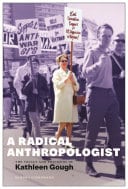
I had never heard of Kathleen Gough, but I was familiar with her bold declaration in 1968 that “Anthropology is the child of Western imperialism.” As the writer Sandra Lindemann makes clear in a recent biography of Gough, there’s a reason most of us have never heard of the woman who spoke it. As a communist academic whose radical antiwar activities not only got her fired from her university, but landed her on FBI and international watchlists in the 1960s and ‘70s, she was often silenced by powerful institutions. Lindemann succeeds in giving the anthropologist her due in A Radical Anthropologist: The Trials and Triumphs of Kathleen Gough (Monthly Review Press, 2026), a slim, 181-page narrative of Gough’s personal and professional life.
Gough’s scholarly feats were nothing short of pathbreaking. Her career spanned the mid-twentieth century at some of the world’s most elite institutions in England (Oxford and Cambridge Universities), the United States (Harvard and Brandeis Universities, the University of Oregon), and Canada (Simon Fraser University). The same could be said of her novel contributions to the discipline of anthropology. A recurring theme of the biography is Gough’s being denied due recognition because of her gender and Marxist politics.
As far as Gough’s contributions to anthropology, Lindemann credits her as one of the first scientists to apply a Marxist historical lens to the study. The English anthropologists Gough challenged had previously used descriptive methods of classifying colonized cultures. The older habits were in keeping with imperial prerogatives. Gough boldly went beyond mere description in her publications. Incorporating historical methods, she underscored change in cultural practices over time. Perhaps her most field-defining practice, Gough made a habit of including herself–the colonial researcher–as a figure of analysis in her field notes as early as the 1950s. This practice of autoethnography, a method of reflective positionality, did not break through professionally until the 1970s and ‘80s and is standard practice among qualitative researchers today. In the early 1970s, Gough was among a handful of anthropologists who called for a set of disciplinary ethics to account for the rights of human subjects in research.
I happened to read Gough’s biography immediately after Emily Eakin’s The Frenchmen: Or, My Life in Theory (Penguin, 2026). Eakin’s is a biographical mash-up of the academic lives of French philosophers (all men famous enough to be recognized by last name only–Althusser, Barthes, de Man, Deleuze, Derrida, Foucault, Guattari, Lacan, and Sartre) whose lives, academic careers, and activism ran parallel to Gough’s. Reading the men’s stories alongside hers revealed a shockingly stark contrast in the treatment of leftist men academics who were heralded as celebrities while they lived.
Gough, who graduated with the highest honors available to students of Cambridge, was barred from participating in her own graduation ceremony as a woman. While her degree was sent in the mail, she sat in the audience to watch her husband accept his degree from the same program. That year, 1950, a young Foucault failed his philosophy agrégation at the École Normale. He passed on his next attempt and was immediately hired by Althusser as an instructor in the country’s most prestigious institution, where he soon began teaching an even younger Derrida (who also failed the agrégation). Meanwhile, Gough’s advisors–the very men who awarded her the highest marks, higher than her husband’s–thought it laughable that a married woman would perform academic work. Her husband was offered a teaching position instead.
Lindemann’s own admiration for her subject comes across clearly. No doubt Gough suffered for all the sleights she endured, persecuted but never acknowledged as a martyr. But in Lindemann’s narrative, one is left to wonder if Saint Kathleen Gough, institutional rebel that she was, had any faults at all. The biographer approaches whatever shortcomings Gough may have had obliquely in the final chapter by acknowledging the anthropologist’s life was “full of contradictions.” She was at once a radical feminist, Marxist, and anti-imperialist with “a loyal devotion to Queen Elizabeth II” (169). Lindemann says little else of the contradictions nor does she interpret them. Anyone searching for Gough’s failings will have to read between the lines. I speculate that the narrative halo around the protagonist was a partial condition of access to the source material, which included “discretionary access to a private memoir written for the family by Kathleen herself” granted by Gough’s son (10).
A Radical Anthropologist still offers important insight into anthropology as a field and the geopolitics of Western universities more broadly. Readers need not be expert anthropologists to appreciate the discipline’s shakes and shifts throughout the twentieth century, as social scientists across the North Atlantic grappled with decolonization, feminism, neoliberalism, and American hegemony.
About the Reviewer
Lauren Lassabe Shepherd is host of the American Campus Podcast. She is the author of Resistance from the Right: Conservatives and the Campus Wars in Modern America (University of North Carolina Press, 2023), and the forthcoming Inventing the Liberal University: How a Right-wing Fantasy Became Mainstream (University of Chicago Press).
0