
The Book
Complicity in American Literature after 1945: Liberalism, Race, and Colonialism
The Author(s)
Will Norman
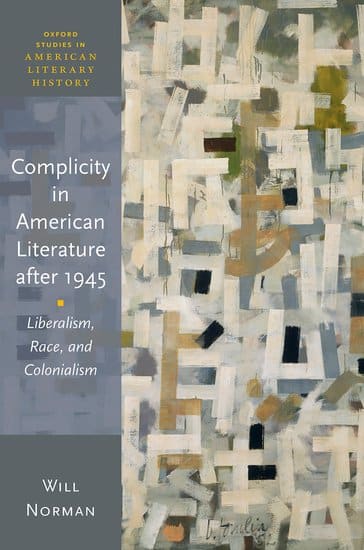
This book is a study of “complicity” as a defining theme in post-World War II liberal U.S. fiction between 1945 and 1970. The authors discussed in-depth include James Baldwin, Saul Bellow, Ralph Ellison, Mary McCarthy, Vladimir Nabokov, Philip Roth, Kurt Vonnegut, and Richard Wright. All were prominent and distinguished writers, whose books sold well and whose opinions on current affairs appeared regularly in major newspapers and magazines. Each had at least one book that had become iconic for its critical assessment of some aspect of U.S. society.
Norman, reader in U.S. literature at the University of Kent and author of several previous studies of mid-twentieth-century liberal culture, begins this insightful study with a lengthy discussion of Jean-Paul Sartre’s distinction between complicity and collaboration. The latter term is the more straightforward. In the context of the Second World War, collaboration was a conscious political choice the French government and many individuals made during the German occupation of France to work with the Nazis. A few collaborators were fascists ideologically sympathetic to the Nazis. Many more French collaborators detested the German regime. They assumed Germany’s military domination of Europe was unlikely to be reversed. Collaboration was a rational if misguided policy with the goal of preserving French political and economic autonomy. All political choices are gambles, in this case with fatal consequences for “collaborators” as allied military superiority exposed the short-sightedness of a policy that in 1940 appeared to be grounded in hard-headed realism.
“Complicity” on the other hand Sartre defined as a moral challenge inherent to living under German occupation. All basic activities maintaining social order and economic productivity necessarily served the enemy, who like leeches (Sartre’s simile) extracted whatever they wanted from French society to maintain the German war machine. Every adult and child, merely by continuing their regular everyday activities, contributed to crimes the majority of French citizens condemned. Acceptance of what actually exists as inescapable and possibly irreversible Sartre termed “bad faith,” a condition of semi-conscious self-deception. For some individuals, however, confronting the brutality of German rule initiated a painful moral awakening. A growing stream of volunteers determined to resist turned the French underground into an increasingly effective resistance movement. Resistance in Sartre’s schema negates the inauthenticity inherent to social relations by revealing the challenging but practical possibilities for liberatory action.
That the dialectic of complicity and resistance was a constituent feature of modern life was demonstrated after liberation when French citizens en masse were turned into accomplices to crimes their government committed fighting independence movements in Indochina and Algeria. These crimes included reopening concentration camps for the extrajudicial imprisonment of civilians deemed potentially disloyal, the routine use of torture during interrogations, massacres of civilians, the imposition of capital punishment on political prisoners—activities that across Europe had been the basis for post-liberation punishment of German officials and their local collaborators.
Norman contrasts Sartre’s argument on the moral foundations of resistance with Hannah Arendt’s cautionary assessment that all repressive societies make the organization and extraction of complicity a task of the highest priority. In Arendt’s formulation, the mass media promote complicity by making sure moral priorities that might undermine government policies are popularly viewed as extreme positions external to “common sense.” Those who resist are marginalized as misguided idealists promoting disorder. While Sartre’s argument foregrounded the dialectic connecting inner moral clarity and resistance movements, Arendt stressed why resistance is difficult to mount and in most situations restricted to symbolic actions whose primary goal becomes separating “radicals” from contaminating policies rather than effecting a change in the political order. Norman effectively uses Arendt’s arguments to foreground how the theme of complicity in U.S. writing increasingly expressed psychological confusion rather than political determination.
Consideration of how complicity emerged as a critical theme in U.S. writing begins with responses to the Holocaust in 1945 as images of the death camps flooded periodicals. Public intellectuals in the United States worried that anti-semitism, a powerful, endemic force within U.S. society, had shaped the failure of the government to disrupt German extermination operations or even to publicize what the intelligence information it had gathered. U.S. refusal to act in any way had in effect made all citizens of the United States complicit in German war crimes.
Novels, such as Laura Hobson’s best-seller, Gentleman’s Agreement (1947), explored anti-semitism as a pervasive feature of everyday life in the United States. Hobson’s book as popular rather than prestige literature stands outside the main argument of Norman’s book, but he observes that this best-seller, quickly adapted into a major Hollywood motion picture, established an approach to anti-semitism that other authors applied to many different types of “discrimination.” Anti-semitism in the United States in Hobson’s treatment did not reflect deeply seated hatreds, or even a divergence of interests between groups. For most Americans, stereotyping Jews was an inherited discursive habit that produced rather than expressed “prejudice.” Given the supposed superficiality of the problem, its solution was relatively easy and started with changing the language people used unthinkingly to describe other groups.
The naïveté of a discursive explanation was abundantly clear with anti-semitism, but even more starkly self-evident whenever discussion of “prejudice” and “discrimination” included the organized separation of whites and blacks operating in every part of the country. The theme of complicity once linked to the country’s system of racial segregation expanded to include discussion of the U.S. relationship to European colonialism and operations to suppress communist activity in Asia, Africa, and Latin America. By the mid-1960s, as the black power movement coincided with growing militant resistance to the war in Vietnam, the theme of complicity played a prominent role in literary discussion of racial politics, both domestic and international.
Mary McCarthy’s book Hanoi, a report of her 1967 trip to North Vietnam at the height of the Vietnam War, provides particularly useful insight into how mid-century liberal writers themselves viewed these questions. McCarthy wanted to present an “objective” report of what she experienced watching the self-defense efforts of a people her government always referred to as aggressors invading a neighboring country. She arrived in North Vietnam frankly suspicious of her own government’s failed policy, but she had no enthusiasm for Vietnamese communism. The political choices available were murky to her. The disastrous effects on Vietnamese civilians of how her government chose its targets were however cruel and inescapably ineffective. She contemplated how racial policies at home and foreign military interventions were united by a desire to punish any people of color claiming a right to self-determination. McCarthy wanted to alert the reading public to the fundamental moral contradictions explaining why U.S. policy in Indochina was failing so dramatically. Her dismay at the situation led to a conclusion that was unexpected and painful for her because it undermined her belief that writers pushed their readers to consider difficult truths that most people would rather evade. The more brutally honest her reporting, she thought, the more likely her book will fail to have any positive effect. Indeed, as McCarthy put it, her honesty as a reporter made her complicit with policies she knew to be criminal as well as failed.
McCarthy’s self-reflexive self-incrimination lies at the center of Norman’s story. The complicity of the citizenry at large with crimes committed as a result of their government’s policies—the central question motivating both Sartre and Arendt in their considerations—gives way a much more limited concern: the failure of authors to act effectively as the consciences of their countries. Did that mean only that as liberals their writing was ineffective? Or might it mean that the claim that literature expressed humanity’s highest ideals in forms that were irresistible to any honest person with a conscience had no substance?
Norman argues that a distinguishing feature of liberal literary culture after World War II was a growing understanding among writers and intellectuals that their role as critical thinkers was what most made them complicit with policies they publicly condemned. The debates they generated in prestige publications created an illusion that controversial policies, whether domestic or foreign, had taken shape in the course of free and lively debate and therefore legitimately represented the will of the people. In fact, policy makers paid minimal attention to public opinion except as a potential problem that must be managed. The growing disjuncture between the esoterics of policy and the charades of publicity promoted among many authors, according to Norman, “a nebulous feeling of guilt for actions not taken with an indirect responsibility for crimes committed by others” (3).
A perverse by-product of this disjuncture was that social contradictions for liberal writers in the mid-twentieth century increasingly took the form of problems for individual conscience, often expressed most eloquently in the anguish of authors who have failed to live up to their profession’s highest ambitions. The variety of responses to this dilemma in the authors Norman analyzes makes this book a particularly valuable forensic study of liberalism as a failing ideology. Norman’s concluding chapter breaks away from the limitations of prestige literature to shift the focus to crime fiction by three African American writers, Chester Himes, Walter Mosley, and Attica Locke. These three authors mobilized the rhetoric of complicity to describe everyday violence and crime in the black community as inherent to the machinery of racial subjugation and therefore of vital importance for any strategy for liberation. Their stories are of course self-conscious diversions, popular entertainments relying on conventions that foreground describing and assessing what characters do to achieve their goals, without more than passing consideration of the dilemmas of personal conscience in inherently violent and unjust situations.
A more broadly conceived literary history might go beyond prestige authors to look at less distinguished but even more popular writers than those considered in this study. Herman Wouk’s The Caine Mutiny (1951) and John Hersey’s The Wall (1950) were best sellers that provided readers more immediate action-oriented approaches to the problem of complicity. Rather than focusing on the inability of conscience to effect change, Wouk wrote a story about junior military officers who driven by their conscience act decisively to remove their authoritarian commanding officer whose actions they consider illegal and immoral, hence illegitimate. Hersey’s novel explores the 1943 uprising by Jewish resistance fighters who successfully took over the Warsaw Ghetto and held off the German army for a month. The stories Wouk and Hersey wanted to tell were timely and relevant to comprehending the Second World War and its aftermath. Their approach, perhaps lacking in literary sophistication, more clearly echoed Sartre’s argument that a genuine awakening of personal conscience leads to action. Their stories required characters who act on their principles despite the risks inherent to what they must do. In that sense Wouk and Hersey both successfully dramatized Sartre’s core argument that meaningful action involves a gamble. Practical victory must be uncertain, but moral victory is inalienable because authentic action reveals potential rather than despair as basic to active engagement with the world.
It is also important to consider that at the time African American critics and readers did not share the enthusiasm their white counterparts had for Ralph Ellison and James Baldwin. Consideration of what complicity meant in the black community requires examining a broader range of authors—perhaps, writers more like Gwendolyn Brooks, Lorraine Hansberry, or Claude Brown—whose work generally emphasized practical choices their characters must make without having any certainty as to the outcome.
About the Reviewer
Richard Cándida Smith is Professor Emeritus of History at the University of California, Berkeley. He has published seven books and over fifty essays. His most recent book is Improvised Continent: Pan-Americanism and Cultural Exchange. He is currently working on a book, tentatively titled A Truer Self, exploring the idea of “everyday life” and strategies proposed for capturing the hidden world of the everyday. His work has explored arts and literary networks, movements, and institutions in the United States, with an emphasis on international connections and exchange. He sits on the board of directors for Voices of Contemporary Art and on the editorial board of Transatlantic Cultures: Cultural Histories of the Atlantic World 18th-21st Centuries. For more information: https://berkeley.academia.edu/RichardCandidaSmith and https://www.richardcandidasmith.com/.
0