
The Book
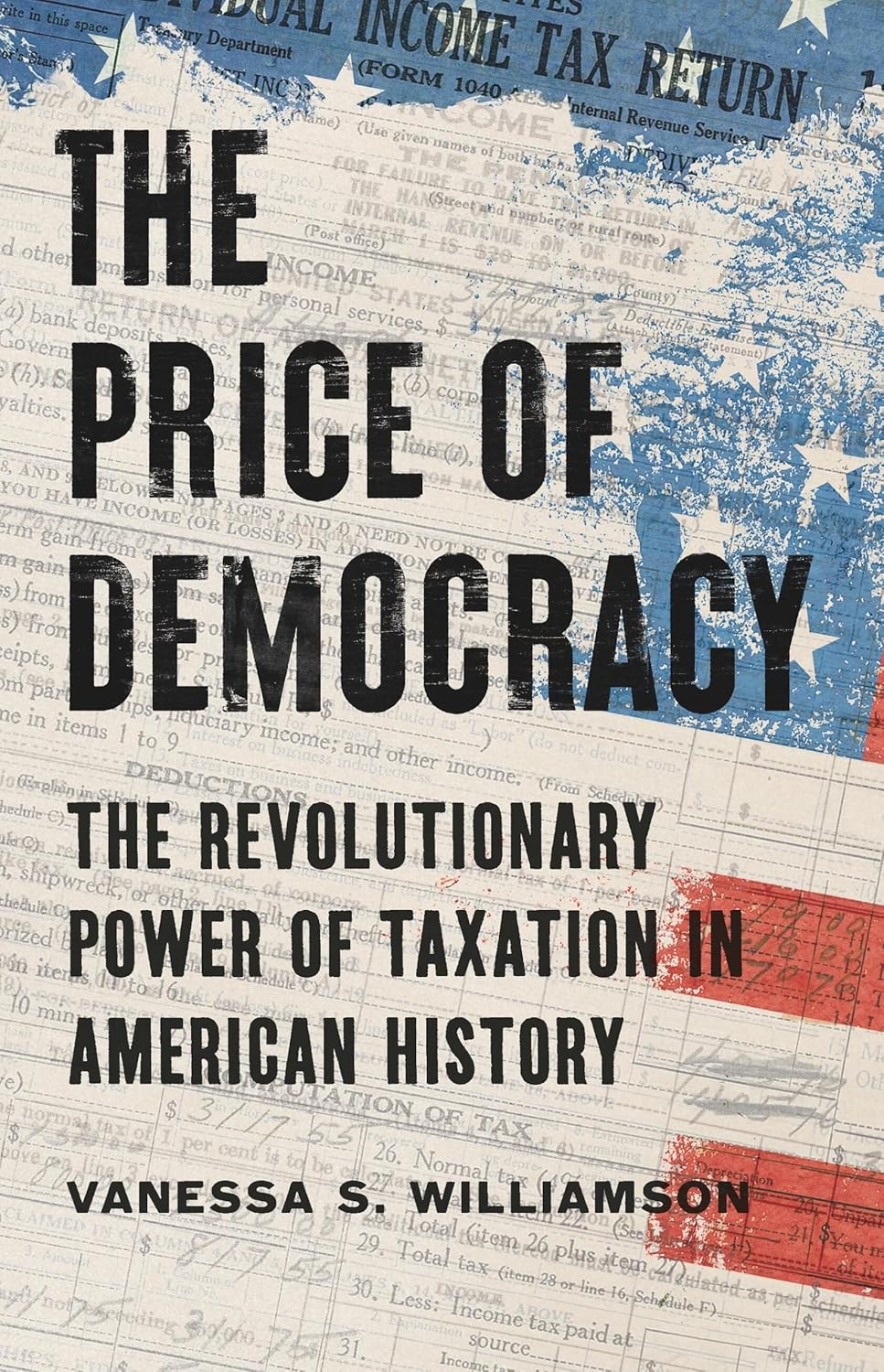
The Price of Democracy: The Revolutionary Power of Taxation in American History
The Author(s)
Vanessa Williamson
“Taxes are the price we pay for a civilized society” is the grand phrase chiseled into the stone façade of the Internal Revenue Service (IRS) headquarters in Washington D.C. It’s derived from U.S. Supreme Court Justice Oliver Wendell Holmes, Jr.’s famous pronouncement in a 1927 dissenting opinion and a personal comment he made among friends when he reportedly said: “I like to pay taxes. With them, I buy civilization.”[1]
Holmes’s remarks and the IRS epigraph are intended to remind Americans that taxes are not an arbitrary and capricious punishment but rather a necessary and productive investment in the many public goods and services that protect and preserve a modern society. Implicit in the quote are the democratic elements of taxation – the idea that taxes reflect, support, and reinforce core values of democracy such as representation, accountability, equality, and civic participation. In this sense, taxes are not only the price of civilization but also the price of democracy.
In her brilliant and timely new book, Vanessa S. Williamson interrogates the changing historical relationship between taxation and American democracy. Chronicling the connection from the Revolutionary War Era to today, she contends that “taxes are a key ingredient in the recipe for successful representative government; leave them out and democracy struggles to rise.”[2] While she acknowledges that voting is a pillar of democracy, holding free and fair elections is not enough. “A government also needs the resources and the organization to fill the demands of the voters. Thus, it is taxes that make democracy consequential,” she writes.[3] Little wonder that opponents of American democracy, as Williamson persuasively shows, have historically sought to undermine – often simultaneously – both the franchise and robust tax systems.
One of the primary objectives of Williamson’s book is to set the historical record straight, especially regarding the supposed anti-tax American creed. She begins her narrative with the ostensibly anti-tax story of the Boston Tea Party – one of the many anti-tax myths she debunks. The dumping of British tea into Boston Harbor is often hailed today by conservatives and anti-statists as the sacred origin moment of the transhistorical and universal American opposition to taxes. “There is just one problem with the familiar story,” Williamson reminds us. “It is utterly untrue.”[4]
Summarizing the existing literature, Williamson shows how the Boston Tea Party was not a simple protest against a tax hike.[5] Rather, it was a more complex reaction to Parliamentary overreach and the Crown’s desire to assist the East India Company with a corporate bailout. The “destruction of the tea,” as it was referred to by contemporaries, was more about political authority and corporate privilege than it was about tax burdens. “To the extent the American Revolution was about taxation,” she writes, “it was about the desire of Americans to tax themselves: to take on the legitimate burdens of a government in which they had a voice.”[6]
In addition to debunking historical myths, the book’s other central aim is to provide a broad, sweeping overview of how taxes have been used throughout American history to empower and to oppress. The book is divided into three broad periods examining changing tax beliefs and politics. Part I explores the Founding Era; Part II investigates the Civil War and Reconstruction Periods; and Part III traces the emergence of the federal income tax during the Progressive Era to the rise and fall of the New Deal order. It is in Part II, in her analysis of the lost promise of Radical Reconstruction that Williamson highlights the crucial role of taxation in providing the infrastructure and resources to sustain a democratic republic. Despite the differences between moderates and radicals during Reconstruction, “the hope fomultiracial democracy rested upon the capacity of the new government to tax their citizens,” Williamson observes. “Social revolutions are expensive; the goals of Reconstruction required an influx of revenue.”[7] That influx, of course, never came to fruition. Reconstruction’s emancipatory vision of democrat taxation died with the collapse of Reconstruction.
Still, there were other historically contingent moments when progressive taxation furthered the goals of economic, if not racial, justice. The 1913 federal income tax, enacted on the heels of the Sixteenth Amendment, was one such achievement. Populist social movements, clamoring for the state to address the massive inequalities of the Gilded Age, were able to energize leading public intellectuals, activists, and lawmakers in building the foundations of the modern American fiscal state.[8] These “reformers agreed on the need for an immense increase in the authority of the federal government, which was seen as nothing less than an immense increase in the power of the American people,” Williamson observes. “The income tax was essential to this mission of government expansion.”[9]
Yet if taxation could help further democracy, as it did during the Progressive Era, it could also be used to subjugate marginalized peoplesAfter Reconstruction, the emergence of Black Codes and Jim Crow laws advanced the causes of White supremacy, particularly through the implementation of the poll tax. Southern Whites, eager to reverse the limited achievements of Reconstruction, enacted state constitutional provisions and statutes linking poll taxes to voting. Many Southern states made the tax particularly difficult to pay “with the intention of disfranchising unwanted voters.” The consequences were horrific. Not only did Black voting decline precipitously, but race-based fiscal exploitation increased dramatically, as “racial disparities in school funding grew even more stark.”[10]
While The Price of Democracy is focused primarily on the political history of taxation, Williamson is attuned to the social and moral elements as well. There is perhaps no better evidence of this than her analysis of Franklin D. Roosevelt’s tax achievements and limitations. In his first term, FDR helped establish Social Security, which was funded via regressive payroll taxes. At the same time, he signed a major tax law that “soaked the rich” with dramatically high marginal income tax rates on the wealthy but also included a slew of regressive excise taxes on everyday goods including gasoline and cigarettes.[11] This mixed record, Williamson argues, became the New Deal’s tax legacy. In attacking “economic royalists” and approving regressive excise taxes, FDR sought to convey a strong moral message that all Americans had a social stake in supporting the nation by paying “their fair share.”[12] Taxes embodied the democratic notion of civic participation or “fiscal citizenship.”[13] That message became amplified during World War II, when the Roosevelt administration transformed the income tax from a class tax aimed at the rich to a mass tax paid by a majority of Americans.
In contrasting the payroll tax with the income tax, Williamson maintains that “FDR had distinguished these two federal taxes in stark moral terms.”[14] The Social Security payroll tax was “sold as a positive contribution to one’s own economic future.” By contrast, social-welfare benefits funded by general tax revenues were seen as relief – as the dole – for the “underserving” poor. “If Social Security pensioners earned their benefits, the implication was that relief recipients did not.”[15] Thus, while the New Deal did much to support the progressive mass income tax we have today, it also stigmatized certain types of government spending while embedding the regressive payroll tax into the American social-welfare state.
The distinction between different recipients of government benefits soon became a rallying cry for many tax opponents. In what are the book’s most compelling chapters, Williamson chronicles how the post-1965 Rightward Turn in American politics and society fueled an anti-tax politics that in turn accelerated an erosion in American democracy. Unlike most conventional histories, which focus mainly on the 1970s property tax revolts that culminated with California’s 1978 constitutional tax limitations in Proposition 13,[16] Williamson turns her gaze to the late 1960s and the redefinition of “welfare” occurring at the time. She shows that just as the Civil Rights movement was building on its achievements in legal equality by turning to economic inclusion, opponents began using taxation to challenge the meaning of welfare. “By the late 1960s,” she writes, “working and middle-class whites looked out from their segregated enclaves at the poor and Black inner cities and felt themselves oppressed: hardworking taxpayers forced to support lazy beneficiaries of what was derisively termed ‘welfare.’”[17] With her braided narrative, Williamson shows how the “taxpayer/tax-eater binary” cemented opposition to both civil rights and robust taxation.
Indeed, the rhetorical distinction between taxpayers v. tax-eaters continued well beyond the 1960s and ‘70s. Ronald Reagan’s allegations of “welfare queens” exploiting the social safety net; Newt Gingrich’s assertions of widespread “waste, fraud, and abuse” in the public sector; and Mitt Romney’s infamous statement that “forty-seven percent of Americans pay no income tax” are all examples of what Williamson describes as a long trend in Republican thinking and rhetoric that has undergirded a policy of “tax cuts above all” – a policy that was intended to fuel anti-government sentiments and undermine American democracy. “Republicans came to oppose the portion of government that could limit the extreme accumulations of private wealth and private power,” Williamson notes. “At the center of this agenda was an unalloyed opposition to taxation of the rich, both because taxes cost the wealthy money and because taxes fund public goods, the social safety net, and the regulatory agencies that limit corporate power.”[18] The GOP orthodoxy of tax cuts at any cost continues to dominate U.S. tax policy to this day.[19]
For many experts of American political history or the history of U.S. tax law and fiscal policy, much of Williamson’s narrative will not be surprising. We have long known that taxation has both advanced and hindered American democracy. But Williamson’s goal is not to convince experts of something they already know. Rather, her bolder and more ambitious project is to reach a broader audience with a forceful and gripping tale about taxation’s central role in the ebbs and flows of American democracy – a lesson that could not be more timely. Williamson achieves this goal with style and verve. The Price of Democracy is a beautifully-written, synthetic account of how political leaders, reformers, and everyday Americans have shaped the connection between taxation and democracy. Williamson, in sum, convincingly shows that fiscal capacity and democratic capacity are mutually constitutive.
Williamson, a Senior Fellow in Governance Studies at the Brookings Institution, is particularly well-qualified to write this sweeping history of U.S. tax politics. As one of the country’s leading political sociologists, she has already written in great depth about tax protest social movements and public attitudes toward taxation. Her first book, with Theda Skocpol, explored the rise of the Tea Party and its consequences for American politics.[20] Her second monograph, Read My Lips: Why Americans Are Proud to Pay Taxes,[21] was a fascinating exploration of public opinion data illustrating that many Americans view taxpaying as a civic duty. In some ways, The Price of Democracy can be seen as the historical prequel to Read My Lips. The new book documents the winding path that has taken us to our current historical moment.
Like all good historical monographs, The Price of Democracy raises some important questions about the past, including changing notions of democracy. Williamson notes that for some American leaders, including among the Founding generation, democracy brought with it the threat of “mob rule.” But she seems to downplay how the Tocquevillian fear of “the tyranny of the majority” can take hold, as it did during the 1920s Red Scare and at other moments of conservative populist uprisings. Williamson generally treats democracy as an unalloyed good, discounting the potential tensions between majoritarian popular sovereignty and liberal constitutionalism. There is little discussion of those historical moments when democratic politics have empowered illiberal movements.
History is replete with examples of populist leaders whose challenges to liberal democratic norms have yielded troubling results. Even in our own times, many have come to question whether our so-called democratic republic, with its recent erosion of individual rights and liberties and its constitutional limitations, has in fact lived up to the ideals of liberal democracy. How, after all, can one explain the rise of a charismatic con-man turned politician who has managed to capture the White House not just once but twice?
Ultimately, The Price of Democracy reminds us that our democratic republic remains a fragile work in progress. Throughout American history, conflicts over taxation have reflected enduring struggles over power, citizenship, and the meaning of self-government. Progressive reformers have deployed the taxing power not merely to raise revenue, but to sustain democratic ideals such as representation, accountability, equality and civic participation. Tax protestors, by contrast, have often challenged both the reach of the state and the use of tax revenues to fund particular public goods and services. By recovering this long history, Williamson compels us to take seriously the wisdom captured in the IRS building’s epigraph and Justice Holmes’s statement. If taxes are indeed the price we pay for a civilized society, Williamson’s sweeping history shows that they are also the price we pay to build, sustain, and constantly redefine democracy.
[1] Compania General De Tabacos De Filipinas v. Collector of Internal Revenue, 275 U.S. 87, 100 (1927) (Holmes, J. dissenting). The personal remark is quoted in Felix Frankfurter, Mr. Justice Holmes and the Supreme Court (Cambridge, MA: Harvard University Press, 1938), 71.
[2] Vanessa S. Williamson, The Price of Democracy: The Revolutionary Power of Taxation in American History (New York: Basic Books, 2025), 5.
[3] Ibid.
[4] Ibid. 2.
[5] See, e.g., Benjamin L. Carp, Defiance of Politics: The Boston Tea Party and the Making of America (New Haven: Yale University Press, 2010); T.H. Breen, The Marketplace of Revolution: How Consumer Politics Shaped American Independence (New York: Oxford University Press, 2005); Joseph J. Thorndike, “The Boston Tea Party Was About Taxation, But Not in the Way Most Americans Think,” Tax Analysts (Dec. 16, 2013).
[6] Williamson, Price of Democracy, 3 (emphasis in the original).
[7] Ibid., 96.
[8] Ajay K. Mehrotra, Making the Modern American Fiscal State: Law, Politics, and the Rise of Progressive Taxation, 1877 – 1929 (New York: Cambridge University Press, 2013).
[9] Williamson, Price of Democracy, 169.
[10] Williamson, Price of Democracy, 153.
[11] Mark H. Leff, The Limits of Symbolic Reform: The New Deal and Taxation, 1933-1939 (New York: Cambridge University Press, 1984).
[12] Joseph J. Thorndike, Their Fair Share: Taxing the Rich in the Age of FDR (Washington, D.C.: Urban Institute Press, 2013).
[13] Ajay K. Mehrotra, Reviving Fiscal Citizenship, 113 Mich. L. Rev. 943 (2015); Lawrence Zelenak, Learning to Love Form 1040: Two Cheers for the Return-Based Mass Income Tax (Chicago: University of Chicago Press, 2013).
[14] Williamson, Price of Democracy, 192.
[15] Ibid. at 199.
[16] Isaac William Martin, The Permanent Tax Revolt: How the Property Tax Transformed American Politics. (Stanford:Stanford University Press, 2008).
[17] Ibid. at 203-4.
[18] Ibid. 224.
[19] Monica Prasad, Starving the Beast: Ronald Reagan and the Tax Cut Revolution (Russell Sage Foundation, 2018); Michael J. Graetz, The Power to Destroy: How the Antitax Movement Hijacked America (Princeton University Press, 2025).
[20] Theda Skocpol and Vanessa Williamson, The Tea Party and the Remaking of Republican Conservatism (Oxford University Press, 2012).
[21] Vanessa S. Williamson, Read My Lips: Why Americans Are Proud to Pay Taxes (Princeton University Press, 2017).
About the Reviewer
Ajay K. Mehrotra is a professor of law and history at Northwestern University and a researcher at the American Bar Foundation. He is the author of Making the Modern American Fiscal State: Law, Politics, and the Rise of Progressive Taxation, 1877 – 1913.
0