
The Book
Elites and Democracy
The Author(s)
Hugo Drochon
One of the first intellectual histories that I read in graduate school was Ben Alpers’s Dictators, Democracy, and American Public Culture (2003), which traces the cultural cachet of authoritarianism during the 1920s and 1930s. In a period of ideological exhaustion and widening inequality, many Americans saw Mussolini, Hitler, and Stalin as the only politicians with coherent and caring political projects. That the interests of the common man would be safest in the hands of a tiny cohort of economic and political elites—what we might now call the populist paradox—was just emerging as a political script. Fast forward to the present, and the script itself verges on exhaustion, run ragged by the imprecision, innuendo, alarmism, and polarization of our political rhetoric. Modern authoritarians bully and bluster to the point of self-caricature, even as their opponents’ accusations of “fascism” elicit eyerolls and yawns.
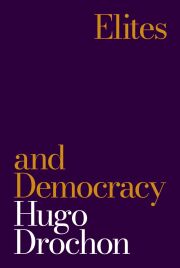
For those who worry about the future of liberal democracy, Hugo Drochon’s Elites and Democracy is a welcome diagnosis of our current predicament. The book traces a particular strain of political critique across the twentieth century: namely, the seemingly impossible task of democratic governance in a world of centralized bureaucracies, industrialization, media saturation, and self-perpetuating power structures. Readers might here recall a familiar roster of names—Theodor Adorno, Joseph Schumpeter, C. Wright Mills, Raymond Aron, Jürgen Habermas, and others—all of whom appear in the second half of the book. But Drochon is primarily interested in an earlier generation of scholars, with whom I was entirely unfamiliar before reading.
Elites and Democracy is really an intellectual biography of Gaetano Mosca, Vilfredo Pareta, and Robert Michels, three Italian theorists writing (more or less successively) during the brief interregnum between the Risorgimento in the 1870s and the rise of Mussolini in the 1920s. All three were interested in the character of democratic regimes, which, far from empowering “the people,” simply brought a new set of elites into power. Their respective theories—of a “ruling class” (Mosca), a “circulation of elites” (Pareto), and an “iron law of oligarchy” (Michels)—did not offer much hope for truly participative or deliberative democratic regimes; the structure and scale of modern institutions meant that power would always fall into the hands of a select few.[1] However, Mosca, Pareto, and Michels offered some clear-eyed comfort in the fact that this was equally true of fascist and socialist regimes. For all the complaints about liberal democracy, no ideological revolution was any more likely to achieve popular rule.
The real question, then, was whether members of the ruling class were colluding or competing with each other, and (relatedly) whether the political system was merely a carousel of existing power interests or if it actually allowed new groups to rise. The latter model, which Pareto described as an “open elite,” is what Drochon takes as our best hope going forward. Real democracy may be impossible, but that does not mean that we should accept sclerotic structures of domination.
Drochon makes a thorough and sophisticated argument in support of this position, with the kind of intellectual depth that has always characterized his writing. (If you have not read Nietzsche’s Great Politics [2016], you should.) Rather than critique the substance of the book, then, I might simply point out one of its underlying assumptions, which could offer a point of departure for other historical and theoretical interpretations.
It is always interesting when a structure becomes so constitutive of an era that theorists merely ask how we should best accommodate ourselves to it. In this case, the existence of a political elite is the defining feature of modern politics, and rather than rail against it, Drochon (drawing from Adorno) argues that our energy is best spent in reshaping it—in achieving “dynamic” rather than “static” political structures. “Democracy’s true location,” he writes, “is to be found neither in institutions nor in principles…[but] must be found in the movement of challenge itself. In this, social movements have crucial role to play: democracy is to be located in the interaction between social movements and elites, mediated through institutions.”[2] Elsewhere, drawing from his work on Nietzsche, Drochon argues that “dynamic democracy…need not be a ‘counsel of despair.’” If he is admittedly pessimistic about popular sovereignty, “that pessimism need not be disheartening. It can be, to borrow Nietzsche’s phrase, a ‘pessimism of strength,’ where the fact of ‘elite rule’ need not be the end-point of the democratic discussion but instead its start: the affirmation of elite rule can open new ways of thinking and acting upon democracy.”[3]
Reading all of this, I kept thinking about Alexis de Tocqueville, who, a century earlier, saw the initial spread of democracy in strikingly similar terms: as an inexorable but dangerously indeterminate development that had to be understood before it could be affirmed. In both cases, dynamism and change—and with them, some degree of popular sovereignty—stand as foundational political realities, bringing with them inescapable questions of civic virtue, participation, and individual and collective identity. With Tocqueville in mind, I would point out that there are those of us who see viable alternatives to political stratification in local institutions and a republican commitment to non-domination, which Drochon sympathetically but summarily dismisses.[4] (He favorably refererences Samuel Ely Bagg’s The Dispersion of Power [2024], for instance, which I would also recommend). Whichever version of democracy one finds viable at the moment—participative and expansive, or chastened and constrained—the important thing is to reject passivity. Politics is struggle, and as such is something to take in hand.
[1] Hugo Drochon, Elites and Democracy (Princeton: Princeton University Press, 2026), 3.
[2] Drochon, Elites and Democracy, 13.
[3] Drochon, Elites and Democracy, 30.
[4] Drochon, Elites and Democracy, 7, 24.
About the Reviewer
Campbell F. Scribner is a scholar of educational policy, history, and philosophy. Although his work covers a broad chronological range, all of it centers on conflicting notions of democracy in American schools. His first book, The Fight for Local Control: Schools, Suburbs, and American Democracy (Cornell University Press, 2016), examines the legal and political controversies around school district boundaries, which present difficult choices between local participation and equal educational opportunity. Other projects include studies the history of school discipline, the history and philosophy of student boredom, and the contested meanings of school vandalism.
0