
The Book
Jim Crow in the Asylum: Psychiatry and Civil Rights in the American South
The Author(s)
Kylie Smith
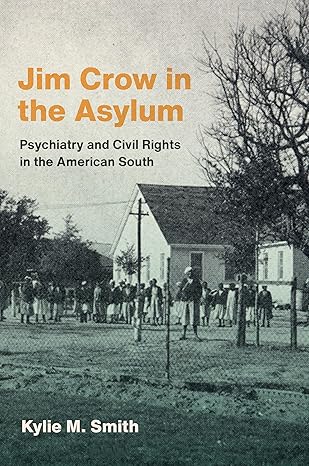
Kylie M. Smith has written an angry book. The subject she addresses – the racial disparities in mental health care and the gross mistreatment of African Americans in the mental hospitals of Mississippi, Alabama, and Georgia – is indeed a shocking one, and the indictment of psychiatry’s complicity and active participation in the abuse of patients is well deserved. Yet the book she has written is in many ways a dull one, replete with denunciations of a racist profession and of a Southern culture that systematically denied the humanity and basic human rights of Black Americans, but one that musters only scraps of novel evidence in support of its contentions.
Part of the problem, as Smith confesses, is the paucity of documentation that survives, often because there never any was much in the way of record keeping about conditions in the largely separate and distinctly unequal asylums in which Blacks were confined. Georgia’s vast Central State Asylum in Milledgeville, the largest in the United States, segregated its patients in distant portions of its vast grounds in the worse-constructed and most dilapidated buildings, which is saying something given the appalling conditions found elsewhere in the “hospital.” Alabama and Mississippi made sure the institutions confining Black patients were miles away from the snake-pits to which it consigned White patients, classic examples of what separate and equal meant in practice.
Smith could obtain no access to patient records (one of the misguided consequences of the Health Insurance Portability Act of 1996) and perforce was forced back on generic statistics about the treatments meted out in both the Black and White wards. For the most part, these provide only limited information about the psychiatric interventions patients were subjected to, and only occasionally were these differentiated by race. Smith has focused on the period from the 1940s to the early 1970s, when these three states continued to confine people in great numbers in what she notes were essentially custodial establishments, but to the extent patients were exposed to the psychiatric armamentarium, they were subjected to psychosurgery, Metrazol shock treatments, insulin comas, ECT, and eventually Thorazine and the antipsychotic drugs that emerged on the scene in the mid 1950s. Lobotomies and insulin shock continued to be employed into the late 1960s, long after they had been scientifically discredited, and electroshock as Smith unanachronistically calls it (ECT was a later euphemism) was used on a grand scale.
The discussion of the use of ECT is quite lengthy. Smith is clear-eyed about its most common use, as a disciplinary tool. It was generally administered, as was Metrazol, without sedation, an approach almost guaranteed to produce fractures of vertebrae and hip sockets among many subjected to it. Smith quotes statistics for a single year at Milledgeville – 3,934 patients, or more than a third of the patient population, Black and White, were given ECT. On average, each patient was shocked more than 8 times, and on average more than ten shocks were administered per hour each day – “a factory-line approach that would have allowed little time for sedation or after care.”[i] By comparison, 15 patients out of more than 11,000, all White, received individual psychotherapy and 182 were enrolled in a nebulous “group psychotherapy.”
Mississippi’s published records are so sparse that little can be said of the treatments meted out there, but Alabama published annual reports for its Black and White asylums on an annual basis. Here the records about the administration of ECT paint a rather complicated picture when it comes to race. In 1956, proportionately more White men were given ECT and they on average received 16 shocks each, while their Black counterparts averaged ten shocks apiece. The picture was radically different among female patients. A quarter of male patients were given shock treatments, as were a fifth of White female patients, but 56.94 per cent of Black female patients were given ECT, though they averaged less than 6 shocks apiece. What explains these patterns? Who knows?
Besides these official statistics, Smith also mined a variety of archival sources, drawing particularly on a handful of patient letters that have survived to try to give us some sense of the humanity of the patients trapped in a racist system. These are moving, but generally so fragmentary and come from such a small sample of the thousands who spent decades of their lives locked up in these appalling places that one hesitates to place too much weight on what they reveal. Efforts by the NAACP to investigate racial oppression in these asylums and later investigations by officials sent from Washington provide other snapshots of an otherwise impenetrable world. Larger generalizations about what was going on in these underfunded, overcrowded, poorly staffed places that purported to be therapeutic places but were in fact carceral institutions surface when Smith turns to journalistic exposés of the grinding daily routine, the violence, and the mistreatment that abounded in these places. There is a long tradition of such muckraking and the long-running series that appeared in the Atlanta Constitution (and that won the reporter Jack Nelson a Pulitzer Prize) provides some particularly powerful insights into the reality of life in these dismal depositories of the forlorn and the forgotten.
Smith concludes with some trenchant commentary on how the three states she has focused on responded to the passage of Civil Rights legislation in the mid-1960s. Jim Crow and segregation were so deeply embedded in a racist society that it comes as no surprise that there was much obstructionism and great reluctance to de-segregate mental health facilities. Georgia, the largest of the states, moved grudgingly to embrace new realities, motivated in part by the threatened cut-off of substantial federal funding if they did not comply. Mississippi and especially Alabama (led by George Wallace) were more defiant, their foot-dragging aided by the cover provided by Senators Stennis, Russell and Hill, and in the end one wonders whether the compliance eventually forced on them went more than skin-deep.
Given the paucity of literature on Jim Crow and twentieth-century psychiatry, and the scantiness of source material with which she has had to work, Smith has done a useful and worthy job. She has diligently searched for ways to amplify the official records and has made creative use of the scraps she has found. The huge asylums that are her focus are no more, though the incarceration of Black victims of mental illness continues apace, albeit in places that no longer pretend to be hospitals and are open about their status as prisons.
[i] Kylie M. Smith, Jim Crow in the Asylum, p. 80
About the Reviewer
Andy Scull received his B.A. from Oxford University, and his Ph.D. from Princeton. He taught at the University of Pennsylvania and at Princeton prior to coming to UCSD. His books include Museums of Madness; Decarceration; Madhouses, Mad-Doctors, and Madmen; Durkheim and the Law (with Steven Lukes); Social Control and the State (with Stanley Cohen); Social Order/Mental Disorder; The Most Solitary of Afflictions: Madness and Society in Britain, 1700-1900; and Masters of Bedlam. His articles have appeared in leading journals in a variety of disciplines, including British Journal of Psychiatry, Psychological Review; European Journal of Sociology; Medical History. He has held fellowships from (among others) the Guggenheim Foundation, the American Council of Learned Societies, and the Davis Center for Historical Studies, and in 1992-93 was the president of the Society for the Social History of Medicine.
He has received an Academic Senate Distinguished Teacher Award, and an Academic Senate Research Lecturer award. In 2015, he received the Roy Porter Medal for lifetime contributions to the history of medicine, and in 2016, he is scheduled to receive the Eric T. Carlson award for lifetime contributions to the history of psychiatry.
0