
The Book
Paul W. Schroeder
The Author(s)
America’s Fatal Leap, 1991–2016
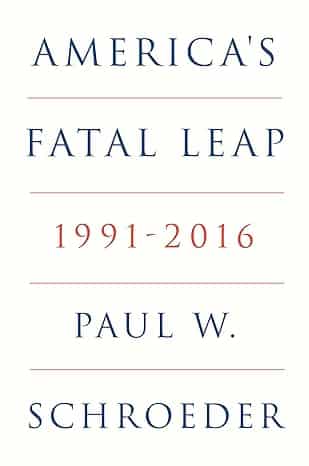
Paul W. Schroeder’s posthumous collection of essays, America’s Fatal Leap, 1991–2016, is a volume of unusual clarity and unusual provenance. Schroeder, trained as a historian rather than a political scientist or opinion-mongering pundit, brings to the reader not simply an archive of commentary but a way of seeing. If the typical Washington analyst operates like a photographer freezing moments into snapshots, Schroeder works more like a videographer, spooling the frames together into a narrative of continuity. His subject—America’s cascade of military interventions from the First Gulf War through the Obama years—demands exactly this longer, evolutionary lens.
One of the book’s principal virtues lies in this epistemological stance. Political scientists and television personalities tend to reduce history to models, slogans, or pseudo-laws. Schroeder, by contrast, insists on tracing causal threads over time. His essays on Saddam Hussein, Al Qaeda, and the “War on Terror” read less like interventions in a policy debate and more like acts of disciplined remembrance. They remind the reader that wars are not isolated accidents but processes—events whose roots sink deep and whose consequences echo far beyond the moment of decision.
The historian’s craft here is also a literary one. Schroeder writes with enviable clarity. His prose flows with a rhythm unusual for policy commentary, avoiding the leaden jargon of international relations while still remaining precise. Dozens of essays—covering a quarter century of American policy—never lapse into the ponderous or opaque. Even his severest criticisms are leavened with wit, and his irony never devolves into cynicism. The result is a collection that can be read cover to cover with ease, rather than dipped into with a sense of duty.
Perhaps most striking is Schroeder’s voice: openly conservative, unapologetically devout, and yet Voltairian in its skepticism. This combination—rare in American intellectual life—gives the collection a bracing originality. His skepticism is not cheap contrarianism but the cultivated crankiness of someone who mistrusts power and its rationalizations, whether they come from liberal interventionists or neoconservative crusaders. That his essays still sparkle, years after their initial publication, speaks to the durability of that stance.
Yet this very skepticism produces what may be called the irony of Paul Schroeder. In dismissing America’s wars in Iraq and Afghanistan as unnecessary or a “fool’s errand,” he often neglects to provide a convincing alternative. What, realistically, could the United States have done after September 11? His essays sometimes glide past the brute fact that Islamist terrorism was not a matter of ragtag stateless actors but a web of state-sponsored, well-armed organizations.
His critique of the Iraq War also strains counterfactuals. While Saddam Hussein was not directly complicit in 9/11, the regime’s existence was entangled with the grievances that spawned Al Qaeda—especially the presence of U.S. bases in Saudi Arabia to enforce the post-1991 no-fly zones. To argue that toppling Hussein was entirely irrelevant to the “War on Terror” is, at best, selective. Schroeder’s parallel, whether explicit or implied, risks being misleading: to bemoan the Iraq invasion as unjustified can begin to sound like lamenting America’s entry into the war against Nazi Germany after Pearl Harbor simply because Hitler had not struck Hawaii.
In these moments, the essays expose a tension between two impulses: the Voltairian mockery of pretension and the Panglossian yearning for a purer, less tainted path America might have taken. That tension is stimulating—but it leaves the reader with questions Schroeder never fully resolves.
For all its flaws, America’s Fatal Leap, 1991–2016 is a work of enduring value. It reminds us of what public commentary looks like when crafted by a real historian: layered, continuous, evolutionary rather than episodic. It demonstrates how skepticism, even crankiness, can be a form of intellectual honesty. And it provokes, even where it fails to persuade. That alone secures its place as one of the most engaging, and most idiosyncratic, reflections on America’s post-Cold War wars.
About the Reviewer
Miles Yu is a professor of military history and modern China at the United States Naval Academy in Annapolis, Maryland. He is also a senior fellow and director of the China Center at the Hudson Institute, a visiting fellow at the Hoover Institution. He served as the China policy advisor to the Secretary of State during the first Trump Administration
0