
The Book
White, Black, Brown: Becoming Puerto Rican in Chicago
The Author(s)
Michael Staudenmaier
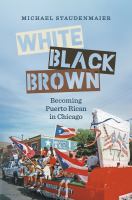
Michael Staudenmaier’s White, Black, Brown: Becoming Puerto Rican in Chicago presents a fascinating historical analysis of how the Puerto Rican community in Chicago developed its conception of race and ethnicity in the latter half of the twentieth century. The book argues that Puerto Ricans moved from conceiving themselves as primarily white, to an understanding of themselves as “Latinos.” White, Black, Brown also contends that the change in racial and ethnic conception was intimately tied to evolving nationalist rhetoric and feelings.
To see how discourses change throughout the years, the book discusses different influential political movements including the Partido Popular Democrático, the Partido Nacionalista, The Partido Socialista Puertorriqueño, the Movimiento de Liberación Nacional (MLN), and the Latin American Defense Organization, among others. Notably absent, however, is an in-depth discussion of the Young Lords Organization (YLO). The author likely felt the YLO had already been the object of many studies, but the organization feels like a connecting piece that the author forgot to place in the puzzle. Despite this absence, Staudenmaier constructs a persuasive story of how Puerto Ricans defined themselves as the decades progressed, the social movements changed, and individuals adjusted to a new context. The book also explains how national identity connects to racial and ethnic identity, and, in the Puerto Rican case, how these identities relate to other people’s conceptions (or misconceptions) of who Puerto Ricans are. That is, Staudenmaier argues that Puerto Rican identity in Chicago was ultimately constructed in response to how other racial and ethnic groups (particularly white Chicagoans) perceived the community.
Overall, White, Black, Brown argues that Puerto Ricans went from considering themselves as a white ethnic group, to a recognition of their non-white status. Although Staudenmaier is careful not to equate race with ethnicity, the book does not really explain how Puerto Ricans connect the term “Latino” to race. For instance, he does not mention what percentage of Puerto Ricans self-identify as Latino and white in the Census. Nonetheless, the book does make a compelling argument that, in ethnic terms, Puerto Ricans have come to see themselves as tied to other Latin American groups, while maintaining a nationalist-Puerto Rican sense of self.
I found the book’s focus on nationalist/separatist groups particularly interesting. More specifically, Staudenmaier’s analysis of the MLN and the Ejército Popular Boricua (Macheteros) brings a new perspective on how the Macheteros related to other liberation movements, and how the group’s acts and rhetoric in Puerto Rico differed from those in Chicago. Overall, White, Black, Brown: Becoming Puerto Rican in Chicago offers a thought-provoking analysis of the relationship between Puerto Rican nationalism and Puerto Ricans’ conception of race and ethnicity. In the current context of the rise of Puerto Rican pop-nationalism, like that presented by Bad Bunny, this book is a particularly relevant read.
About the Reviewer
Naida García-Crespo is an Assistant Professor of English at the Universidad del Sagrado Corazón in Puerto Rico. Her work has appeared in Film History, Early Popular Visual Culture, and CENTRO Journal, among other journals and essay collections. She is the author of Early Puerto Rican Cinema and Nation Building (1897-1940): National Sentiments, Transnational Realities (Bucknell University Press, 2019).
0