
The Book
Apocalyptic Abolitionism: How Millennialists Helped Abolish Slavery and Reform America
The Author(s)
Kevin M. Burton
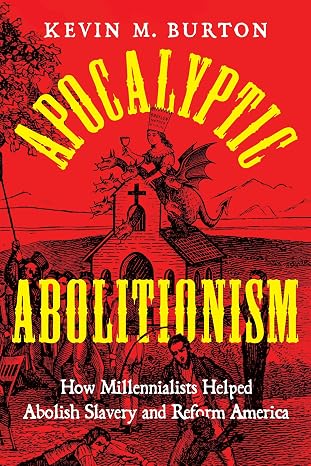
With so many treatments addressing slavery in just the last two decades it is difficult to find one that does not read like déjà vu. That is not the case with Kevin M. Burton’s, Apocalyptic Abolitionism: How Millennialists Helped Abolish Slavery and Reform America. Burton examines the ideological beginnings of the abolitionist movement. Apocalypticism, which was borne out of the idealism during the antebellum period, believed in the imminent return of Christ and necessity to repent and reform for the subsequent thousand years of worldwide peace. The nation needed atonement for its original sin of chattel slavery. According to Burton and contrary to “distorted scholarly and popular perspectives”[1] assumptions about passivity in the face of the world’s end, “even its most extreme catastrophic forms—was radically liberal, active, and political”[2]
Burton primarily focuses on the abolitionist contributions made by the apocalyptists during the years 1840-1844, when their influence peaked during the Second Great Awakening—the author uses millennialists/apocalyptists interchangeably, citing both “desired millennium of peace,”[3] but differed exactly when the Rapture will occur, with the former certain it would be immediate, i.e., in their time, while the latter argued it would be “at some point”[4] but not necessarily during their lifetime. The author organizes the book into eight (introduction and conclusion included) easily readable chapters. Perhaps the most important chapter is the “Introduction”. It is necessary for understanding going forward. In it, Burton chronicles previous works regarding apocalypticism. His historiographical enumeration is a graduate student’s dream. The author further explains the variants within the apocalyptic movement. He explains the differences between pre- and post-millennialists: pre- believe Christ’s second advent (arrival) will occur before the millennium, while post- believe it will occur afterwards. Burton notes the binary between the two (pre being pessimistic and politically disengaged and post being optimistic and socially engaged) is more a 20th century creation and the differences between two were not nearly as profound during the antebellum era.
In the first two chapters, Burton primarily focuses on the movement’s beginnings and demographics. In a short section (perhaps too short for its significance), he chronicles the movement’s ideological precursors, including how Black abolitionists “made apocalypticism a prominent feature within America’s first civil rights movement.”[5] All the core tenets of the subsequent apocalyptic abolitionism of the 1840s movement can be found in the “moral suasionism” of the 1820s: Christ’s imminent return and judgment of sinners, God’s wrath upon white America, and encouragement toward the enslaved to await patiently for divine-induced emancipation. Burton then segues to the primary focus of the book. He details apocalyptic abolitionism by focusing on Adventism, the Second Coming of Christ. A movement born from the preachings of William Miller in 1831, Adventism was borne from the utopian/reform spirit animating the country during the antebellum period. A Baptist farmer-turned-preacher who proclaimed Christ’s imminent return to be in 1843, Miller condemned “the sins of slavery, violence, intemperance and immorality.”[6] Miller’s teachings were promoted and popularized by William Lloyd Garrison, who, despite reservations on Miller’s details and not being an Adventist, “championed apocalyptic abolitionism.”[7] “Millerism”, as critics denounced such beliefs, quickly spread throughout the North and into the various anti-slavery circles. One of the most enlightening aspects of the book is the author’s discussion about “Millerism.” He notes that it began not as a Christian denomination, since its followers remained members of their respective Christian denominations. According to Burton, the vast majority of “Millerites” whose identity and background could be determined were Northerners or Canadians and were Baptists, Methodists, Presbyterians/Congregationalists, or Restorationists (return to earliest Christian teachings, Christian primitivism), with small representations from all other 19th-century Christian sects. “In America,” according to the author, “this apocalyptic minority came from virtually every religious denomination, class, and ethnic group, making it one of the most heterogenous religious mass movements in history.”[8] Adventism only became an established religion in the traditional sense during the American Civil War, becoming the Seventh-day Adventist Church.
Burton spends the remaining chapters chronicling significant points within the Adventist movement to reform a dystopic United States. One such event was the Groton Convention in 1840. This was a three-day universal reform convention to unify the various apocalyptic abolitionists under the Chrisitan Union umbrella. Motivated by sectarianism, the historical friction between various Christian sects at the expense of Christian values, the convention condemned such exclusivity and partisanship, believing “it destroyed ‘the visible union of Christ’s body,’ paralyzed ‘the moral power of Christians” . . . [,and] brought ‘confusion and strife among brethren.”[9] Adventists leveled animosity toward evangelicals for their silence in the midst of unspeakable evil, the systems of slavery and white supremacy. In order to reform the church to its “imagined primitive purity.”[10]
Adventists chose to remove themselves from evil. They advocated for disunion, created Liberty sanctuaries with their support of the Liberty Party, which was “an alternative to America’s proslavery two-party system,”[11] and divorced themselves from mainline evangelical churches, which they indicted as Babylon from the Biblical warning in Revelations to believers to separate themselves from a sinful world. Those who removed themselves (or at times were kicked out) would be known as come-outers. High-profile “come-outers” such as Abigail H. Folsom, who was sent to an insane asylum for her antics, and Thomas Parnell Beach, a Congregationalist minister who interrupted mainline services that resulted in violent dragouts, engaged in maverick assaults on Christians’ apathy as complicity. “Apocalyptic abolitionists,” noted by Burton, “viewed human authority as corrupt because the church and state supported slavery, promoted racial segregation . . . and forcefully protected the supremacy of white men. The structure of dystopic America enabled such injustice to thrive, and the apocalyptic abolitionists believed that this beast could be conquered only through divine intervention and millennial revolution.”[12]
Adventists experienced mockery, marginalization, and violence for threatening racial norms—as well as economic norms to a lesser extent because enough Adventists criticized capitalism and flirted with socialism to lend credence to claims of anti-capitalist. They believed in racial equality. Their meetings were a testament to a desegregated society, and their rituals completely offended antebellum racial and gender norms. Adventists engaged in foot washing and the holy kiss irrespective to the race of the parties. The thought of African-American men being so intimate with white women elicited a fierce response. Newspapers libeled Adventists with the vilest smears of miscegenation that ultimately inflamed the public and moved local authorities. Adventists, who became synonymous with insane fanaticism, faced arrests, asylumization, and vigilante mob violence.
In a quick-paced and well documented work, although at times reads like a dissertation, Burton conclusively centers morality at the heart of the anti-slavery movement, a morality based upon scripture and not necessarily humanism. For a contemporary population who inherited a society changed in the past century (20th) in the name of democratic ideals, individual liberty, or the country’s standing in the world, the messianic justification of the apocalyptic abolitionists seems antiquated, perhaps even dangerous. The Adventists seem a relic of Medieval Europe and not a part of a rational, modern world. Burton, however, shows the importance the afterlife was to 19th-century Americans. Where Enlightenment philosophes argued for flourishment of mankind here on earth, apocalyptic abolitionists highlighted such reform for the redemption of mankind and entry into Heaven. Their warning about Christ’s imminent return “was central to abolitionist advances”[13] and “gave moral suasionism new power and urged the antislavery remnant to act with a radical integrity.”[14]
Perhaps better definitions about Biblical terms and Adventist justification were needed in this work. Burton’s knowledge Scripture unquestioned. He does not just research it, he lives it. Many who will read this work not so. Furthermore, he notes certain religions proved less receptive to apocalyptic abolitionism, yet leaves the reader asking why? The Baptists, which he notes was because Miller was Baptist, the author makes apparent. But the Methodists he never explains. With the Restorationists, since they rejected “denominational names, ecclesiastical hierarchies,”[15] the author insinuates Adventism might appeal to them. He completely ignores, however, why the Presbyterians and Episcopalians among others were not drawn to Adventism in significant numbers? The author simply states they “were not as receptive to Millerism as most other Protestants.”[16] Perhaps geography or perhaps sectarianism, the reader is left wondering. One last aspect that deserves further elaboration was one of the tactics used by the Adventists, disunion. Burton admits the tactic “significantly contributed to the outbreak of Civil War,” but declares “the Confederates moved beyond the abolitionists’ peaceful agitation tactics . . . to violent and rebellious action.”[17] This reviewer’s issue is not equating Confederate secession with abolitionist civil disobedience, although divorcing one-self from civil rule is a slippery slope to a complete break. The issue is the author’s failure to address the continuity within Christianity in the United States of elements divorcing themselves from society as a reforming strategy. A brief examination is needed of how the Adventists simply were the latest “city upon the hill” to shame the sinners into repentance and reform. Despite any oversights in this work, this reviewer believes it greatly contributes to our understanding of religious, reformist, and abolitionist movements in the United States and highly recommends it to expert and novice alike.
[1] Kevin Burton, Apocalyptic Abolitionism: How Millennialists Helped Abolish slavery and Reform America (New York: New York University, 2026), 5
[2] Ibid, 1.
[3] Ibid, 11.
[4] Ibid, 11.
[5] Ibid, 21.
[6] Ibid, 38.
[7] Ibid, 29.
[8] Ibid, 32.
[9] Ibid, 50.
[10] Ibid, 51.
[11] Ibid, 169.
[12] Ibid, 93.
[13] Ibid, 200.
[14] Ibid, 200.
[15] Ibid, 33.
[16] Ibid, 34.
[17] Ibid, 168.
About the Reviewer
Christopher B. Bean is chair of the history department at East Central University in Ada, Oklahoma, and the author of Too Great a Burden to Bear: The Struggle and Failure of the Freedmen’s Bureau in Texas and editor of Texas and Texans in World War II.
0