
The Book
Building Walls, Constructing Identities: Legal Discourse and the Creation of National Borders
The Author(s)
Marie-Eve Loiselle
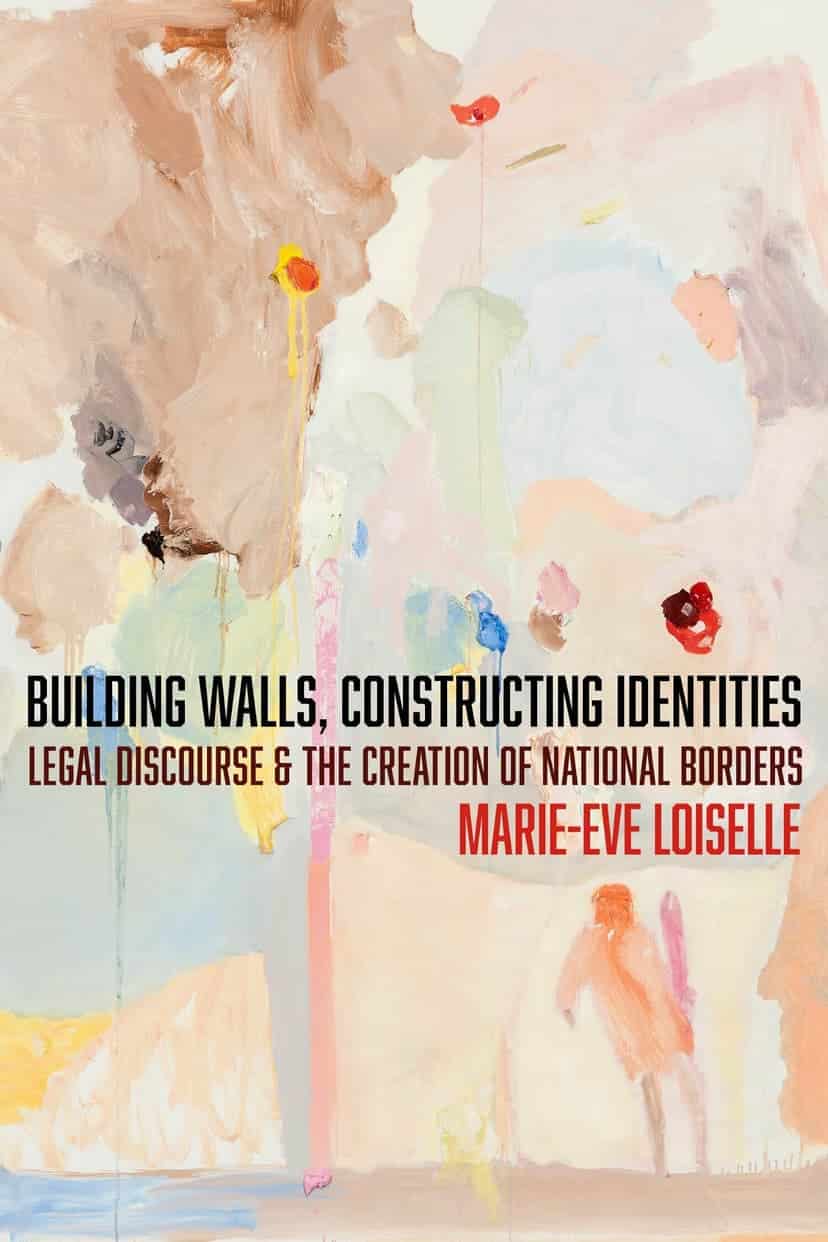
The body of scholarly literature on the US-Mexico borderlands is substantial and has significantly shaped the global discourse on the histories, politics, and experiences of borders.[1] Building Walls, Constructing Identities here emerges within existing scholarship as a compelling interdisciplinary analysis of the US-Mexico border, situated at the intersection of law and sociolegal studies, critical race theory, history, geography, and philosophy. In just over 200 pages of text, Loiselle succeeds in cohesively tracing the long and complicated legal history of what is at stake when speaking about ‘the border wall’ today.
Loiselle argues that legal matter, particularly the walled landscape “provides a unique site for communicating meanings” and “translat[es| sovereign power into space”[2] . One of the book’s strongest features is its interdisciplinary attention to material law. Throughout, Building Walls, Constructing Identities embeds legal texts on the US-Mexico border wall (and fences, a distinction Loiselle emphasizes early on) within the spatial, historical, and lived dimensions of the landscape. In contrast to French jurist Hélène Ruiz Fabri, who argues that walls, but not their legality, are inherently neutral, Loiselle conceptualizes the wall itself as law. She approaches the law, which includes the border wall, “as a form of discourse that influences social relations”[3] (, thereby moving beyond legal positivism and its emphasis on the law’s neutrality. This argument on the rhetoric powers of law resonates with C.J. Alvarez’s treatise on the history of construction on the US-Mexico divide in Border Land, Border Water (2019). Alvarez describes early surveys of the boundary between Mexico and the United States and argues that the language about the environment and the people that lived in it had a significant impact on how ideas about the natural world, race, and violence were and are tightly linked to the border region. The space, here, is perceived as completely outside of the human realm and the derogative language used to describe the desert also translated to geographical and social attitudes towards it (“An awful place inhabited by awful people”[4]).
In line with scholars such as James Boyd White, Teemu Ruskola, Robert Cover and Joshua Fishman, the law similarly emerges as imaginative and constructive language in Building Walls, Constructing Identities, in actively producing social relations through the creation of categories. In the context of today’s immigration law, for example, this includes distinctions between immigrants, refugees, and the ‘illegal alien.’ The legal discourses that form such rigid categories are not only situated in the law’s language, but also in its materiality and in the legal and cultural histories that have contributed to the construction of walls in the US-Mexico borderlands.
After contextualizing the relationship between law and language in the first chapter, Loiselle moves on to the historical production of the US-Mexico border by analyzing and situating the legal texts on the landscape. In three sections, the chapter traces the boundary and state formation processes between the United States and Mexico from the Treaty of Guadalupe in 1848 to the adoption of the Act of August 19, 1935, which marked the onset of a lengthy legal battle for the construction of border fences. Here, the book interweaves legal matter, of both texts and fences, with the contradictory treatment and perception of Mexican guest workers in the U.S. While on the one hand perceived as lawless, perverted, criminal and vile, and thus creating the narrative of a U.S. national emergency in need of fencing for protection, U.S. Americans, on the other hand, heavily relied on the Mexican workforce, specifically as part of the Bracero Program that ran from 1942 to 1964. Additionally, U.S. Americans frequently traveled to Mexico in the 1920s to participate in smuggling activities, while it was exclusively Mexicans who were declared smugglers. The battle for the construction of border fences could only be justified by this ongoing othering process to actively construct Mexican difference, a “constitutive rhetoric” that “uses pertinent cultural references to develop an argumentative discourse aimed at constituting a ‘rhetorical community’”[5]. This rhetorical community was essential to validate the construction of physical fences as the law itself was too weak to affect any practical division.
Over the course of the mid-20th and the early 21st century, the US-Mexico border, or the “southern border,” was continuously constructed as a dangerous space. Here, the book critically examines the second discursive process by which the wall and the law unite to communicate legal knowledge: The Secure Fence Act of 2006. Inherently racist attitudes towards the southern neighbor were obscured by narratives of the Mexican as sexually perverse people, terrorists, and drug-smugglers, thereby embodying a national security threat to the U.S. These immigration concerns were further exacerbated after the attacks of September 11, 2001. Ultimately, the Secure Fence Act was “molded by an emotional portrait of the southern border”[6] , which introduced the law as an implicit othering narrative. Throughout the third chapter, Loiselle observes that legislations such as the Act of August 19, 1935, and the Secure Fence Act of 2006 are direct consequences of the U.S.’ enduring settler-colonialist mindset, through which members of the “American public … integrate their beliefs about the border and those crossing it into law”[7] .
These beliefs culminate in the book’s final, and arguably most compelling, chapter. The wall, here, serves as the materialization of law. Loiselle bases her argument in Andreas Philippopoulos-Mihalopoulos’ notion of the “landscape,” where material intertwines with law and renders it visible. The wall, built to communicate an image of national strength and security, serves as a symbolic assertion of security and ‘keeping things under control.’ Its physicality, usually built higher than an average adult and secured with barbed wire, literally and figuratively cuts through people’s bodies in the borderlands. With the exception of chapter one, each chapter of the book is preceded by excerpts of Gloria Anzaldúa’s Borderlands/La Frontera (1987). Anzaldúa’s highly acclaimed analysis of the lived experiences in the borderlands examines the embodied tension of having to navigate what Loiselle calls the walled landscape. By including excerpts of Borderlands/La Frontera in a book about the wall as law, Loiselle makes this embodied experience tangible, amplifying the intersection of law, materiality, and the body.
Similar to her treatise on the racialized Mexican body in earlier chapters, Loiselle compares the “border parks” at both the US-Mexico and the US-Canadian border. While the International Peace Garden in Manitoba, Canada and North Dakota, U.S., serves as an open space for communication and leisure, thus creating the illusion of not being in border territory at all, the Friendship Park fifteen miles south of San Diego resembles a deserted, military space guarded by Border Patrol agents. This distinction between two supposedly similar projects represents clear racialized attitudes towards the United States’ southern neighbor, illuminating that not every border is treated the same; that it has never been about the border space itself but about the racist and anxious attitudes towards the people who might cross it.
In this sense, Building Walls, Constructing Identities is not only a book about law, but also concerned with the lived experiences of and with the border wall. The appendix “A Tour of the US-Mexico Borderland” makes this experience tangible for readers who might have never previously engaged with the borderlands. Curiously, Loiselle notes that she is “conscious of the fact that indigenous tribes are not deeply affected by the border and the contemporary border wall”[8] . She grounds this in an argument made by Kevin Bruyneel, in that indigenous tribes were deeply affected by the Treaty of Guadalupe Hidalgo and the 1854 Gadsen purchase. If we, however, acknowledge that the entire history of US-Mexican territoriality led to the construction of the border wall today,[9] it is challenging to draw a clear line at what point indigenous peoples have been affected or unaffected by the intertwined histories of the borderlands.
Ultimately, Building Walls, Constructing Identities offers a nuanced and interdisciplinary account of the US-Mexico border wall as both a legal and material construct that actively produces social meaning and reinforces racialized distinctions in comparison to the U.S.’ treatment of its northern neighbor. By conceptualizing the wall itself as law, Loiselle makes an important contribution to legal border studies, thus illuminating facets of a largely silenced topic by demonstrating how legal discourse extends beyond texts into landscapes and bodies. The book’s integration of historical analysis, legal theory, and lived experiences is particularly compelling and invites further scrutiny. Loiselle challenges readers to reconsider the border not as a fixed or neutral barrier, but as inherently embedded in law, which continues to construct and justify the wall’s existence.
[1] See for example C.J. Alvarez, Border Land, Border Water. A History of Construction on the U.S.-Mexico Divide, University of Texas Press: 2019; Wendy Brown, Walled States, Waning Sovereignty, Cambridge: 2017; Alexander C. Diener and Joshua Hagen ed., Borderlines and Borderlands: Political Oddities at the Edge of the Nation-State, Rowman & Littlefield: 2010; Camilla Fojas, Border Optics: Surveillance Cultures on the US-Mexico Frontier, New York University Press: 2021; Harsha Walia, Border and Rule: Global Migration, Capitalism, and the Rise of Racist Nationalism, Haymarket Books: 2021; Peter Andreas, Border Games: The Politics of Policing the US-Mexico Divide, Cornell University Press: 2022; Roberto Hernández, Coloniality of the US/Mexico Border: Power, Violence, and the Decolonial Imperative, University of Arizona Press: 2018.
[2] Marie-Eve Loiselle, Building Walls, Constructing Identities: Legal Discourse and the Creation of National Borders, 3; 8.
[3] Loiselle, Building Walls, Constructing Identities, 16.
[4] Alvarez, Border Land, Border Water, 25.
[5] Loiselle, Building Walls, Constructing Identities, 57.
[6] Loiselle, Building Walls, Constructing Identities, 107.
[7] Loiselle, Building Walls, Constructing Identities, 53.
[8] Loiselle, Building Walls, Constructing Identities, 214.
[9] See for example Alvarez, Border Land, Border Water: “[T]he border that was codified in the Treaty of Guadalupe Hidalgo remains the border of today,” 20.
About the Reviewer
Anja Keil (she/her) is a second-year Ph.D. student in American Studies at the College of William & Mary, Virginia. Her research areas include borderland studies, migration and mobility studies, and the inheritance and embodiment of states of exception. She holds a B.A. and M.A. in both English and Biology from Münster University, Germany. She has previously done research on nationalism and sedentarist ideology in contemporary borderlands in San Juan, Puerto Rico, and will be conducting field research on border mentality and necropolitics in Patagonia, Arizona, in the summer of 2026.
0