
Editor's Note
With the submission deadline for the annual conference being May 1 (April 15 for individual paper submissions), conference co-chairs Daniel G. Hummel (Lumen Center, Madison, WI) and Jennifer Ratner-Rosenhagen (University of Wisconsin–Madison) discussed what the 2026 theme of Intellectual Historians’ Toolkits: Methods, Theories, Practices is really asking for—and what it isn’t. The conversation below is meant as an FAQ to help potential submitters think through how their work might fit, and to signal what kind of conference they’re hoping to build together with the Program Committee in Madison this November.
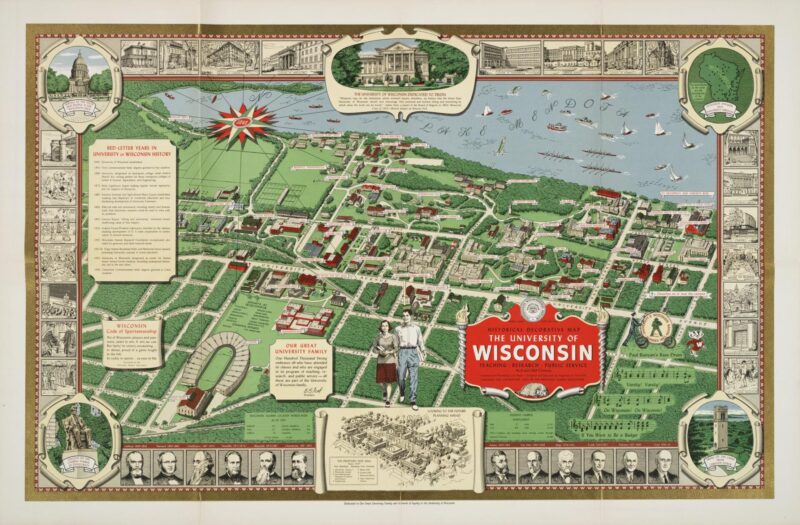
A classic map of the University of Wisconsin campus from 1951. The Pyle Center, where the SUSIH conference will be headquartered, was not yet built but is located on Lake Mendota’s coast immediately east of the right edge of this map. Courtesy: UW Digital Archives.
Q: How did you come up with the theme of “Intellectual Historians’ Toolkits: Methods, Theories, Practices?”
Jennifer: We had the idea that it would be both refreshing and timely to convene conversations about how scholars today are conceptualizing and executing their work. The SUSIH conferences have long been a treasure trove of varieties of intellectual history. But the conversations have been typically organized around subject matter—that is, the content of our studies. We thought it would be productive and energizing to shift our attention from “what” to “how” questions–how we think about, approach, and execute our work. And even the “why” questions: why we do the sort of historical work we do.
Dan: We also thought that it would be rewarding to experiment with a conference that fostered practice-based conversations, so that participants could go home with new ideas and inspiration on how to approach and execute their research, writing, and teaching.
So if the theme is more practice-focused than past S-USIH conferences, does that mean submissions are expected to engage explicitly with how intellectual history is (or can be) practiced, and not just offer a well-executed example of it?
Dan: Exactly! The focus of the submissions should be on the approach, the framing, the theories, and/or the sources being used and why. Potential participants are still asked to focus on their own work, but to consider a submission that highlights some aspect of how they do it, rather than showcasing their new material and arguments.
Does this mean that participants shouldn’t emphasize their scholarly interventions?
Jennifer: They are absolutely welcome to, as long as they are framed in terms of their methods, theories, practices, sources, etc…. However, for the purpose of this conference, one’s “interventions” are less important than the process that leads up to them.
What do you mean by “toolkit?” Are you thinking about grand theoretical frameworks, or more practical research and writing habits? Or both?
Dan: Both. And everything in between. For example, there might be a panel on microhistorical approaches, where participants explore their uses of Ginzburg, Ghobrial, or Hartman, while another one makes no mention of other scholars’ work and focuses more on her own archival practices. Or there might be a panel on different narrative forms, where one participant explains how she draws inspiration from particular theorists or writers, and another focuses on a particular narrative approach after repeatedly failing to get some new writing done that is more straightforwardly argument-driven.
Jennifer: The key thing is that prospective panelists simply reflect on what’s important to them, and that they can explain why (and how).
There are many people who work in an adjacent field to US intellectual history—religious studies, literature, political theory, history of science, economics, etc. Is this conference for them?
Jennifer: Absolutely. Some of the most exciting work in intellectual history has been produced by scholars from other fields as well as by historians who don’t self-identify as “intellectual historians.” The aim of this conference is in no way to police the borders of this subfield. Quite the opposite: it’s to bring scholars who work in some way or another on the mental and moral worldviews of people from the past into a more focused conversation about the varieties of ways of accessing those worldviews.
Is the Semiquincentennial framing just symbolic, or does my paper need some connection to 2026 and American founding themes?
Dan: Participants do not need to make a connection to the Semiquincentennial, 1776, or anything to do with the American founding, unless it is relevant for the panel they are proposing. We have considered this anniversary alongside other aspects of the conference, including the keynote and plenary sessions.
What are some illustrative examples of how we hope people approach this theme that might be different than in the past?
Jennifer: We don’t want to be too prescriptive and thereby unnecessarily narrow the range of panels and combinations out there. But here are just a few ways prospective participants might think about a potential paper:
Participant A is working on a new project on the transformation of economic debates from the New Deal to the Great Society.
- It required that she learn a new type of quantitative analysis to understand from the inside how her subjects did their work. So she puts together a panel of scholars who had to learn a new skill, or take some sort of practice-based approach to their project. She reaches out to historians who similarly had to learn a new field, habits of mind, or practices to better understand their historical actors, and so they frame the conversation around their experiences working in this new way. They need not be historians of the economy or even of the 20th What they share is the effort to learn a new skill or practice to better understand their historical actors’ experiences.
- The archival sources for the first half of the project were very different from those for the second half, so she had to adopt different strategies for compiling her materials for the two halves. She therefore wants to foreground a conversation about how to navigate uneven source material and troubleshoot ideas for possibilities she hadn’t yet considered. She reaches out to two other scholars who have encountered similar problems, and they propose a panel on the similar, complementary, or mutually exclusive ways they navigated this problem.
- While this book project spans a half-century, her last project spanned only one decade, so she is interested in a conversation about timescales in framing a project. She enlists another panelist whose recent book takes a panoramic look across three centuries, and another whose upcoming book takes a zoom lens to a 3-month period and they form a panel on timescales in intellectual history.
Dan: That’s excellent. We’d be excited with any of those ideas. Let’s also think about Participant B, who knows he wants to form a panel on a method or theory question—maybe at the intersection of intellectual history and the history of science.
- He realizes he has a special overlap of sub-disciplines, so he reaches out to a few other historians who have worked at the same intersection to create a panel about the significant benefits or challenges of bridging the two.
- He reflects on his own career trajectory as a grad student in a history of science program who came to see the benefits of intellectual history through a series of research or conceptual problems that intellectual historians and works of intellectual history helped to address. He is interested in probing how his training as a historian of science prepared him for bridging intellectual history with the history of science and creating a panel with others who can share about the same career trajectory.
- With his current research on the intellectual life of the computer science pioneer Grace Hopper, he reaches out to two other historians whom he knows are also approaching the history of science through intellectual biography (with very different figures, chronologies, and topics) to create a panel on the history of science and intellectual biography.
What can people do if they have questions, ideas, or musings on the conference theme?
Email us at [email protected].
Or, attend a Zoom drop-in session (where one or both of us will be available to chat about any and all aspects of the conference and its theme):
We hope to see you in Madison!
0