
The Book
Fighting With the Past: How Seventeenth-Century English History Shaped the American Civil War
The Author(s)
Aaron Sheehan-Dean
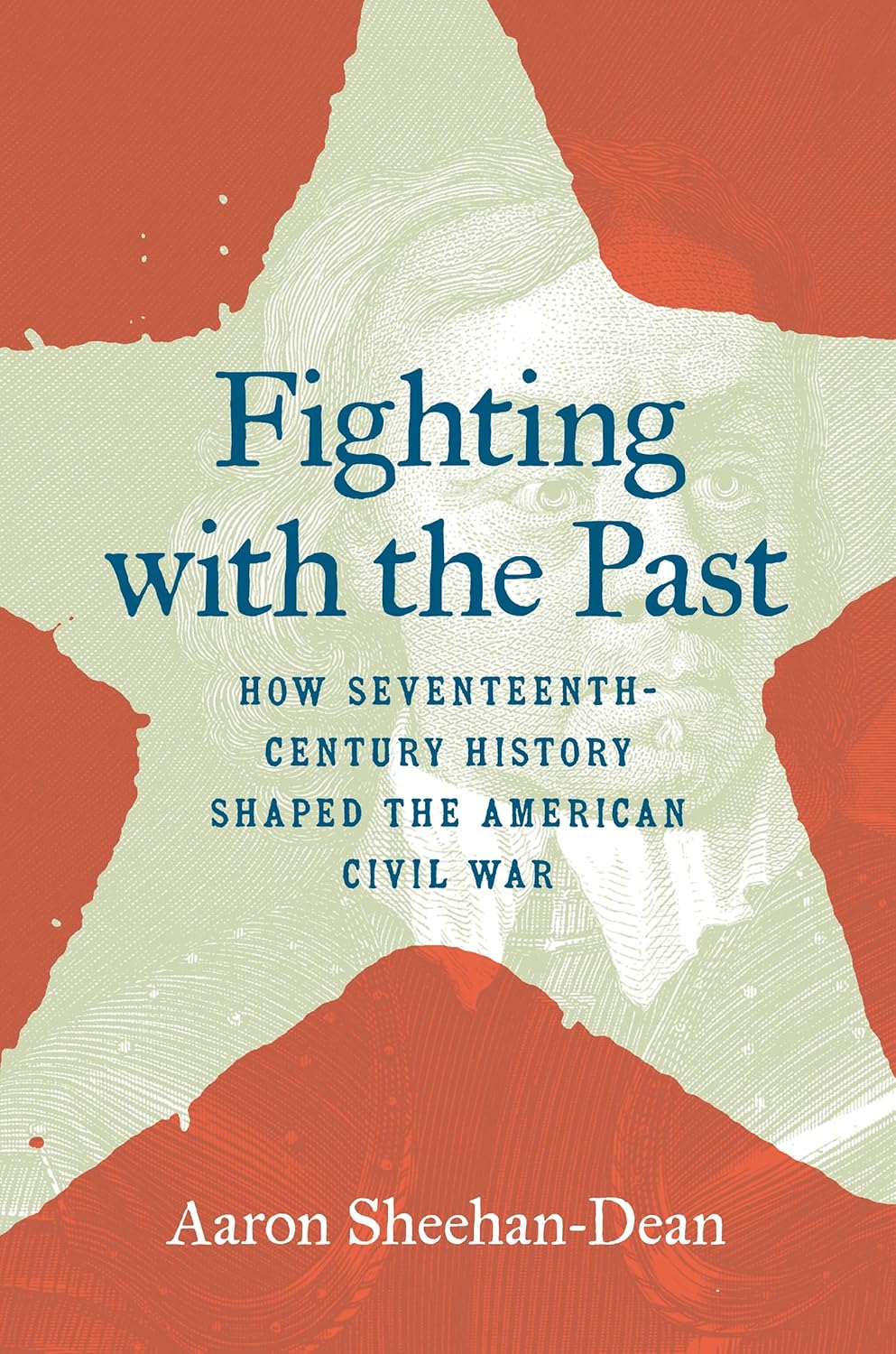
For the casual student (even learned scholars), what comes to mind with the American Civil War are its bloody battles, like Antietam and Gettysburg, its legendary military personalities, such as Robert E. Lee and Ulysses S. Grant, and its social consequences, like slavery’s abolition. Perhaps furthest from their mind is the war’s intellectual aspect. Not so with the latest work by Aaron Sheehan-Dean. In Fighting with the Past: How Seventeenth-Century History Shaped the American Civil War, Sheehan-Dean uses the “tools of intellectual history to consider Civil War Americans’ conceptions of the past.”[1] Participants “looked to the history of another civil conflict, the English Civil Wars of the seventeenth century, as they sought to navigate their crisis.”[2] Americans looked to the past for a blueprint for their present, or in the author’s words, “The lessons people drew from the seventeenth century shaped how they acted in the nineteenth century.”[3] An English struggle more than two centuries prior shaped their thinking, their rhetoric, and their understanding from the leadup to secession, throughout the bloody battles to subdue the Confederacy, and into the post-war attempt at Reconstruction.
Extrapolating meaning from the past for understanding the present is often fraught with contradictions. As Sheehan-Dean notes, these meanings were more emotional than intellectual, “reading histories selectively, creating a memory of the past that suited their present purposes.”[4] These Americans were prone to interpret the past through subjectivity. Historical memories are often hazy and allow for very simplistic (euphemism for inaccurate) analogies. In an ironic twist, Confederates hoped for victory by identifying with the historical loser, while the Northerners, particularly the Radical Republicans, identified with Oliver Cromwell, whose idealism quickly degenerated into reestablishing authoritarianism. Rather than learn from the past and approach others with empathy and understanding, Civil War Americans “weaponized the past, using it to bolster preexisting arguments.”[5] This drove Southerners to a “fatalistic millennialism.”[6] They doubted man’s capacity for progress. Northern conservatives shared Southerner’ skepticism and cautioned about the excesses of revolutionary zeal. Republicans, both moderate and Radical, shared a belief in progress, but differed on patience . . . Radicals understood opportunity is fleeting, while moderates warned that change cannot come at the expense of constitutional norms and law and order.
Sheehan-Dean organizes his book into ten (introduction and conclusion included) easily readable chapters. The author begins with an excellent chapter on “Historical Thinking in the Nineteenth Century.” He highlights “the sea of print” that contributed to “deeply held perspectives on the relationship between the past, present, and future.”[7] Not through a formal education, Americans at the time experienced historical knowledge through “lifelong learning,” something the author notes as democratizing education. Nineteenth-century Americans’ willingness and desire to consume multi-volume works detailing history would shock today’s “TL;DR”-attitude.
With this shared experience and as the sectional divide hardened, a general consensus formed in the two regions of the country. White Southerners, greatly influenced by their feudalistic society, saw in themselves Charles I and the Royalists (also known as Cavaliers) during the English Civil War, who resisted the forces of revolution and anarchy that threatened order, stability, and tradition. On the contrary, Northerners, dependent upon their ideological bent, saw similarity with both Oliver Cromwell and his supporters, the Parliamentarians/Puritans, as well as the Royalists. As Sheehan-Dean chronicles in “The Dangers of Despotism,” conservative, northern Democrats focused less on Cromwell’s struggle against monarchism and more on the aftermath once in power. He deposed Charles I only to reinstitute another despotic regime. These Democrats warned about, in this case an explicit indictment toward Radical Republicanism and abolitionist thought, the “ideological excess that perverted a regrettably necessary war into a holy crusade . . . [and led]] to suspend the regular patterns of governance contradicted civilian control of the military upon which the American system rested.”[8]
Especially enlightening is the chapter, “Ending Civil Wars.” With victory at hand, Northerners promoted different approaches to the South. Radicals wished for a policy of conquest and appropriation similar to Cromwell’s approach to the Irish Rebellion, where Catholics were ostracized from public life and much of their land was confiscated and redistributed to Protestants. They desired a fundamental restructuring of the South to upend root and branch the slave culture that led to this unjust and illegitimate rebellion. At the heart of this would be breaking up the plantations and redistributing the land to the former enslaved. Conservatives and moderates, both Democrats and Republicans, however, advised against such an approach. They saw what Cromwell did to Ireland as a road map to be avoided and not emulated. In the case of the Irish Rebellion, to these cautionary forces, the need for restraint was paramount.
Much to the chagrin of African Americans, the Radical approach failed to materialize. Sheehan-Dean notes that the traditional explanations for the failure of land redistribution, and perhaps the “failure” of Reconstruction, has been white supremacy and American conservatism toward proper rights. “Racial solidarity undoubtedly played a central role in discouraging a robust Reconstruction,” the author states. “So, too, did reading the history of the Irish Rebellion.”[9]Sheehan-Dean concludes, national memory serves to moderate change. “Because history restricts our range of vision to what has preceded us, it can produce less radical blueprints than what some communities (particularly historically oppressed ones like the freed people) might feel is necessary to create lasting change.”[10]
In short, Sheehan-Dean argues that to truly understand the Civil War one has to understand history matters. Perhaps too simplistic for some, it is its simplicity that makes is so profound; a lesson too often overlooked and definitely forgotten. Maybe the only thing forgotten in this work (nice segue) is an ideological explanation of the forces during the English Civil War. Sheehan-Dean constantly refers to the various groupings during the Civil War sympathizing with the Cavaliers/Royalists or the Roundheads/Puritans, but never fully explains their philosophies. What did the forces of Charles I and Cromwell represent? To most readers of this work, Charles I is completely unknown, Cromwell represents “warts and all,” and the Puritans are sexually repressive colonists that bullied Hesther Prynne. A brief synopsis would have complimented Sheehan-Dean’s main point: how contemporaries understand but really misunderstand history for their understanding in the present. Such a listing is warranted in any work with comparing and contrasting. Although intellectual history, this work is an easy 150-page read. Lively and fast paced, it does not have the typical faults with intellectual history . . . grindingly boring and obtusely theoretical. Sheehan-Dean’s organization and writing style will appeal to both the entry level student and learned
[1] Sheehan-Dean, Aaron, Fighting with the Past: How Seventeenth-Century History Shaped the American Civil War (Chapel Hill: The University of North Carolina Press, 2025), 2.
[2] Ibid, 2.
[3] Ibid, 19.
[4] Ibid, 70-71.
[5] Ibid, 8.
[6] Ibid, 18.
[7] Ibid, 12.
[8] Ibid, 94.
[9] Ibid, 114-115.
[10] Ibid, 144.
About the Reviewer
Christopher B. Bean is chair of the history department at East Central University in Ada, Oklahoma, and the author of Too Great a Burden to Bear: The Struggle and Failure of the Freedmen’s Bureau in Texas and editor of Texas and Texans in World War II.
0