
Editor's Note
Shelley Fisher Fishkin is the Joseph S. Atha Professor of Humanities, professor of English, and professor (by courtesy) of African and African American Studies at Stanford University. Her books include Writing America: Literary Landmarks from Walden Pond to Wounded Knee, Was Huck Black? Mark Twain and African American Voices, and, most recently, Jim: The Life and Afterlives of Huckleberry Finn’s Comrade (Yale University Press, 2025). The editor of the twenty-nine-volume Oxford Mark Twain and co-editor of Oxford’s “Race and American Culture” book series, she has been awarded the Bode-Pearson Lifetime Achievement Award by the American Studies Association and the John Tuckey Lifetime Achievement Award from the Center for Mark Twain Studies.
Many readers view the speech of Jim in Mark Twain’s 1885 novel, Adventures of Huckleberry Finn, as part of a racist and disrespectful characterization of a Black man by a white author. But although nearly all of his white contemporaries who wrote in Black dialect viewed it as a source of humor, Twain did not. To assume that he did is to make a category mistake—one that misrecognizes what Twain was up to when he crafted one of the most iconic Black characters in American fiction.
Black dialect was a fraught subject in the nineteenth century. While Black writers generally eschewed it, white writers often embraced it for comic effect. The comic use of Black dialect reached its broadest audiences in the nineteenth century via minstrel shows, the most popular entertainment form in nineteenth-century America from the 1830s on. In these shows, white actors in blackface portrayed ludicrous figures who were bumptious and boastful, fatuous fools who deserved to be objects of derision. After the Civil War, most minstrel shows featured a deep nostalgia for the bygone plantation era, celebrating it in story and song. The many works of post-war fiction and poetry written by white contemporaries of Mark Twain, such as Thomas Nelson Page and Irwin Russell, expressed similar views, peopling stories, novels, and poems with dimwitted contented slaves who lived to serve their masters. These writers viewed Black dialect as a dependable source of humor. Twain didn’t share this view.
Twain viewed Black dialect as being as capable as any other form of speech—including so-called “standard English”—at conveying complex ideas, as well as powerful emotions. Indeed, it was a story he was told in Black vernacular dialect by a formerly enslaved woman he knew well in upstate New York in 1874 that helped launch him on the road to Huck Finn. Mary Ann Cord, the cook at Quarry Farm, where Twain spent summers, told Twain and his family the wrenching story of her being separated from her last child on the auction block—and then miraculously reunited with him after the war. At a time when the reigning racial ideology of the day assumed that Black people were relatively insensible to pain, Mary Ann Cord’s description of the anguish she felt at her separation from her children on the auction block was moving proof of the myopic fallacy of this assumption. Recalling Cord’s “gift of strong & simple speech” a quarter century later, Twain wrote that her story was “a curiously strong piece of literary work to come unpremeditated from lips untrained in the literary art.” Hearing it helped make him aware of the power of a vernacular narrator—a lesson that would be central to the novel he would begin writing two years later. Cord’s story would be the basis of Twain’s first publication in the prestigious Atlantic Monthly in 1874. He called it “A True Story, Repeated Word for Word as I Heard It.” Twain noted that he had worked hard to convey her dialect accurately on the page, “by talking & talking it till it sounds right.” Although it confounded the magazine’s readers, who expected humor when they saw the byline “Mark Twain,” the story won him the lifelong respect of its editor, William Dean Howells.
Mary Ann Cord’s language would find its way directly into Jim’s language in Huckleberry Finn, foreshadowing his poignant expressions of grief over his separation from his children. Cord (as well as other Black speakers Twain knew) had taught Twain that Black dialect was as capable as any other form of speech of conveying strong emotions.
He was also convinced that it was as capable as standard English of conveying important concrete information. To prove this latter point (and to show off his own virtuosity), in 1882, Twain wrote his publisher, James R. Osgood, a letter detailing the length of a manuscript he was about to send and the kinds of editorial judgments he was willing to accept. The letter would be unremarkable were it not for the fact that Twain decided to write it entirely in what Osgood would have recognized as Black dialect. While Twain was obviously having fun here, the letter also demonstrates his belief that the Black vernacular speech he was experimenting with was as efficient as any other for communicating complex subjects with precision.
Mark Twain penned the Black dialect spoken by Jim, the central Black character in Adventures of Huckleberry Finn, in the interest of realism and authenticity. In the “Explanatory” that prefaces Huckleberry Finn, Twain tells us even before Huck begins telling the story that the vernacular dialect in the book—including “Missouri negro dialect”—has been crafted “painstakingly.” Twain’s marginal annotations also demonstrate that he wanted to make sure that the copy editor did not make some of Jim’s locutions sound like the exaggerated stage dialect one would hear in a minstrel show. Twain viewed minstrel shows as artificial concoctions—stylized forms of entertainment that had little to do with reality. “The so called ‘negro minstrels’ simply mis-represent the thing,” he wrote in 1873. “I do not think they ever saw a plantation.” Getting Jim’s dialect right was part of his effort to portray a Black man he respected with authenticity. The failure of so many readers and critics to grasp this fact has not only led them to misunderstand the function of Black dialect in his work; it has led them to make a category mistake about Twain’s project as a writer, assuming that he was presenting Jim as a proper object of ridicule who embodied humor drawn from the minstrel show.
Not all critics made this mistake. In 1937, in The Negro in American Fiction, the eminent Black writer and critic Sterling Brown called Jim “the best example in nineteenth century fiction of the average Negro slave. . . And he is completely believable.” Brown’s respectful view of Jim would prefigure the poet T. S. Eliot’s comment in 1950 that Huck and Jim “are equal in dignity,” and would be echoed by Langston Hughes, Milton Meltzer, and Charles Eric Lincoln, who wrote in their Pictorial History of the Negro in America in 1968 that “The character of Jim in Huckleberry Finn is considered one of the best portraits in American fiction of an unlettered slave clinging to the hope of freedom.” This perspective would also be voiced by later writers and scholars, including David Bradley, Jocelyn Chadwick, Ralph Ellison, Robert Paul Lamb, Hilton Obenzinger, Forrest Robinson, David L. Smith, Ralph Wiley, and myself. But scores of other critics over the last 140 years got it wrong.
I argue in my newly published book, Jim: The Life and Afterlives of Huckleberry Finn’s Comrade, that Mark Twain crafted J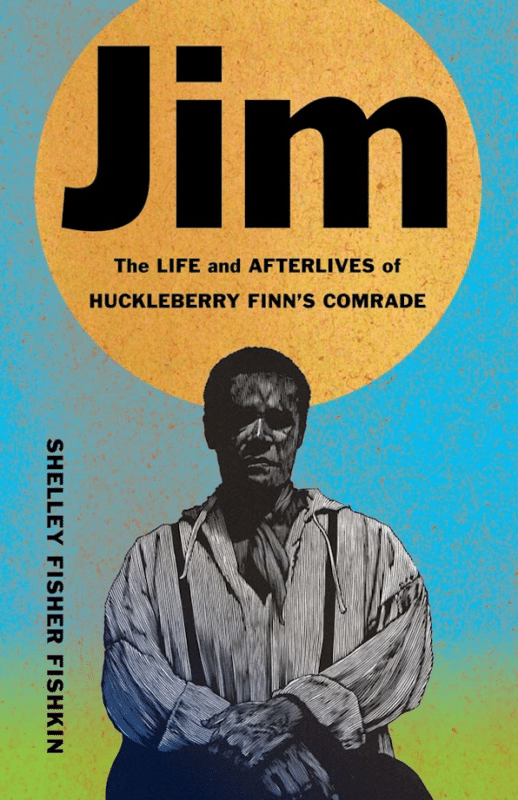 im as a smart and enormously admirable man whose movements and behavior are constrained by his status as an enslaved person in a morally bankrupt society where human beings are regularly bought and sold as property. His companion, Huck, the titular hero of the story and the book’s narrator, does not see Jim that way. Nor does Huck recognize the moral failings of those around him, much as Sam Clemens had not condemned the world of his childhood when he himself was a child. But by the time Mark Twain wrote Huckleberry Finn, his understanding of that world had radically changed. His travels and his marriage into the abolitionist Langdon family helped spark his growing awareness of what was wrong with a world where people who thought of themselves as upstanding, God-fearing citizens could support and benefit from an indefensible status quo. Although Huckleberry Finn is supposedly narrated by a boy who, like young Sam Clemens, did not question the justice of the world in which he lived, the novel was written not by Huck but by Mark Twain, the adult author who, by 1885, was ready to challenge norms that he had accepted in his youth.
The erroneous assumption that Twain, like most of his white peers, was using Black dialect as a source of humor has led readers and critics to misrecognize what he was trying to do in his most famous novel: criticize a morally bankrupt society that dismisses the most admirable man in it as not even human. Jim has been hiding in plain sight. The first Black father in a novel by a white male American author, Jim has been disparaged and demeaned by many critics for more than a century. Both Jim and Twain deserve better. So do we.
I was recently reminded of how much Twain’s use of Black dialect contributes to the misrecognition of his goals as an author when I asked my publisher when the audiobook of Jim would appear. It won’t, they told me. When their regular audiobook partner tried to get a Black actor to narrate the book (something that was important to me), they struck out: every Black actor they contacted said he would be “embarrassed” to read all that “slave dialect.” Despite the fact that I had no idea how to produce an audiobook, I asked for the audiobook rights back and decided to produce it myself, which I did. Alvin Richardson, the brilliant Black actor who narrates my audiobook (available on Audible and Amazon), did a superb job. In fact, we had so much fun working together that our next project will involve his recording an audiobook of Huckleberry Finn itself. We plan to produce it together next summer.
0