
The Book
The Presidential Pardon, The Short Clause with a Long, Troubled History
The Author(s)
Saikrishna Bangalore Prakash
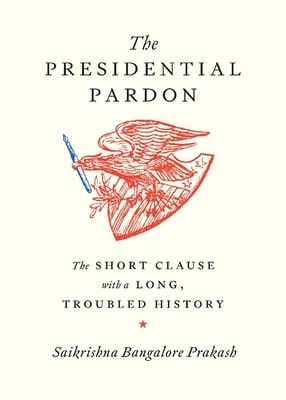
Given the parlous state of the pardon power under President Donald Trump, we the people could use a good primer on the subject. Professor Saikrishna Prakash has attempted this task, and indeed, the initial parts of this short book provide helpful background.[1] He reviews the origins of the pardon concept in history, the purposes the pardon power may serve, and the Framers’ debates on the wisdom of resting the federal pardon power exclusively with one person.[2] Prakash also describes the two-channel course for pardons which has arisen in practice, one through the Office of the Pardon Attorney in the Department of Justice and the other straight to the White House and the President’s ear. Unfortunately, after the initial solid sections, as the book delves into the pardons from Ford to Trump, the author’s right wing ideology slants the discussion too much; readers seeking an even-handed and judicious treatment will be disappointed at several points in the book’s latter sections.
Pardons can deliver mercy, but there are other positives, which Prakash lists as calibration, law enforcement, reconciliation, and attachment.[3] Sometimes sentences of incarceration have been too harsh, sometimes personal circumstances call for mercy, and sometimes pardons help to quell civil unrest and to reconcile. But pardons can also be nefarious. They can be used for self-enrichment; for favoritism to family, friends, and supporters; and for political advantage. In addition, the Framers worried that the pardon could be used to cover up misdeeds perpetrated by the President and associates, which might even include plots against the government itself (although impeachment is not pardonable).[4]
Prakash catalogues the types of pardons that presidents have used.[5] He explains why both criminal and civil offenses against the U.S. are eligible for pardons.[6] He shows that accepting a pardon does not always connote admission of guilt.[7] In the next chapters, he reviews George Washington’s wise exercise of the pardon power,[8] through more questionable uses by other presidents, especially Andrew Johnson.[9] This is all well done.
Then Prakash comes quickly to examining the modern era. His examination of President Ford’s much criticized pardon of ex-President Nixon,[10] the only such pardon in our history, is surprisingly short, just two pages of text. Watergate led to the conviction and imprisonment of many high officials in the Nixon Administration, while the highest official of all went unpunished and unrepentant. Ford’s motivation remains murky, a mixture of political expediency, partisan advantage, and perhaps a sincere hope to renew a clean political slate. Despite all the criticism many put on Ford, Prakash declares this pardon “brave.”[11]
The author’s discussion of the George H. W. Bush pardon of the Iran-Contra conspirators is also surprisingly short, at one page. Yet this pardon can be seen as embodying exactly the behavior that so terrified the Framers, a pardon to shield the President himself and his collaborators from investigation and conviction.[12] Prakash does cite how incensed prosecutor Lawrence Walsh was as his investigation was derailed just as he was getting to Bush, but then just leaves it at “suspicions” that “[t]o some, Bush had all but pardoned himself.”[13]
President Clinton’s last-minute pardons, on the other hand, are dealt with at length and more harshly. None of the lamentable Clinton pardons went beyond some political considerations and favors to family, friends, and supporters. Many of these pardons certainly deserve condemnation as self-indulgent and ill-advised, especially the notorious Marc Rich pardon, but they are arguably less severe than the Bush I pardons of high officials just as indictments were pending. Could it really be that Ford’s and Bush I’s pardons, each involving the criminal culpability at the highest levels, were less serious and influential than Clinton’s? Yet that is the impression Prakash gives.
In the following chapters on the two Trump presidencies and the Biden presidency, the rightward slant of Professor Prakash, who clerked for federal appeals court judge Lawrence Silberman and Supreme Court Justice Clarence Thomas, becomes more evident.
Prakash touches too briefly upon merely a few of the controversial first-term Trump pardons, including of Charles Kushner (family), Joe Arpaio (a racist sheriff who defied court orders), and convicted Trump-connected criminals Michael Flynn, Roger Stone, and Paul Manifort. But all of the first term pardons are treated in just one paragraph of forty-two words, never to be heard from again.[14] This minimization is startling, given that Trump’s use of the pardon power just in his first term was considered “abnormal.”[15]
Just as startling are the many paragraphs that follow. Prakash asserts that “in the annals of pardon history, nothing before comes close to what transpired on January 19 and 20, 2025.”[16] In order to make his January 19/20 conceit work, Prakash proceeds to attack the last-minute preemptive pardons Joe Biden bestowed on family members and others. Although he concedes that Trump had threatened retribution, Prakash lends credence to Trump’s bogus claims that he was treated unfairly in being investigated and prosecuted after he left office. That, in turn, somehow excused Trump’s clear intention to pursue widespread retribution, even against people Biden protected including General Mark Milley, Dr. Anthony Fauci, and congressional members of the January 6th investigatory committee. This is fatuous reasoning. Then Prakash flatly declares that, “For many years, Joseph Biden had been involved in a sordid business, where he was the product.”[17] Hunter Biden’s misdeeds receive more attention than the Nixon and Iran-Contra pardons combined.[18] The treatment of President Biden reads as lifted wholly from the MAGA playbook. After reading this section, those who are not fervent members of the Federalist Society may find it difficult to proceed further in the book.
But proceed we must. Prakash is critical of Trump for inciting the mob on January 6, 2021— he was “utterly reckless” and “bears some responsibility for the riot.”[19] But, Prakash then professes not to understand exactly why Trump used January 20, 2025, his first day in office, to pardon all the people who were convicted of disrupting Congress by attacking the Capitol and hurting police officers. Prakash tells us that it is impossible to detect Trump’s intent issuing blanket pardons.[20] It seems not to occur to him that the most violent offenders at the Capitol were Trump’s most loyal foot soldiers. Were they all “patriots,” as Trump proclaimed?[21] Prakash doesn’t rebut that risible claim, stating that “the typical demonstrator bore no intent to harm anyone.”[22] Trump, we are told, showed admirable restraint in not pardoning the protestors in January 2021 right after they tried to stop Congress from fulfilling its constitutional duty. (At that time, Trump faced impeachment, so pardoning even part of the mob would not have helped his defense.) When Trump did issue pardons in January 2025, Prakash says it was in an atmosphere where each side was equally guilty of mistrust. When Trump declared that his pardons “begin a process of national reconciliation,”[23] Prakash neither reflects back on the Ford example, nor punctures the absurdity of this claim. Prakash’s conclusion to this key chapter, “A Tale of Two Clemencies,” is that it is hard to tell who is more at fault for debasing the pardon power, Biden or Trump.[24] One wonders whether Prakash would have reached the same conclusion if he had not stopped the narrative on January 20, 2025, and had gone on to assess even part of Trump’s pardon record since that day.[25]
Prakash is not finished yet. Acknowledging that Trump uses high visibility pay-to-play pardons,[26] Prakash equates Clinton’s single Marc Rich pardon with Trump’s pardon auctioneering. Prakash thus observes that in politics, payoffs are traditional and that, “I am not at all sure that pardons fundamentally differ from vetoes, appointments, or any other presidential decision.”[27] Credulously accepting Trump’s many claims and rationalizations at face value, he equates Biden and Trump, stating that “Both sides believe the other is weaponizing prosecutions; the sad truth is that both sides seem right.”[28] As former Attorney General Bill Barr might say, this is bullshit.[29]
Even as Prakash approaches the technical aspects of the pardon, such as whether a pardon must be in writing, [30] he cannot stop himself from injecting partisanship. Can an autopen be used for pardons? Prakash thinks so.[31] But then, Prakash asks if a pardon can be legal if the President is not mentally competent.[32] Here, the problem is that Prakash just assumes Biden’s “mental deterioration”[33] for much of his term as president, and that it was a “lamentable failure” not to use the Twenty-Fifth Amendment to remove him from office.[34] Prakash does not offer a parallel assessment of Trump’s fitness for office.
The book’s closing chapter sketches a few of the possible reforms to the pardon power, but Prakash does not endorse one. Since formal change must come from a constitutional amendment, Prakash suggests making any proposal effective years later, so that the incumbent president and party might not oppose limits.[35]
The country could use a good primer on the presidential pardon. Despite many worthy sections, unfortunately, bowing to personal ideology in key places will prevent Prakash from persuading interested readers who do not share those views.
[1] Saikrishna Bangalore Prakash, The Presidential Pardon: The Short Clause with a Long, Troubled History (Cambridge, MA: Harvard University Press, 2026). The book comprises 167 pages, including notes, plus a 9-page preface.
[2] Prakash, 1-15.
[3] Prakash, 2-5.
[4] U.S. Const., art. II, § 2, cl. 1.
[5] Prakash, 17-20.
[6] Prakash, 20-25.
[7] Prakash, 25-26.
[8] Prakash, 33-44.
[9] Prakash, 45-57.
[10] Prakash, 57-59.
[11] Prakash, 59.
[12] Prakash, 59-60.
[13] Prakash, 60.
[14] Prakash, 64.
[15] Zachary J. Broughton, “Constitutional Law–Loyalty, Money, and Business: The New Price for a Presidential Pardon,” Western New England Law Review, 44, no. 1 (2022): 259-299, 260.
[16] Prakash, 64.
[17] Prakash, 67 (emphasis in original).
[18] Prakash, 67-69 and 108-109.
[19] Prakash, 72.
[20] Prakash, 76.
[21] Prakash 73.
[22] Prakash, 71.
[23] Prakash, 74.
[24] Prakash, 81. Twenty pages later, in a different context, Prakash does say, “As with much else, Donald Trump takes the cake.” Prakash, 101.
[25] Office of the Pardon Attorney, Clemency Grants by President Donald J. Trump (2025-Present) https://www.justice.gov/pardon/clemency-grants-president-donald-j-trump-2025-present (visited February 19, 2026).
[26] As one of many articles making this point, see Kenneth P. Vogel & Susanne Craig, “Trump Sets Fraudster Free From Prison for a Second Time,” New York Times, January 16, 2026.
[27] Prakash, 93.
[28] Prakash, 114.
[29] Susan B. Glasser, “Bill Barr Calls ‘Bullshit’ on Trump’s Election Lies, The New Yorker, June 13, 2022.
[30] Prakash, 94-96.
[31] Prakash, 97-98.
[32] Prakash, 98-100.
[33] Prakash, 98.
[34] Prakash, 99.
[35] Prakash 124.
About the Reviewer
Levine is Raymond L. Sullivan Professor of Law, University of California College of the Law, San Francisco. Shenkin is a Member of the Board of Advisors, University of California, Goldman School of Public Policy. The reviewers have published articles on the pardon power, including Budd N. Shenkin and David I. Levine, “Should the Power of Presidential Pardon Be Revised?,” Hastings Constitutional Law Quarterly 47, no.1 (Fall 2019): 3-23.
0