
The Book
Strong State, Weak Links: Eugenics and the Southern Politics of Welfare
The Author(s)
Anna Krome-Lukens
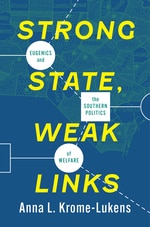
Throughout much of the twentieth century, North Carolina governmental officials expressed concern about the public and private problems caused by persons not considered part of mainstream society. Labeled feeble minded, defective, deviant, delinquent, or retarded, these individuals ostensibly required both care and control by state entities to ensure they caused as few difficulties as possible. In her provocative book Strong State, Weak Links, UNC professor Anna Krome-Lukens lays out the story of North Carolina reformers and their use of progressive scientific thought combined with traditional racial (and racist) ideology to manage society. Dividing society into categories like “deserving” versus “undeserving” and “productive” versus “inefficient,” these bureaucrats worked assiduously to separate those they saw as drains on society from “regular” North Carolinians.
Looking at the state’s evolving public welfare system combined with institutional settings designed to house those labeled as mentally ill or feeble minded, Krome-Lukens examines how officials sought to advance North Carolina into the modernity of the twentieth century. Realizing “the need for concerted government action” and “inspired by expert knowledge flowing from the burgeoning social sciences, they rarely questioned their conviction that they knew what was best for the poor, dependent, or delinquent.”[1] Yet, they simultaneously tied themselves to the Lost Cause ideology that extolled the virtues of a Southern society based on racial hierarchies and assumed Black intellectual inferiority. This world view allowed reformers, often upper-class first-generation college graduates, to push for changes in society while retaining much of the benefits of traditional Southern life. Many of these reformers were women, often daughters of Confederate veterans, who organized in groups like the Federation of Women’s Clubs (FWC). Through these organizations, Krome-Lukens concludes that “women drew on their influence as mothers and as moral guardians to tackle a multitude of social ills, both through charitable efforts and by pushing Progressive reforms through the legislature.”[2]
Krome-Lukens discusses female reformers like Daisy Denson and Kate Burr Johnson not only in terms of their connection to reform issues but also as they embraced the solution to societal difficulties provided by the emerging science of eugenics. Not yet tainted by its relationship to shoddy biased research and Nazi excesses, eugenics seemed the perfect answer to problems caused by defective people. Tying human reproduction to the ideas of human breeding, eugenics proponents sought to prevent the passing on of what they viewed as heritable negative traits to future generations. This could be accomplished by passing laws like marriage restriction requirements, by segregating people labeled as inferior, or finally by sterilizing them. Krome-Lukens defines this as “preventive social work,” designed to stop abhorrent behavior before it starts, rather than spending state funds on the “results [emphasis in original] of crime, insanity, and poverty.”[3] This preventive work would both protect the productive citizens of North Carolina and save money, always a major consideration for a parsimonious legislature.
Krome-Lukens weaves a sordid story of government officials using the criminal justice system in conjunction with state and county welfare agencies to attempt to ensure the safeguarding of productive North Carolinians. Following World War I, North Carolina constructed a whole series of institutions designed to accommodate individuals who did not fit into mainstream society. Opened with innocuous sounding names like Samarcand Manor and Caswell Training Center, these facilities were overcrowded, underfunded, poorly staffed, and lacking in any coherent function from the beginning. Were they designed to care for the state’s most severely impaired individuals? Were they set up to control delinquent young people? Or were they developed to permanently segregate those persons deemed a threat to the state’s gene pool by their rampant breeding? Krome-Lukens argues that by trying to simultaneously accomplish these three aims, these facilities accomplished none of them and set the stage for North Carolina’s more draconian next steps regarding welfare policy.
By the mid-1930s, in the midst of the Great Depression, North Carolina developed a growing bureaucracy designed to move public welfare programs into the community. Operating under the auspices of a series of state agencies like the Division of Mental Hygiene, the Child Welfare Division, and the Eugenics Board, officials spread the word around the state of “supposedly rampant mental defects and the horrifying costs of cacogenic [sic] families.”[4] North Carolina’s solution was a law that allowed county welfare officials to initiate sterilization procedures on individuals (usually women) in the community. This was a unique enactment- all other states required institutional placement for sterilization to take place. By the 1940s, approximately 40% of the state’s 1540 authorized sterilizations took place outside the walls of state institutions. That percentage would only go up after Worl War II.
While Krome-Lukens does an excellent and important job discussing the eugenic welfare policies of North Carolina, the book title is misleading. There is no mention of welfare and eugenic policies in other Southern states. North Carolina was a leader in the development of a “surprisingly effective, homegrown network of welfare offices filled with trained social workers.”[5] (p. 15). Did other Southern states follow this example? Was there a coherent Southern strategy regarding the amelioration of problems caused by the defective, delinquent, and deviant classes? How did other Southern states deal with the issues raised by sterilization? Why, for instance, did Virginia become a leader in the nationwide sterilization movement and Florida never pass sterilization legislation?
And then there is the issue of race. Krome-Lukens is at her best tying issues of race to eugenics when she concludes that “racial segregation and discrimination framed conversations about fitness and feeblemindedness” as “white leaders in North Carolina used the supposedly scientific authority of eugenics to prop up white supremacy” (p. 8). Yet, there is little discussion in the book about the welfare policies regarding Black patients and institutions. I would have liked more material on the facility originally named the Asylum for Colored Insane, located in Goldsboro in the eastern part of the state. Krome-Lukens brings out the human stories of patients at Caswell and Samarcand; doing so for residents at the Black Asylum would have added much to the book. Finally, taking the time frame for the book forward into the post-World War II era would have built upon Krome-Luken’s strong emphasis on the racial dynamic of North Carolina policy. During this time, the racial and gender demographics of sterilization changed dramatically, as Black women became the main target of eugenic sterilizations. A discussion of this shift and its rationale would have been a fitting coda to the book. These are simply small suggestions, however, for improvement to a book that is both well-written and important in its content. It should find a wide audience in a variety of historical fields.
[1] Krome-Lukens, Strong State, Weak Links, p.33.
[2] Krome-Lukens, Strong State, Weak Links, p. 26.
[3] Krome-Lukens, Strong State, Weak Links, p. 95.
[4] Krome-Lukens, Strong State, Weak Links, p. 157.
[5] Krome-Lukens, Strong State, Weak Links, p. 15.
About the Reviewer
Steven Noll is an instructional professor in the history department at the University of Florida, where he has taught since 1993. His research interests include Florida environmental history and environmental history.
0