
The Book
The Painter’s Fire: A Forgotten History of the Artists Who Championed the American Revolution
The Author(s)
Zara Anishanslin
As the United States approaches the end of a year-long celebration of its independence, it is worth considering how early American studies has recently re-framed the scholarly conversation surrounding its own focus and methodology. Almost by necessity the study of European colonization, the Revolution, and the early republican period has always been defined by the circulation of ideas, goods, and human beings around the Atlantic rim. Anyone familiar with the foundational work of scholars like Perry Miller and, to a lesser extent, Bernard Bailyn, however, cannot fail at this point to see the shortcomings of those pioneers’ approaches when it comes to capturing the full picture. Efforts to expand the geography, demography, and disciplinarity of the field over the past half century have shaped a new Atlantic history paradigm that Karin Wulf in 2014 named “Vast Early America.” This collection of heuristics has reshaped how we understand the evolution of American culture, weaving previously unseen places, people, and cultural objects into the fabric of the national history.
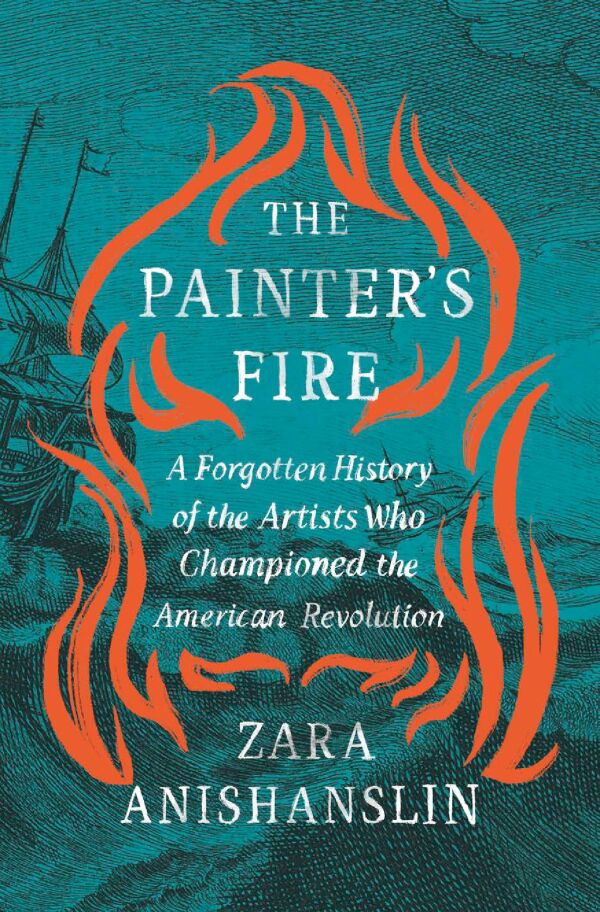
Statues of the men Americans unironically call “the Founders” still dominate the landscape, of course, but representations of other people are now visible as well. This change is evident even in the study of early American art, where publicly enshrined works such as Gilbert Stuart’s portraits of Washington and Jonathan Trumbull’s history paintings reflected mostly an artistic community at least superficially indistinguishable from the men who signed the Declaration. Among the artists who are now receiving a fresh look are the British-born painter Robert Edge Pine, the wax sculptor and putative American spy Patience Wright, and the portraitist Prince Demah, who was born into slavery but later enlisted as a free man in the Continental Army. Enter Zara Anishanslin, whose excellent study, The Painter’s Fire, brings these artists into conversation with one another, establishing them as a sort of transatlantic network of revolutionary artists who enlisted their talents (and in Demah’s case, his very life) in the American cause. Anishanslin’s gripping narrative situates them as both individuals and as a small group of interlocking lives in the astonishingly complicated history of the revolutionary-era Atlantic world.
Anishanslin’s title derives, appropriately enough, from an ekphrastic verse written by the enslaved Boston poet Phyllis Wheatley, “To S.M. A Young African Painter, on Seeing His Works.” This poem presumably refers to drawings made by the enslaved artist Scipio Moorhead. Wheatley wishes “the painter’s and the poet’s fire” might continue to inspire S.M.’s labors, fueling a creative spirit that transcends its personal circumstances. “During the revolutionary era,” Anishanslin argues, “a network of diverse people on both sides of the Atlantic used their own creative fire to help ignite and spread the flame of liberty that blazed around the Atlantic.”[1]
Aptly, Anishanslin begins the narrative with Prince Demah, born of an unknown father to an African woman named Daphny, who was enslaved by a Boston merchant named Henry Barnes. Showing an early artistic promise but working chiefly as an enslaved mariner in his youth, Demah ultimately reversed his mother’s middle passage voyage in 1770 by traveling to London with the Barnes family in order to train with Pine, already an established British painter with political ties to the radical community and its patron saint, John Wilkes. Pine was also, Anishanslin notes, possibly of partial African descent—a possibility alluded to in the portrait of Pine done by his friend, the eminent satirist and painter William Hogarth. Hogarth’s depiction of Pine is decidedly racially ambiguous. (Given the wide circulation of the portrait and the mixed-race nature of London’s population in the eighteenth century, Anishanslin notes, the truth of Pine’s heritage is somewhat beside the point.)[2] Patience Wright, already well established as a celebrity artist in the colonies, would arrive in 1771, after a warehouse fire destroyed much of her work. While no evidence confirms that Wright met Prince Demah, she and Pine became friends and remained so after Pine’s student Demah returned to the colonies with the Barnes family in 1772.
Having briefly brought these three extraordinary lives together amid a braided narrative of interlocking biography and historic contextualization, Anishanslin separates them again as the Revolution approaches, tracking their individual progresses through the backdrop of a global political and military tumult until their unfortunate deaths. Demah found himself free (if not necessarily emancipated) when the loyalist Barneses fled Massachusetts in 1775, then signed on with the Continentals in 1777 before dying—possibly of smallpox—in 1778. Pine remained a vocal champion of the American cause throughout the war and relocated his family to the United States in 1784, dying suddenly in 1788. Wright’s advocacy in London for American prisoners of war and free airing of her revolutionary politics led her to leave England for France in 1781 before dying in 1786 in England while arranging her return to the United States. As Anishanslin notes, “…although, ultimately, none of these transatlantic Patriots got exactly what they hoped for out of the American Revolution, their stories are inspiring as well as instructive.”[3] Their flame burns on.
There are inherent limitations to Anishanslin’s ability to tell this story, no matter how engagingly she tells it. Many of the works that matter most to this history—especially those by Demah and Wright–have disappeared over time. Buildings burn, wax melts, and portraits of forgotten ancestors signed by unknown artists get discarded or lost. (As a theater historian, I know all too well the scholarly difficulties caused by the ephemerality of art.) Ultimately, as Anishanslin sums up the death of Demah and the postrevolutionary disappointments of Pine and Wright, “Revolution destroys as much as it creates.”[4] One could scarcely ask for a better summary of the last 250 years of American history than that.
[1] Anishanslin, 12.
[2] Anishanslin, 47-53.
[3] Anishanslin, 267.
[4] Anishanslin, 262.
About the Reviewer
Jason Shaffer is Professor of English at the United States Naval Academy, where he specializes in the literature and history of the eighteenth-century British Atlantic world. The views expressed in this book review are those of the author and do not reflect the official policy or position of the U.S. Naval Academy, Department of the Navy, the Department of War, or the U.S. Government.
0