
The Book
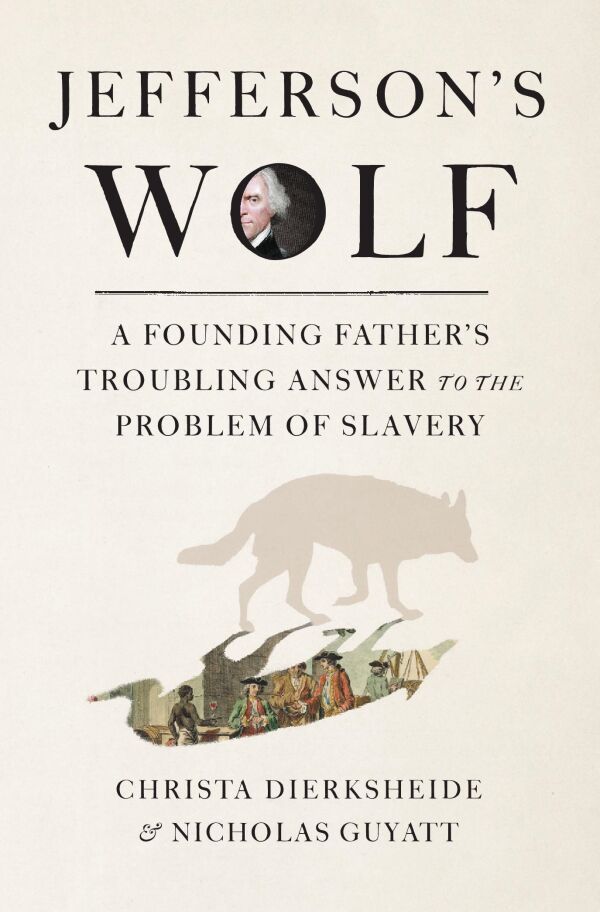
Jefferson's Wolf: A Founding Father's Troubling Answer to the Problem of Slavery
The Author(s)
Christa Dierksheide and Nicholas Guyatt
Based on my decades of teaching students in a leading southern state university and lecturing widely on law and politics in the Revolutionary Era, I’ve found that many people perceive that, before the Civil War, Americans fell into one of two camps on slavery. Personified by the likes of Frederick Douglass and William Lloyd Garrison in the Antebellum Period and by Anthony Benezet and perhaps Benjamin Franklin during the Revolutionary Era, one camp favored abolition in situ on moral, religious, or economic grounds. Those in this camp typically freed those that they enslaved and labored to end slavery in place. Another camp, with supporters ranging from South Carolina planter and politician Charles Cotesworth Pinckney at the Constitutional Convention to Vice President John C. Calhoun during the Jacksonian Era, defended the enslavement of Africans in the United States as a necessary fact or positive good for the country and perhaps even for the enslaved. Enslavers in this camp clung to their enslaved property and opposed abolition.
One thing stands out from the debate at the Constitutional Convention and among political leaders thereafter: those in both camps believed that, absent some cataclysmic event, slavery was embedded in the Deep South and not on the road to extinction in America despite its gradual demise in the northeast and exclusion from the upper Midwest by the Northwest Ordinance of 1787. If not a pro-slavery document (as some historians charge), at least the U.S. Constitution protected state-sanctioned slavery in states that chose to maintain and expand the institution.
Jefferson’s Wolf offers a useful corrective by fully developing Thomas Jefferson’s distinctive political and intellectual commitment as “an antislavery enslaver” to emancipation with expatriation.[1] Unlike those in one or another of the two dominant camps, Jefferson neither freed the hundreds of enslaved people that he owned (except for some of his own children by Sally Hemings and a few members of their extended family) nor endorsed slavery as anything other than “an anachronism in an independent republic.”[2] With remarkable consistency over his extraordinary five-decade career as a political leader and public intellectual, from 1774 to 1826, Jefferson advocated the abolition of slavery coupled with the removal (either voluntary or by force) of all free and enslaved people of color from his state and, after confederation, from the country. In his eyes, post-colonial Virginia and the United States should be white polities—American extensions of Europe. He would neither free his own enslaved people nor endorse the freeing of those owned by others without a ready means for their expatriation, which was always “far-fetched” and became utterly impossible as slavery spread west during the early nineteenth century.[3]
Jefferson’s position on slavery led contemporary critics and later historians to dismiss him as a dreamer or damn him as a hypocrite on these matters, but Dierksheide and Guyatt present Jefferson as consistent and sincere, if perhaps naïve.[4] Unpacking Jefferson’s long career, they manage (with a few notable exceptions) to fit his legislative proposals, public and private words, and treatment of his own enslaved people within a considered pattern of antislavery exclusionism. Certainly, his landmark book, Notes on the State of Virginia, denounced slavery but it also disparaged people of color and declared that freed Blacks should never live alongside or amalgamate with whites. Naturally he supported ending the Atlantic slave trade and espoused the deportation of free and enslaved Blacks at first to Africa and later to Haiti. Under laws he espoused, Virginia coupled manumission with the removal of freed Blacks from the state and Congress barred the extension of slavery into the Northwest Territory, with most of the resulting free states restricting Black settlement. Only his relationship with Sally Hemings seems incongruous but, due to their ancestry, his children with her, although born into slavery through their mother, were white under Virginia law and, once freed, passed as such.[5]
By employing a chronological framework, this book offers something of a cradle-to-grave narrative biography of Jefferson, but one that focuses narrowly on his engagement with slavery to the exclusion of other aspects of the rich and complex life for which he is mainly remembered and widely honored. Rather than as biographer Joseph Ellis’ American Sphinx, in his public policies and private practices as an antislavery enslaver recounted here, Jefferson appears as a singular (and singularly ineffective) advocate of a quixotic policy of emancipation with expatriation that crumbled in the face of the economic and social realities of an expanding agrarian empire reliant on enslaved labor for cotton production. In this account, for example, one of Jefferson’s greatest achievements as president, the Louisiana Purchase, by adding fertile soil for plantation agriculture, features mainly as a further obstacle to the implementation of his exclusionist vision for ending slavery.
Although the authors do not attempt to assess the practical impact of Jefferson’s idiosyncratic position on emancipation with expatriation, they distinguish it from the private effort launched in 1816 by the American Colonization Society, which encouraged the voluntary relocation of free and enslaved Blacks from the United States to Liberia. Despite the central role played by his neighbors and political allies James Madison and James Monroe in this effort, Jefferson remained aloof, presumably (the authors surmise) because it required the consent of would-be colonizers and did not involve the state.[6] In this and other ways, the authors present Jefferson as rejecting potentially viable means to advance his goal of emancipation with expatriation incrementally even as he continued to profess his enduring opposition to slavery.
In a somewhat similar manner, by stressing the need to prepare Blacks for emancipation by training them first in marketable trades or skills, Jefferson put off manumitting his own enslaved persons so long that (except for a few Hemings) they never became free. Instead, they remained at work for Jefferson until his death in 1826, when most were sold to pay his debt, which tore families apart and sent some to distant plantations in the Deep South. For Jefferson, it seemed, Blacks were so innately inferior to whites that they never qualified for emancipation even if expatriated—yet by keeping the best trained ones in bondage allowed him to retain his best workers. In private correspondence, when challenged by opponents of slavery about his “maddening” speculations about Black inferiority, commitment to expatriation, and failure actually to free anyone that he personally enslaved, the authors quote Jefferson as reiterating his “commitment to the cause of abolition” and then go on to suggest that, based on his personal experience, he knew best how to achieve it.[7]
The authors admit finding it hard to square Jefferson’s repudiation of race mixing with his long-term concubinage with Sally Hemings, which the authors suggest began by 1789 when Hemings was around 16 and continued until Jefferson’s death nearly 40 years later, but they try. “To our eyes, Jefferson’s actions can hardly seem other than hypocritical,” they write. “In his mind, however, it was Britain that had entailed slavery and empire on Virginia, and racial mixing was the inevitable and dreadful consequence.”[8] All the more reason, they argue, for Jefferson to enforce racial purity through emancipation with expatriation.
Without showing that Jefferson’s peculiar antislavery beliefs directly impacted American law or policy, or even that anyone else shared them, Dierksheide and Guyatt serve a valuable purpose in so meticulously unpacking them. Jefferson, after all, was a central figure of the founding era and early national period. As a life-long enslaver in a revolutionary age, how Jefferson reconciled Black enslavement with white liberty while professing his opposition to slavery offers a cautious and distinctly American tale that would have been largely lost in a general biography.
[1] Dierksheide and Guyatt, 204.
[2] Dierksheide and Guyatt, 71.
[3] Dierksheide and Guyatt, 74.
[4] Dierksheide and Guyatt, 185-86, 210.
[5] Dierksheide and Guyatt, 101.
[6] Dierksheide and Guyatt, 197.
[7] Dierksheide and Guyatt, 186.
[8] Dierksheide and Guyatt, 102.
About the Reviewer
Edward J. Larson is University Professor of History and holds the Darling Chair in Law at Pepperdine University. The Pulitzer Prize winning author of 16 books, including American Inheritance: Liberty and Slavery at the Birth of a Nation, Larson previously he taught and chaired the History Department at the University of Georgia.
0