
The Book
The American Revolution and the Fate of the World
The Author(s)
Richard Bell
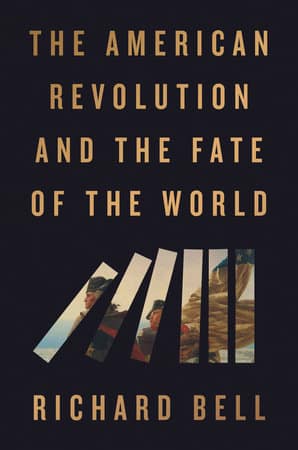
On July 4th, 1837, the townspeople of Concord, Massachusetts first heard the lyrics of Ralph Waldo Emerson’s “Concord Hymn,” which was read and then sung (to the tune of the widely known hymn referred to as the “Doxology”) before a recently completed obelisk monument to the battles of Lexington and Concord. This, then, was the debut of Emerson’s famous description of these battles as “the shot heard round the world.” The historiography of the American Revolution has, ever since, been marked by tension between the intensely local and the global contexts of the war–with a fair amount of Christian eschatological subtext built in, just as in Emerson’s poem. Richard Bell’s impressive new history of the American Revolution’s broader contextual effects, The American Revolution and the Fate of the World, acknowledges both sides of this structural tension and also the eschatological subtext without falling victim to the interpretive fallacies that overemphasizing any one of these elements can easily generate.
I will freely admit that, with the 250th Anniversary of the Declaration of Independence drawing near as I picked up Bell’s book, I very nearly judged it by its cover–or at least its title, which seems to signal a divine inevitability about American global preeminence associated with nineteenth-century historians like George Bancroft or Frederick Jackson Turner–or at least with Western liberal democracy as representing “the end of history,” that famous intellectual misfire from Francis Fukuyama. I am happy to admit that the actual text is a remarkably rich series of historical readings of the Revolution’s importance to sometimes obscure groups of Americans and to the shifting tides of great power competition in the late-eighteenth century. All of these studies combine to form a remarkable diachronic narrative of the Revolution from its outbreak to postludes in British India and Australia. For scope and depth as a grand narrative fueled by nonetheless intensely detailed research, it reminds me of Fred Anderson’s masterful Crucible of War: The Seven Years’ War and the Fate of Empire in British North America (Knopf, 2000).
Bell, born and raised in Britain but trained in the United States, has a keen awareness of the contingency of the United States’ rise to global preeminence, but an even keener eye for the connections tethering the Revolutionary past and present. Consider, for instance, Bell’s first chapter. The book begins, as perhaps it must, with the colonial outrage over the Tea Act of 1773, and Bell draws together the history of global commodity consumption (and smuggling!), xenophobic editorials in New England newspapers about the dubious cleanliness of Chinese tea packers, the pervasive if quotidian ritual of decorating acts of political protest (and violence) in the contemporary United States with teabags, and a repetition with revision of colonial “tea parties” in China in 1839, when the Daoguang emperor ordered some 21,000 chests of imported opium to be dumped into the Pearl River in attempt to drive out the East Indian Company. The result is a remarkably rich global and chronological reading of what initially might appear to be just another in a series of tax protests by unruly citizens who disliked excise measures more than they loved “perform[ing] their Britishness” by engaging in such stereotypical metropolitan consumption habits as tea, play-going, and other such practices that would come to be viewed by the incipient Patriot movement as mere luxuries or frivolities.[1]
From this point forward, Bell engages in a remarkable series of what are initially localized deep dives into the documentary evidence, only to expand the significance of the events and personages that he chronicles and interlace his theme of the Revolution as a global phenomenon, a tectonic shift in the balance of power throughout the Europe and Asia and well as the Americas. Some elements, such as the second chapter chronicling British domestic sentiments about the American War, feel like well-trodden ground, while others, such as his studies of the Iroquois Confederacy’s wartime diplomatic efforts and the Revolution’s effect on the Atlantic world’s use of chattel slavery, clearly reflect the disciplinary shift away from earlier generations’ emphasis on Founders and battles as the defining features of the Revolution’s historiography. Despite the widespread nature of the narrative, Bell manages stick to the through-line of the war’s progress around the globe, concluding the book with chapters on Britain’s reassertion of military influence in India and settlement of Australia, along with the migratory patterns set off among American loyalist refugees by the British defeat.
In 1783, as peace was nearly in the grasp of the American negotiators, John Adams wrote in a letter that “A compleat [sic] History of the American War … is nearly the History of Mankind,” a sentiment I cannot do better than to repeat by way of endorsing this excellent work of scholarship.[2]
[1] Bell, 21.
[2] Quoted in Bell, 345.
About the Reviewer
Jason Shaffer is Professor of English at the United States Naval Academy, where he specializes in the literature and history of the eighteenth-century British Atlantic world. The views expressed in this book review are those of the author and do not reflect the official policy or position of the U.S. Naval Academy, Department of the Navy, the Department of War, or the U.S. Government.
0