
The Book
White Care: The Impact of Race on American Infrastructure
The Author(s)
Cotten Seiler
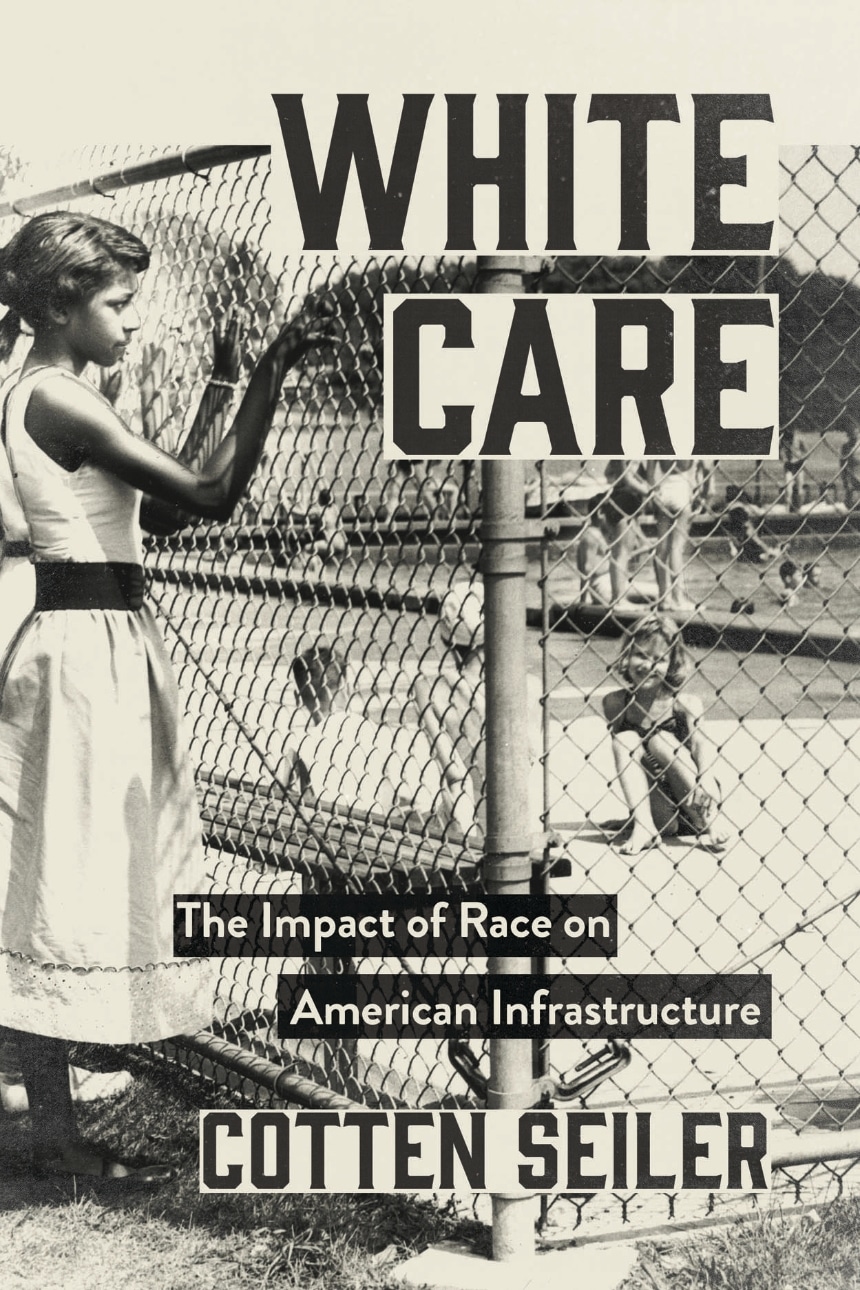
Cotten Seiler’s White Care: The Impact of Race on American Infrastructure offers a history of discourses both about race and human potential, and public spending in infrastructure throughout, mostly, the twentieth century. The book argues that eugenicist rhetoric permeated, and still permeates, public policy in the United States, and has at moments both advanced and hindered the development of public projects. White Care also contends that the rhetoric of progress, in the United States, is inextricably linked to anxieties about the loss of white control of public spaces.
Throughout the book, Seiler details the history of the Eugenics and Euthenics movements in the United States, and analyzes how these discourses affected social projects in sanitation, leisure, education, and many other social areas. White Care also describes how demographic and legal changes affected how the government understood, planned for, and developed public systems and spaces. Additionally, Seiler argues that overtly racist eugenicist discourses have been supplanted by calls for an amorphous “American essence,” coded as white, that nonetheless continues to similarly affect how we see publicly-funded projects. Overall, the book contends that a desire to exclude non-white populations from receiving public benefits has caused the decay of American infrastructure.
Although the title of the book highlights its discussion about infrastructure, I find that the book’s rhetorical analysis of public discourses regarding race applies to many other public policy decisions in the United States, from tax exemptions to health insurance. The book mostly concentrates on Federal policy, even if it presents concrete examples at the local level. Consequently, White Care looks at the United States as a whole and does not detail how different states have deployed racist discourses or how these discourses have affected local infrastructure priorities. That is, Seiler concentrates mostly on the national Executive Branch and the many public programs it has prioritized throughout the twentieth century.
I found the book’s third chapter, “’A Heritage of Hygienic Experiences’: Euthenics and the Population as a Child,” to be its most compelling section. In this chapter, Seiler explains the role of women’s groups in the betterment of public spaces and the creation of sanitary infrastructure. Further, the chapter argues that these groups helped to shape a vision of the public as children who needed the state’s care. Additionally, the chapter introduces the argument that the government only prioritizes infrastructure that serves non-white populations when it is necessary for maintaining white populations’ safety (as is the case with sanitation and public health issues). Overall, White Care: The Impact of Race on American Infrastructure offers a very detailed and persuasive rhetorical analysis of national discourses about race and the impact they have had on the development of public policy.
About the Reviewer
Naida García-Crespo is an Assistant Professor of English at the Universidad del Sagrado Corazón in Puerto Rico. Her work has appeared in Film History, Early Popular Visual Culture, and CENTRO Journal, among other journals and essay collections. She is the author of Early Puerto Rican Cinema and Nation Building (1897-1940): National Sentiments, Transnational Realities (Bucknell University Press, 2019).
0