
The Book
Health as Property: Racial Capitalism and Sexual Liberalism in Los Angeles
The Author(s)
Nic John Ramos
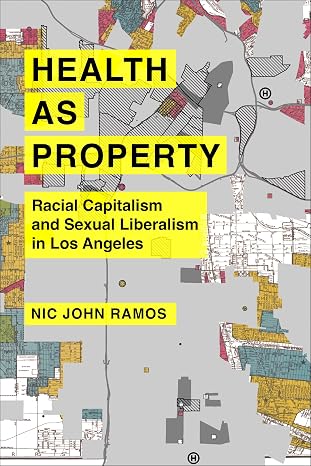
In Health as Property: Racial Capitalism and Sexual Liberalism in Los Angeles, historian Nic John Ramos delivers an ambitious and deeply unsettling account of race, healthcare, and urban political economy in postwar L.A. The book centers on the history of the King-Drew Medical Center, a Black-led hospital established in the aftermath of the 1965 Watts uprising. But Ramos’s project is far larger than institutional history. He argues that modern American healthcare cannot be understood apart from the intertwined histories of racial capitalism, redevelopment, and the policing of sexuality and gender.
The book’s central concept — that “health” functions as a form of property — is provocative and generative. Ramos contends that access to health in the United States has long been distributed unevenly through systems that protect wealth, whiteness, and real estate value. Healthcare, in his telling, is inseparable from housing policy and urban planning. Rather than viewing hospitals as neutral institutions of care, Ramos presents them as battlegrounds where competing visions of citizenship, public investment, and social worth collide.
One of the book’s greatest strengths is its refusal to romanticize liberal reform. Ramos examines the hopeful coalition politics that emerged around King-Drew during the late 1960s and 1970s — civil rights activists, Black Power organizers, welfare rights advocates, physicians, and antipoverty reformers all imagined the institution as a vehicle for democratic transformation. Yet the book argues that these aspirations were gradually constrained and redirected by the demands of Los Angeles’s emergence as a “global city.” Public officials and liberal elites increasingly reframed poverty, illness, and social unrest as problems of individual pathology rather than structural inequality. In the process, healthcare institutions became tools for managing marginalized populations rather than empowering them.
Ramos is especially persuasive when tracing how racialized ideas about gender and sexuality shaped public health discourse. The subtitle’s invocation of “sexual liberalism” is not ornamental. The book shows how narratives surrounding Black families, homosexuality, mental illness, welfare dependency, and violence informed policy decisions in Los Angeles during the 1970s and 1980s. Ramos argues that liberalism often accommodated itself to punitive assumptions about poor people of color even while claiming the language of inclusion and reform. This analysis gives the book a sharp contemporary resonance, particularly in an era when debates over healthcare inequality are frequently detached from broader discussions of housing precarity, policing, and labor exploitation.
Methodologically, Health as Property is impressively interdisciplinary. Ramos combines urban history, African American history, queer studies, public health history, and political economy into a cohesive narrative. Its archival depth is substantial, drawing from government reports, activist materials, medical records, planning documents, and local political debates. The book’s chapter titles — “Profiting from Black Sickness,” “The Psychological Wages of Blackness,” and “Profiting from Violence” — signal its sustained interest in how crises affecting Black communities were repeatedly converted into opportunities for institutional expansion, political legitimacy, and economic accumulation.
At times, however, the book’s theoretical density can deter even an avidly interested reader. Ramos writes with intellectual precision, but some sections appear more invested in conceptual synthesis than narrative momentum. Still, this criticism is relatively minor compared to the book’s accomplishments. Ramos succeeds in demonstrating that healthcare inequality is not simply the byproduct of policy failure or bureaucratic inefficiency. Instead, he argues that inequality is structurally embedded within systems designed to protect property and capital accumulation. The result is a work that reframes familiar debates about public health by situating them within broader histories of segregation and neighborhood redevelopment.
The Los Angeles setting is also crucial to the book’s power. Ramos portrays the city not merely as a backdrop but as a laboratory for late twentieth-century neoliberal governance. The transformation of L.A. into a decentralized global metropolis depended upon forms of displacement, policing, and disinvestment that directly shaped public health outcomes. King-Drew becomes emblematic of the contradictions of postwar liberalism itself: a visionary institution born from demands for racial justice that was ultimately constrained by the bourgeois values of its management and the urban political economy surrounding it. The fact that the institution failed in the end and was closed reflects how so many of the hopes of activists and medical professionals in the 1960s and 1970s fell short.[1]
What makes Health as Property particularly compelling is its timeliness. The book speaks directly to contemporary crises involving medical debt, unequal life expectancy, homelessness, mental health infrastructure, and privatized healthcare systems. Ramos suggests that these are not disconnected problems but manifestations of a deeper political logic in which health is treated as an asset to be protected for some and withheld from others. In that sense, the book offers not only a history of Los Angeles but also a broader interpretation of modern America. I would recommend the 2018 documentary Power to Heal: Medicare and the Civil Rights Revolution by Charles Burnett, Daniel Loewenthal, and Bullfrog Films as a vivid complement to this book.[2]
Ultimately, Health as Property is an important contribution to the growing scholarship on race, capitalism, and public health. Ramos combines rigorous archival research with an expansive analytical framework that challenges readers to rethink what healthcare institutions actually do within American society. For historians of cities in the United States, public health scholars, and readers interested in the intersections of race and political economy, it is likely to become a significant work in the field.
[1] Charles Ornstein, Tracey Weber, and Jack Leonard, “King-Harbor Fails Final Check, Will Close Soon,” August 11, 2007, Los Angeles Times, https://web.archive.org/web/20071108035742/http:/www.latimes.com/news/local/la-me-king11aug11,0,3698687.story.
[2] Charles Burnett and Daniel Loewenthal, dirs., Power to Heal: Medicare and the Civil Rights Revolution (Bullfrog Films, 2018).
About the Reviewer
Alex Sayf Cummings is a professor of History at Georgia State University. She is the author of Democracy of Sound (Oxford, 2013), Brain Magnet (Columbia, 2020), and Streaming at the End of the World (Rutgers, 2027).
0