
The Book
Banished Citizens: A History of the Mexican American Women Who Endured Repatriation
The Author(s)
Marla A. Ramírez
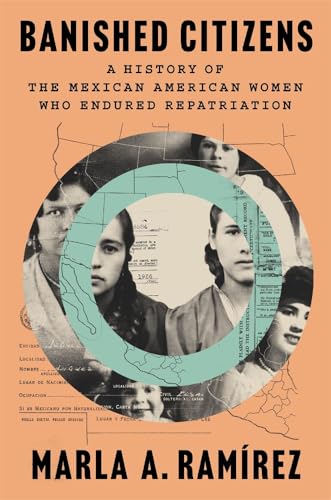
Marla A. Ramírez’s Banished Citizens: A History of the Mexican American Women Who Endured Repatriation presents a first-hand account of four Mexican-America families who were banished from the United States (US) during the 1920s, 30s and 40s as part of a US-government campaign to deport ethnic Mexicans who were categorized as burdensome to the state. The book argues that these American citizens were targeted for deportation as a way to direct away blame for the great socioeconomic crisis of the Great Depression from government policies and into already marginalized communities, like Mexicans. Banished Citizens also argues that the decades of banishment policies worked to cement in the American imaginary the association of Mexicanness with illegality, and to diminish the transgenerational wealth of Mexican-Americans.
Through interviews with four families, the Rodríguez, the De Anda, the Robles and the Espinoza, Banished Citizens details how Mexican-American women were easy targets for deportation because of their “dependent” status as women. That is, Ramírez argues that the government legally thought of Mexican-American women as extensions of their husbands, and thus not as US citizens, but rather as Mexican wards. Additionally, the book contends that these women were doubly victimized by two states (the US and Mexico) that refused to see them as their own and that denied them their right to define their own national identity.
Although Banished Citizens offers important historical and ethnographic insight into a shameful and not often discussed part of America history, the narrative argument is somewhat repetitive and the historical timeline of events hard to follow. The four families’ histories are not clearly tied to particular historical events/policies but rather to how banishment affected the families’ internal structure and relations. Consequently, rather than its historical account of events, the book’s greatest strength is its ethnographic work. That is, more than a history, Banished Citizens offers an insider account of the social relations, economic and political challenges, and intergenerational traumas of the banished Mexican-American community.
I found the book’s epilogue to be its most fascinating section. In this section, Ramírez conducts a discursive analysis of the similarities between how banishment-era and contemporary politicians and government policies frame Mexican-Americans and their social contributions. In this section Ramírez presents a compelling argument for how banishment-era discourses about the expendability of Mexican-Americans (as social actors, and more specifically as workers) have been deeply ingrained into American society, and resulted in contemporary policies and discourses that create racial hierarchies of citizenship based on prejudices that categorize ethnic Mexicans as criminals and disposable. Overall, Banished Citizens most important contribution, in my estimation, is its deep, contextual understanding of the long-lasting effects of government policies on families and communities.
About the Reviewer
Naida García-Crespo is an Assistant Professor of English at the Universidad del Sagrado Corazón in Puerto Rico. Her work has appeared in Film History, Early Popular Visual Culture, and CENTRO Journal, among other journals and essay collections. She is the author of Early Puerto Rican Cinema and Nation Building (1897-1940): National Sentiments, Transnational Realities (Bucknell University Press, 2019).
0