
The Book
A Little Queer Natural History
The Author(s)
Josh L. Davis
The idea that natural history is more than a little queer—and that its queerness might shed light on how to better understand sexual and gender diversity among our fellow humans—describes a longstanding current within LGBTQ intellectual history. One of its earliest widely circulated manifestations appears in French author Andre Gide’s Corydon, first published in its entirety in 1924, which presents a series of Socratic dialogues in which the eponymous protagonist argues that same-sex love among men actually surpasses exclusive heterosexuality in its naturalness. In addition to his evocations of Ancient Greece and Renaissance Italy, common among early homosexual writers, Gide’s character constructs an elaborate argument drawing on examples from the early twentieth century’s natural history canon, from hermaphrodite cirripeds and white Doris sea slugs described by Darwin to practices of “inversion” among Belgian carrier pigeons. While the book’s narrator was not convinced—nor, frankly, was I, attempting to follow its baroque logic a century later—the status of Corydon as a landmark within homosexual apologetics established natural history as a reservoir from which advocates might water their arguments for social tolerance.[1]
The book first appeared in English translation in 1950; it should not surprise us that the following year, The Homosexual in America—the most influential apologia to emerge from the United States in the pre-Stonewall era—would be published under the name Donald Webster Cory, a pseudonym derived from Gide’s hero. Amidst a range of sociological and psychological arguments, Cory too alluded to natural history and cross-species comparisons, musing whether “widespread homosexuality among males, not only in human beings but in other forms of animal life, might be nature’s manner of providing an outlet for the sexual impulse which is usually stronger in the male.”[2] LGBTQ advocates in the following decades drew on a variety of rhetorical strategies and intellectual traditions, but the allure of natural history continued to animate works ranging from scholarly expositions such as Bruce Bagemihl’s Biological Exuberance (1999) and Joan Roughgarden’s Evolution’s Rainbow (2004) to the embattled children’s book And Tango Makes Three (2005) about the “gay penguins” who raised a chick at the Central Park Zoo.[3] Scholar Joanna Wuest has documented in her study Born This Way how approaches to sexual and gender advocacy based in the biological sciences emerged in the 1950s and became central to LGBTQ rhetoric from the mass media to the courtroom in recent decades.[4] As a discipline which folds into its very name a refutation of one of the most common phobic criticisms of queer sexuality and gender nonconformity, natural history appears to offer an invaluable tool to justify acceptance of a wider range of behaviors and identities.
For historians of (human) sexuality, however, such appeals to the queerness of other species can appear whimsical at best, and disingenuous and troubling at worst. We insist, against common perceptions within our communities to the contrary, that sexual and gender identities are culturally contingent and change over time—that to be “lesbian” or “gay” or “trans” makes sense only within a particular social framework, not as a biological absolute. And the stakes of such debates are not merely intellectual hair-splitting or disciplinary competitiveness. On one side, advocates propose that scientifically demonstrating the “naturalness” of same-sex sexual behavior and gender diversity beyond the human species can induce those hostile to LGBTQ communities to accept our appeals for social acceptance and legal protection. Indeed, such arguments have featured heavily in court cases around gay and lesbian rights, with varying degrees of success. On the other hand, some critics counter that by relying on such biological explanations, we frame our queer and trans lives not as valuable for their own sake but merely as unavoidable and thus pitiable deviations, and even open the door towards eugenic projects to eliminate us.
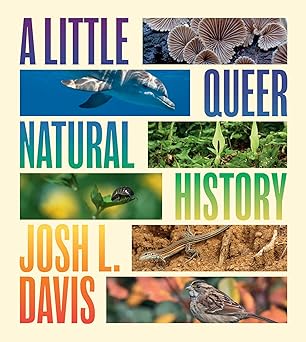
It is in this context that A Little Queer Natural History has appeared, exactly a century after Gide’s Corydon, and like its predecessor provoking readers to rethink their perspectives on sexuality and gender among humans by examining their expression in the non-human world. Its author, Josh L. Davis, is a science writer at London’s Natural History Museum, which first published the book in the UK as A Little Gay Natural History. (The University of Chicago Press, publisher of a wide range of scholarly monographs on gender, sexuality, history, and the sciences, apparently decided that dubbing the book’s brand of natural history as “queer” better suited an American audience.) Across 120 lavishly colorful pages divided into a series of concise vignettes, it unfolds the stories of 29 species across the animal, plant, and mushroom kingdoms that demonstrate how human paradigms of heterosexuality and the gender binary break down when confronted with the dazzling diversity of life on Earth. From the New Mexico whiptail lizard to the common cockchafer to the Dungowan bush tomato, these varied species display a bewildering range of variations in all features related to sex and sexuality. And as one of the book’s key lessons emphasizes, it is not straightforward observation of the natural world, but efforts to shoehorn its complexity into untenably limited frameworks, that results in the mistaken notion that sexual behavior in “nature” primarily takes place within male/female dyads and that biological sex fits into one of two clear options.
Reading A Little Queer Natural History from the vantage point of a historian of US LGBTQ communities prompted two contradictory reactions. First, the book is an absolute delight: sumptuously illustrated with dozens of color photos, accessibly written but informative and thought-provoking, it completely succeeds at imbuing the reader with a sense of profound wonder at the living world that the best nature writers and documentarians can produce. It can unquestionably serve as a powerful tool to expand minds and advocate for social understanding. This is the type of book you could easily give to a narrow-minded family member to spark constructive conversation, or to a gender-expansive teenager for solace and inspiration. A partner and I delighted in its vivid photographs and fantastical stories as we read it aloud together in the evenings before bed. A standout within the long tradition of queer apologetics drawing on natural history from Gide to Cory to Tango, it effectively balances nuance, detail, and rigor with accessibility, humor, and sheer wonder. By nearly any measure, it is a triumph.
Also: speaking as a historian, the intellectual framework that scaffolds its entire approach is unsupportable. Throughout the book, sexual behaviors, pairings, and individual animals are described with modern human sexual identity labels, jarring against every scholarly sensibility that defines my field. How can I square this with the book’s many appealing features? Am I being too precious or disciplinarily narrow-minded? Does it matter if the author merges rigorous scientific testimony with informal popular categorization? Do the potential political ends justify the questionable analytical means? What does this tell us about queer intellectual history?
In the introduction, Davis begins by insisting, perhaps a bit disingenuously, that the book “is not a justification for queer behaviors—animal or otherwise—as these behaviors need no justification,” and “is not making analogies between what is seen in nature and the human race” (5-6). While this may reflect part of the author’s intention, it disavows how the book is situated within the century-long tradition of queer engagements with natural history for advocacy purposes, as well as the primary uses to which it will certainly be put.[5] While Davis acknowledges that readers might “question how some words are applied to non-human life,” his approach hinges on the assumption that labels within the LGBTQ spectrum generally connote not just behavior but an innate sense of self. Since “it is impossible to ask other life forms if they are actually gay, lesbian, bisexual, or queer,” the book claims it will use the terms as adjectives for behaviors to avoid “rather clunky” formulations such as “same-sex sexual behavior” (6-7). Yet throughout many sections of the book, Davis refers to animals, not just behaviors, with sexual identity labels: as we learn, experiments have studied “the brain structure in gay sheep” (34), “homosexual swans” show more equitable behavior in parenting chicks (49), and scientists have been “observing queer penguins in the wild for more than a hundred years” (8). When it comes to lesbians, however, Davis is more circumspect; in a section on seagulls, he qualifies that “while we can’t say that the gulls are ‘lesbian,’ we can say that they form lesbian pairings” (82). (Why male but not female animals should more easily merit identity labels is not explained.) But even setting aside the labeling of individual animals, is it justifiable to describe male giraffes necking and mounting one another as “gay behavior” (55-56), or the genital-genital rubbing of female bonobos as “lesbian activity” (33), when such paradigms for interpreting same-sex sex among humans by no means universally apply?
From the vantage point of US LGBTQ history, successive activist generations have considered it vitally important to disavow the merging of behavior and identity in the forging of an identity-based movement. In the 1950s, groups such as the Mattachine Society adopted the term “homophile” to distinguish an orientation towards same-sex intimacy from the narrower behavioral term “homosexual.” Liberationists in the late 1960s and 1970s proposed models of gay identity that did not reduce to same-sex sexual behavior, but denoted a broader affiliation with the movement’s politics, aesthetics, self-fashioning, and sense of community. Historians in the 1980s characterized sexuality as socially constructed, maintaining that, for instance, participants in ancient Greek pederasty could not meaningfully be described as “gay,” since they lacked any cultural framework prescribing “sexuality” as a determinant of personal identity as it emerged in Euro-American societies in the late nineteenth and twentieth centuries. Queer theorists in the 1990s insisted that the use of the term “queer” should not be understood as a mere umbrella for gay, lesbian, bisexual, and related identities, but as a relationship of marginality to social norms that governed sexuality and gender; what made someone “queer” depended on what a given society deemed normal, which varied across cultures and time periods. Yet despite these political and intellectual trends to the contrary, the notion that such labels function basically as synonyms for same-sex sexual behavior across time, space, and even species has persisted. The approach of A Little Queer Natural History, while it may frustrate historians, certainly reflects widespread popular conceptions of sexuality that merge behavior and identity without concern for such variations.
However one might critique or sympathize with this approach, two other themes in the book provide meaningful insights to readers interested in scientific and intellectual history. First, Davis provides a series of cogently argued case studies of how narrow ideologies of sex and gender sabotage scientific understanding of the natural world when confronted with the “queer” behaviors of animals. Among the many examples he documents: evolutionary biologists have described same-sex bonds among swans as “maladaptive,” neglecting their various social functions; entomologists characterized sex between male beetles as coercive and “perverse,” despite the mutual willingness of both parties and its ubiquity across populations; ornithologists attempted to classify the same behaviors among redshanks as non-sexual when occurring in same-sex pairs but as sexual when occurring in cross-sex pairs. As late as the 1980s, a naive naturalist strained credulity with claims that reciprocal oral-genital contact to orgasm between male orangutans was “nutritively rather than sexually motivated” (89)! Davis persuasively illustrates how homophobia and sexual conservatism blinkered scientific observation and interpretation for centuries, and how thinking beyond the binarized and heteronormative limits imposed by conventional gender/sexual paradigms can lead to clearer understandings of animal behavior and the natural world as a whole.
This becomes increasingly clear in Davis’s fascinating engagement with the complexity of sex among plants, fungi, and other animals. The book teems with fascinating stories drawn from the 65,000 animal species known to be hermaphroditic, from bicolor parrotfish who change sex as they reach a certain age and size to blue-banded gobies whose sex is dictated by social status. Certain woodlouse populations develop sex based not on chromosomes but on bacteria, while among green frogs, sex reversals and intersex conditions occur in as many as 16% of individuals. From gynandromorph butterflies that feature male and female characteristics along a bilateral split dividing individuals, to yews that develop seed-bearing branches on an otherwise pollen-producing tree, to splitgill mushrooms that offer over 23,000 possible mating types, the book dazzles readers with its portrayals of biological sex as immeasurably more complex than we have been led to believe. Much anti-trans agitation in the public sphere today hinges on the ostensible division between gender as a social product (or more perniciously as an “ideology”) in contrast to sex as a supposedly immutable biological given anchored in the timeless dimorphic truth of reproduction. Into this toxic context, A Little Queer Natural History explodes like a colorful bomb—or perhaps like a fruiting fungus that disperses thousands of spores across the landscape, seeding countless new ways to understand the incandescent diversity of life beyond the binaries and boundaries humans have erected to constrain it. Such spores produce an almost hallucinogenic effect over the course of the book, illuminating connections and complexities beyond the everyday consciousness of sexuality and gender permitted within conventional cultural frameworks.
In the context, I must set aside or at least qualify my historian’s concerns over how Davis deploys his terminology. A Little Queer Natural History offers a masterful new chapter in the century-long story of LGBTQ advocacy that brings the insights of biological sciences to bear on our understandings of sex, gender, and sexuality. From Gide’s discussion of inversion and Uranianism through Cory’s reflections on the homosexual in America to this charming book’s gay and then queer natural history, the next generations of historians, scientists, and activists will certainly devise new terms and frameworks to interpret what they see around them, in their own species and others. Whether supporters of today’s backlash against LGBTQ rights will be swayed by appeals to the bewildering variety of forms that sex can take in “nature,” that fraught concept and embattled reality, remains to be seen.
[1] André Gide, Corydon, trans. Richard Howard (New York: Farrar, Strauss, Giroux, 1983[1924]), 32-71.
[2] Donald Webster Cory, The Homosexual in America: A Subjective Approach (New York: Greenberg, 1951), 30.
[3] Bruce Bagemihl, Biological Exuberance: Animal Homosexuality and Natural Diversity (New York: St. Martin’s, 1999); Joan Roughgarden, Evolution’s Rainbow: Diversity, Gender, and Sexuality in Nature and People (Berkeley: University of California Press, 2004); Peter Parnell and Justin Richardson, And Tango Makes Three (New York: Simon and Schuster, 2005).
[4] Joanna Wuest, Born This Way: Science, Citizenship, and Inequality in the American LGBTQ+ Movement (Chicago: University of Chicago Press, 2023).
[5] Indeed, the back cover includes a quote from Stephen Fry describing the book as “a most useful settler of arguments and silencer of bigots” who critique same-sex love as “unnatural”—a use which certainly sounds similar to justifying queer behaviors and making analogies between nature and the human race, the claims of the introduction notwithstanding.
About the Reviewer
Nikita Shepard is Assistant Professor of History at Elon University. They received their PhD in history from Columbia University. Their dissertation, “Embodied Politics: A Social Movement History of the Public Bathroom in the Modern United States,” explores the role of toilets as sites and symbols of struggle for social justice activists and their opponents over the past century. Their writings have appeared or are forthcoming in Signs: A Journal of Women and Culture in Society, Washington Post, Journal of the History of Sexuality, Oral History Journal, Nursing Clio, Spectrum South, and the 2023 University of Washington Press anthology Queer Data Studies.
0