
The Book
Choctaw Confederates: The American Civil War in Indian Country
The Author(s)
Fay A. Yarbrough
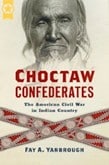
In the voluminous literature of the Civil War, the role Indian peoples had in the great conflict has been neglected. Even in works that detail indigenous histories, their involvement receives only glancing mention. In an easily readable work, Fay A. Yarbrough addresses this oversight in Choctaw Confederates. Rather than people lacking agency buffeted by forces beyond their understanding and control, the Choctaw, as shown by Yarbrough, were active participants, possessing “authentic internal Choctaw fervor for the Confederate cause. . .” By explaining Choctaw culture and national interest, Yarbrough explains their “level of commitment to the Confederate cause . . . and . . . aspects of Confederate ideology.”[1]
Yarbrough’s work is organized into six chapters. Although the chapters do have a chronological element to them, the book is generally organized in thematic form, starting with the Choctaw people and their customs, which is one of the best explanations of Choctaw culture in any work on the subject, and ending with the Choctaw during Reconstruction. Throughout almost all the chapters, the subject of slavery looms, always present from the Choctaw’s time in the Southeast to their relocation to Indian Territory (Oklahoma). Central to her work, in fact, is how slavery and Choctaw sovereignty became so intertwined to be almost indistinguishable.
For the Choctaw, the Civil War highlighted something that may be a surprise to some readers. The Choctaw were thoroughly southern in their outlook and sympathies. They were southern, according to Yarbrough, “far more . . . than their white contemporaries realized.” Their society was founded on chattel slavery and their customs more in-line with those of Mississippi and Alabama than New York or Massachusetts. In a subtle defense of the Choctaw, Yarbrough splits hairs by declaring, “Instead of seeing the Choctaw Nation as siding with the Confederacy, it may be more accurate to say that the Confederacy proposed principles that were more in line with Choctaw goals than with federal ones.”[2]
The Choctaw enthusiastically enlisted in regiments to fight for their Confederate alliance. Perhaps one fifth of the free population rallied to the cause. They whole-heartedly sided with the Confederacy when given the chance, seeing the secessionists as not just their best chance to maintain their sovereignty, but also kindred spirits in which “we must stand or we must fall.” Yarbrough also uses her discussion about the war to explain the importance it had on Choctaw masculinity. As the Choctaw became dependent upon European goods, traditional masculinity was threatened. Choctaw men no longer were free to earn their name in warfare and this “dependence on outsiders for the basics of survival, or being unable as a Choctaw man to provide some of these essentials, could be a blow to masculinity.” The Civil War presented an opportunity to regain that waning martial spirit.[3]
The Choctaw’s immersion in southern ideology is examined in Chapters 2 and 6. In the former, Yarbrough details racial ideology through Choctaw eyes. She notes that slavery in people of African descent was foreign to the Choctaw until introduced by European traders and settlers. Nonetheless, they quickly embraced enslavement as practiced by the Europeans, unwittingly gravitating toward the emerging slave culture in the South. Perhaps her best argument for the Choctaw embodying Confederate society is the discussion about Reconstruction in Chapter 6. Here, the Choctaw acted similarly to their former-Confederate counterparts with their refusal to accept African-American equality. Although accepting emancipation and even granting land ownership to some of their former enslaved, the Choctaw still refused to adopt these very people as citizens of the Choctaw Nation, even attempting to remove the freedpeople from the nation. The freedpeople, according to Yarbrough, “fell outside both traditional clan relations and gender systems. . .”[4]
This book’s primary strength (by no means its only) is the convincing argument the Choctaw embodied Confederate identity. Yarbrough shows that their alliance with the Confederacy was more than a simple marriage of convenience or even necessity. It was one of ideological kinship. With that said, however, Yarbrough does appear to pull back from indicting the Choctaw as fully embracing “Confederate ideology” and the racial supremacy that anchored it. She even mentions that the Choctaw treated their enslaved “better” than those by white southerners. The author, in fact, seems to ignore any discussion about racial supremacy or it being a motivating factor for the Choctaw, instead highlighting the Choctaw joining the Confederacy as a decision more about self-interest, sovereignty, or the best deal for them . . . “state’s rights” anybody? How the author deals with the Choctaw in this instance reads like a historical defense. Yarbrough seems hesitant to acknowledge the Choctaw could be similar to their white Confederate counterparts. Human nature is not unique to any one people or culture. Discussion of Confederate ideology or secession warrants examination of the ideology of slavery. Any treatments of the Confederate governments in the South would not get a free pass on not addressing this fundamental point.
One final observation has less to do with any particular failing in this work and has more to do with historical research and researchers in general. The failings of the WPA Slave Narratives are so known to be trite. Any first-year graduate student let alone an established historian such as Yarbrough knows this. Authors, and I am not indicting Yarbrough specifically in this case, need to spare readers the enumerated biases and problems with these interviews then draw heavily from them to make their argument. That notwithstanding, Yarbrough has written the definitive treatment of the Choctaw in the Civil War Era. Her work, like any excellent scholarship, answers questions and raises others. This reviewer believes she will be in the forefront of the ensuing debate.
[1] Fay A. Yarbrough, Choctaw Confederates: The American Civil War in Indian Country (Chapel Hill: The University of North Carolina Press, 2021), 113 (first quotation), 2 (second quotation).
[2] Ibid, 7 (first quotation), 91 (second quotation).
[3] Ibid, 1 (first quotation), 160 (second quotation).
[4] Ibid, 190.
About the Reviewer
Christopher B. Bean is chair of the history department at East Central University in Ada, Oklahoma, and the author of Too Great a Burden to Bear: The Struggle and Failure of the Freedmen’s Bureau in Texas and editor of Texas and Texans in World War II.
0