
The Book
Incorporating Architects: How American Architecture Became a Practice of Empire
The Author(s)
Aaron Cayer
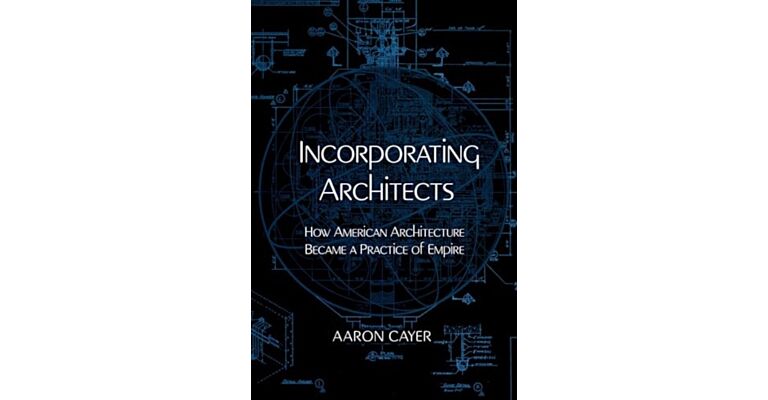
The corporatization of the US American university has attracted significant attention in recent academic literature. Scholars have examined not only the so-called “administrative bloat,” but also universities’ increasing involvement in seemingly extraneous ventures, ranging from real estate investments to nation-building projects. Aaron Cayer’s Incorporating Architects: How American Architecture Became a Practice of Empire (University of California Press, 2025), contributes to this growing body of critical university studies scholarship by focusing specifically on architectural education and practice.
The book is structured chronologically and thematically into six chapters, along with an introduction and conclusion. The first half of the book largely focuses on the corporatization of design practice and the rise of conglomerate architecture firms—some of the most recognizable examples include Perkins & Will, SHoP Architects, and Gehry Partners. These firms generate revenue not only through architectural design but also a host of other normally external services, including consulting, technology development, and regional projects that require specialized expertise. Cayer zeroes in on AECOM specifically, a firm founded by three young architects in Los Angeles in 1946. Thanks to its Cold War-era courtship with US and foreign governments, AECOM expanded its scope and political influence, eventually becoming the largest publicly traded firm in Los Angeles. As Cayer notes, “by 2020, AECOM’s revenue rivaled only that of the Walt Disney Company” (3). Despite its mammoth scale, the firm remains largely unknown to the public, even as it constructs growing numbers of offices, airports, and other faceless buildings worldwide.
While the AECOM story is no doubt intriguing, the book is much more than a business history of a singular architectural conglomerate. Midway through the book, Cayer broadens his scope beyond these firms to explore how the corporatized expansion of architectural expertise has reshaped not only professional practice but also the education of architects themselves. While this pivot was in part due to the secrecy and restrictions imposed by AECOM’s legal department—Cayer explains he sent well over a thousand emails in pursuit of records—it nonetheless offers a much-needed critical perspective on the current state of US American architectural education. The author shows that examining architectural conglomerates helps us understand why professional architecture schools have so readily adopted corporate models, inviting firm principals to sit on boards, sponsor studios, and even shape licensure and accreditation protocols. By transforming architectural education into a pipeline for corporate employment, universities have aligned themselves with industry priorities that function as extensions of US power.
Corporatization and conglomeration are key operating concepts that thread together disparate geographies, political contexts, and architectural design projects throughout the book. In Chapter 1, Cayer explores how architects embedded themselves within corporate structures, redefining the meaning of architectural practice itself. Historically, architects maintained a distance from politics, perceiving themselves to be members of a gentlemanly profession invested in noble arts rather than vile struggles for political power. The postwar context, however, created an opening for architects to embrace corporate structures and in turn “set their firms free from ethical, and thus legal and regulatory, constraint” (28). By collaborating with the federal government on overseas projects, architects shifted their responsibilities from public to governmental priorities. In turn, they privileged the acquisition of political skill over design acumen to distribute risk on the global scale during economic downturns, wars, and environmental crises.
Chapter 2 situates AECOM within the Southern California context. Cayer engages with political economists Peter Drucker and Adam Smith to explain how architects came to see incorporation as a material infrastructure, a bridge “through which capital, labor and resources could flow between ‘developing’ and developed regions, as well as between states and private enterprises” (82). This flexibility was not merely a profit strategy but defined the work itself. Cayer analyzes circular diagrams to show how architects increasingly incorporated flexibility into office layouts—for example, preferring partitions designed by Herman Miller over traditional rigid walls—to enable a flexible labor structure with armies of temporary workers.
What kind of architecture did conglomerate design firms produce? Chapter 3 examines postmodernism, a 1980s aesthetic often critiqued as emblematic of neoliberal globalization. Cayer engages with critical theorists Fredric Jameson, Charles Jencks, and David Harvey, who famously critiqued postmodernism as a shallow stylistic movement that reflected the fragmented relationship between capital and culture. Yet, Cayer offers a fresh perspective, expanding his analysis of flexibility and corporate office architecture. He analyzes a rendering of Teledyne Laboratories from 1968, to argue that “the building quite literally took on the form of an organization chart transposed onto the ground,” maintaining modernist principles of form and function while accommodating an uncertain corporate future (119). Cayer’s reframing of postmodern architecture as corporate infrastructure not only reinforces the political roles of architects but also reframes a popular cultural narrative.
Chapter 4 explores how corporate architectural expertise became a tool for US American imperial activity abroad. Architects capitalized on government contracting, working alongside military personnel to develop construction projects. Architect-contractors relied on US-manufactured technologies such as airplanes, computers, and drawings to reframe architecture as a spatial practice that operated “between people, cities, buildings, and industries” (171). By entwining architectural practice with government contracting, designers further expanded their capacity to not only build but also to destroy. The US government, on the other hand, outsourced labor and risk to private actors while using taxpayer money to support domestic productivity.
In the remaining chapters, Cayer examines how the corporatization and imperial entanglements of architecture firms reshaped postwar education. In Chapter 5, he focuses on industry-wide discussions of practice, showing how publications and handbooks expanded the architect’s role beyond design and centered professionalization instead. Portfolios, Cayer argues, “were directly informing corporate conglomeration” (193), encouraging diversification for the sake of business expansion. Schools quickly became pipelines to firms, which in turn shaped program and even university governance. Cayer asks how architectural education might evolve beyond this corporate model by testing alternative frameworks, for example trade unions. In Chapter 6, Cayer concludes with a compelling discussion of secrecy in corporate culture and its effects on architectural practice and education. As firms expanded, so did their bureaucracies: memos, contracts, budgets, manuals, and reports proliferated. The labor of managing these records often fell to marginalized workers. Cayer narrates that secretaries, librarians, and data processors “were hired to produce and maintain ‘secrets’ before they were formally embraced by the profession as bona fide architects” (205). The conglomerate structure itself therefore enabled secrecy in design practice and education, obscuring operations within subsidiary companies or nebulous professional networks.
In the conclusion, Cayer expresses his disenchantment with the profession, citing “deeply entrenched practices of cronyism and corruption” (233). He calls not for further professionalization, but for deprofessionalization, a radical decoupling of architecture from corporate culture. Architecture school faculty have long observed a curricular shift toward corporate priorities, as administrators sideline commitments to public service and history in favor of regulation, technology, and business. Cayer makes clear that corporate professionalization teaches students to be efficient tools of capital, reproducing the world in return for greater profits rather than transforming it at its foundations. With higher education’s recent embrace of artificial intelligence (AI), Cayer’s call to action is especially important—architects and pedagogues must seek inspiration in alternative embodied and collectivist forms of production.
As universities compete for students, many of whom question the value and purpose of higher education itself, professionalization maintains its strong appeal to administrators. Capital enables institutions to build luxury gyms and dormitories, which signal quality and investment to families paying near six-figure tuition bills. Corporate partnerships, internships, and skill-building programs become the academic equivalents of deluxe amenities. Yet, as Cayer warns, by aligning with corporate interests, universities risk betraying the social and cultural missions of their institutions. While conglomerate models offer tools for navigating economic volatility, they also restructure curricula in ways that threaten the purpose, meaning, and promise of higher education. Surviving economic transformations is important but so is recognizing ourselves on the other side of the crisis.
About the Reviewer
Vyta Pivo is a scholar of the intersecting histories of material lifecycles, construction labor, ordinary landscapes, and climate change. Her forthcoming book, Cast in Concrete: How the US Built Its Empire (University of Chicago Press), traces the history of the US cement and concrete industries and their global and transplanetary expansion. Pivo’s research has been published in various academic and public-facing outlets, including Architectural Theory Review, Journal of the Society of Architectural Historians, Journal of Architectural Education, PLATFORM, Psyche/Aeon, and others. Her research has received support from the Michigan Society of Fellows, the National Science Foundation, Andrew Mellon Foundation, American Council of Learned Societies, the Smithsonian Institution, the Library of Congress, and the MacDowell Fellowship. Pivo works as an assistant professor of architectural history and theory at the University of Miami School of Architecture.
0