
The Book
Scrap Theory: Reproductive Injustice in the Black Feminist Imagination
The Author(s)
Mali D. Collins
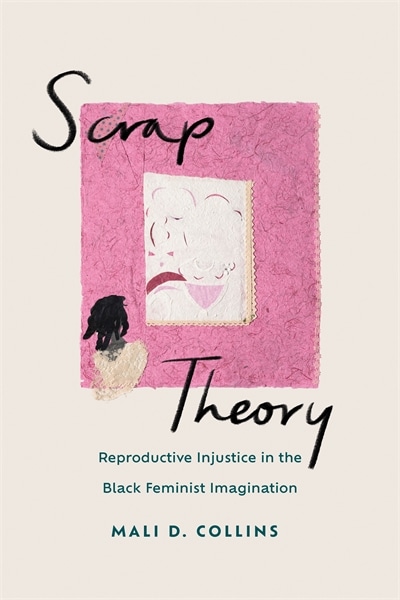
In Scrap Theory: Reproductive Injustice in the Black Feminist Imagination, Mali D. Collins opens with a haunting account of enslaved African women losing their children, a narrative choice that immediately grounds the book in the enduring realities of Black familial separation. Collins argues that these ruptures are not aberrations but structural features of American life, reproduced across generations and obscured within traditional archives. By foregrounding the archive’s limitations in capturing Black maternal experiences and mother–child dispossession, she reveals the gaps, silences, and violences embedded in the historical record.
Collins further draws readers in through her own narrative as the mother of a Black son, positioning her personal stakes as central to the project’s urgency. This maternal standpoint becomes the impetus for what she names scrap theory, a methodological framework that “search[es] for traces and fragmentations of Black reproductive life that exist without” (4). Scrap theory invites scholars to consider how remnants, overlooked materials, and incomplete collections can be mobilized to reconstruct histories of Black reproduction that the archive has disregarded or rendered illegible.
The book is organized into four chapters that collectively advance Collins’s formulation of scrap theory, each one engaging the creative works of Black women writers and artists. Chapter 1, “The Fictional Archive of Disappearance,” examines Toni Cade Bambara’s novel centered on a mother searching for her missing son for two years. Collins reads this narrative alongside the incomplete archival documentation of missing Black children in Atlanta, highlighting how fiction often preserves what official records neglect or erase.
Chapter 2, “Margaret Walker, Jubilee, and the Fight for Black Feminist Historicity in Alexander v. Haley,” turns to the poet, novelist, and educator Margaret Walker. Collins situates Walker’s novel Jubilee within broader conversations about cultural production, intellectual labor, and historical ownership. By juxtaposing Alex Haley’s Roots with Walker’s 600-page narrative of the Civil War and Reconstruction, Collins underscores the persistent struggle for Black women’s historical authority. Throughout this chapter, as in the book as a whole, she emphasizes memory-keeping as a crucial site of Black feminist resistance.
Chapter 3, “The Corporal Archive of Separation in Contemporary Black Women’s Cultural Production,” turns to literature and visual art to explore how the body becomes a site of historical memory. Drawing on Edwidge Danticat’s memoir Brother, I’m Dying, her novel Breath, Eyes, Memory, and M. NourbeSe Philip’s She Tries Her Tongue, Her Silence Softly Breaks, Collins examines how colonialism, migration, and reproductive vulnerability are inscribed on and through Black women’s bodies. She extends this analysis to contemporary visual artists, showing how their work reimagines reproduction, care, and the enduring technologies of colonial domination in the present. Collins’s theorization of “the body as archive” is especially valuable for researchers interested in embodiment, intergenerational memory, and Black feminist approaches to reading bodily knowledge as a form of historical documentation. Students and scholars alike will find this chapter a rich model for interdisciplinary analysis across memoir, poetry, and visual culture.
Chapter 4, “Refused Memorials and the Black Feminist Archival Praxis of Samaria Rice,” investigates the materials, objects, and physical remnants saved from the memorial dedicated to Tamir Rice. Collins situates Samaria Rice’s practices of preservation within broader conversations about space, memory, and the scraps left behind when Black children disappear or are taken by state violence. By examining how Rice salvaged items from a memorial slated for demolition, Collins demonstrates the everyday forms of archival caretaking that emerge from Black maternal grief. This chapter offers readers a powerful and deeply practical example of scrap theory in action, illustrating how nontraditional archives—objects, spaces, and community-created memorials—can serve as critical primary sources for understanding contemporary Black life. Researchers interested in community archiving, police violence, memory work, or Black maternal activism will find this chapter particularly illuminating.
Collins concludes by theorizing what she calls the Black maternal superbody, which she frames as “a call to action” that foregrounds the gendered and racialized traumas borne by Black mothers confronting reproductive injustice. Returning to the theme of Black maternal dispossession, she highlights the activism and sacrifices of Erica Garner as a contemporary embodiment of this struggle. Collins also emphasizes the wide-ranging research that undergirds the project, which spans personal narratives, archival documents, artistic productions, and museum exhibitions. In doing so, she draws attention to the contributions of Black women artists such as Elizabeth Catlett, whose work offers critical visual pathways for understanding Black reproductive life and memory. Through this interdisciplinary approach, Collins demonstrates how scrap theory compels readers to reckon with the Black children rendered invisible within official archives and public memory, urging scholars to attend to the fragments and remnants that preserve these histories.
Scrap Theory is essential reading for scholars of reproductive justice, Black feminist theory, and Black archival studies. Its blend of historical and contemporary analysis also makes it a valuable resource for undergraduate and graduate students in women’s, gender, and sexuality studies seeking to understand the long trajectory of reproductive injustice in Black communities.
About the Reviewer
Kimberly F. Monroe, PhD, is a writer, cultural curator, and associate professor of Africana Studies based in Washington, DC. A native of South Louisiana, her work examines Black radical traditions, historical memory, and global liberation movements. Her recent writing has appeared in Picturing Black History, The Funambulist, La Créole, and Spirit House: A Crossroads Project. She is currently completing her manuscript, The Black Underground: Assata Shakur and Global Freedom Struggles.
0