
The Book
Karl Marx in America
The Author(s)
Andrew Hartman
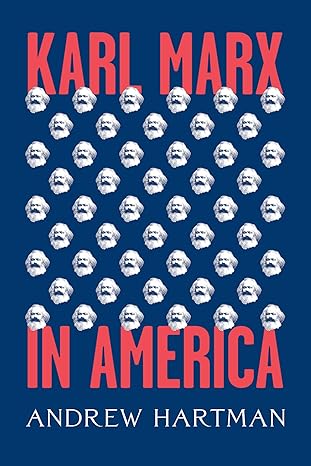
When thinking of Marxism as a political, socioeconomic, or philosophical doctrine, the United States is not the first country that comes to mind. Andrew Hartman’s new book challenges that impression, detailing the impact of Karl Marx’s ideas in the US, from the Civil War to the present. As befits the study of a thinker whose philosophy focused on the active transformation of the world, Hartman’s work is not just about intellectual influences but also considers Marxism’s relationship to political and social movements. Written in a clear and simple style, aiming at a broad audience of general educated readers, the book describes a plethora of individuals and intellectual currents—some familiar, others a discovery—carefully placed within their political, social, and economic contexts. At times, questionable judgements, lacunae, and problematic assumptions weaken the author’s account, although interesting assertions are always present.
The initial sections of the book, covering the years 1860-1914, record little interaction. Hartman discusses Marx’s views of the struggle against slavery and offers an overview of American dissident movements, but connections between Marx’s ideas and Abolitionism, the Knights of Labor, Henry George’s Single-Taxers, the Populists, the Progressives, or the IWW (Hartman tries, unconvincingly, to describe this syndicalist union as Marxist), are hard to ascertain. Marxism was almost entirely the property of immigrants who brought it to the US from their countries of origin—at first, Germans, later Jews from Eastern Europe—and who propagated Marxist ideas in the US Socialist Party. It was only in the early twentieth century that indigenous Marxist thinking developed among America’s bicoastal literati, including Jack London, Max Eastman, and John Reed.
The Russian Revolution dramatically expanded the reach of Marx’s ideas, in the US as in most of the extra-European world, and Hartman discusses conceptions of early American communists, such as Louis Fraina and Joseph Cannon. The revolution also brought the first wave of American anti-communism, the 1919 Red Scare, although its proponents did not really distinguish between Marxists and anarchists, or, more generally, suspicious foreigners. The Great Depression and the resulting crisis of capitalist society were tailor-made for followers of Marx. Hartman follows closely l930s leftist intellectual and cultural currents, focusing on Sidney Hook’s combination of Marxism and pragmatism, the literary critic V.F. Calverton’s conceptions of ideology, W.E.B. DuBois’s Marxist interpretations of American racism, and the artist Hugo Gellert, whose work foreshadowed contemporary graphic novels. Mass movements of the 1930s rejected long-standing endorsements of laissez-faire capitalism, and while Marxism was one intellectual current involved, so were others, deriving from the Progressives, the Populists, and Catholic social doctrines. It is regrettable that the author does not try to weigh the relative importance of these very different forms of thought.
The 1930s also saw the creation of a more intellectually sophisticated and specifically anti-Marxist anti-communism, which developed and expanded during the initial Cold War decades. Hartman provides a very useful guide to American anti-communism, distinguishing between its liberal and conservative strains. Adherents of the former, including Reinhold Niebuhr and Arther Schlesinger Jr., criticized Marxism as unscientific, condemning it as an ersatz religion, and unfavorably contrasting it with a positivist social science underlying liberal principles. If liberal anti-communists saw Marxism as a failed religion, their conservative counterparts, such as Whittaker Chambers or J. Edgar Hoover, denounced it for its hostility to religion, for its atheism and godlessness.
The author has less to say about American Marxists in the post-1945 decades, praising heavily the ideas of dissident Trotskyists C.L.R. James and Raya Dunayevskaya. He also discusses Paul Sweezy, the most important American Marxist economist, through his journal Monthly Review a very influential figure on the US left for half a century. Somewhat surprisingly, Hartmann has nothing to say about Sweezy’s opus magnum, his 1966 book Monopoly Capital, which attempted to update Marx’s economic treatise for mid-twentieth century America. Another unconsidered issue, particularly noticeable in this period, but ongoing throughout the century after 1917, is the consequence of American Marxists devoting a large portion of their time and their intellectual and political energy to defending purportedly Marxist regimes in the USSR, China, Cambodia, or, more recently, Cuba, Nicaragua, and Venezuela.
The 1960s were a decade of radical mass movements, which the author identifies with Marxism—a problematic interpretation, since central New Left documents, such as the Port Huron Statement, rejected classic Marxist ideas like the impoverishment of the workers or the inevitability of capitalist crisis. Hartman emphasizes similarities to the writings of the young Marx, then newly translated into English. This involves identifying alienation, for Marx a technical concept of Hegel’s philosophy, with diffuse feelings of anomie and discontent, understood in vaguely Existentialist fashion. Marxism made its appearance in the US radical student movement only at the moment of its collapse. The two groups that struggled for control of the corpse of SDS in 1969-70, the Revolutionary Youth Movement, the later Weather Underground, and the Maoists of the Progressive Labor Party, were all self-proclaimed Marxists. It is difficult to bring most of the African-American freedom struggle, such a crucial feature of the 1960s, dominated by Christian ideals and, later, Black nationalism, into connection with Marx’s doctrines. The one political group of the era that did consciously assert Marxist ideas, the Black Panthers, rates barely a mention.
The last quarter of the twentieth century was, for Hartman, a paradoxical era of the domination of a resurgent capitalism, defined by the neo-liberal unholy trinity of privatization, de-regulation and financialized globalization, and the simultaneously increasing influence of Marxist ideas in American academia. Hartman offers an analysis of historical studies, which he describes as the scholarly discipline most influenced by Marxism (more so than literary studies, sociology, or anthropology?). He contrasts Eugene Genovese’s Gramscian understanding of American slavery as pre- and anti-capitalist paternalism, with other historians’ identification with past popular struggles, under the influence of the Existentialist English Marxist, E.P. Thompson. The former ended up as an apologist for the slave South, while the latter rejected a systematic understanding of past societies. Briefly considering the ideas of Michel Foucault (but not those of Louis Althusser, very important at the time), Hartman does not mention the leftist historians, often connected to feminist and gay movements, who deployed structuralist and post-structuralist conceptions—Joan Scott, to take one prominent example, an ex-Marxist who argued that class was a discursive construct obscuring gendered social and historical structures. More broadly, the author has insightful discussions of African-American criticisms of Marxism but little to say about feminist ones.
Coming up toward the present, Hartman observes the growing frequency of mass movements aimed at particular elements of neo-liberalism, from the 1999 “Battle of Seattle,” to opposition to the US war in Iraq, to Occupy Wall Street, Black Lives Matter, and the strike wave of the early 2020s. Most participants, he argues, were animated by an American moralist leftism that condemned individual social and political evils but did not perceive their interconnections and embeddedness in a specific social and economic system. By contrast, the author praises “millennial Marxism,” articulated in the podcast Chapo Trap House, Jacobin magazine, or the Democratic Socialists of America, pointing to their 2016 attacks on neo-liberal Hilary Clinton. The results of that year’s presidential election and the subsequent decade of US history might cause one to wonder about this Marxist-inspired politics. More generally, the author does not consider the extent to which large portions of America’s population, particularly within the working class, have responded to neo-liberalism not by endorsing socialism but by supporting billionaires, cryptocurrency, protectionism, autarchy, and authoritarian government, while focusing their hatred on immigrants or racial and sexual minorities rather than on global capitalism.
In the end, the author’s findings at least in part undermine his own assertions of the significance of Marxism in American life. Thinkers whom he praises for their subtle and insightful deployment of Marxist ideas—Max Eastman, Louis Fraina, Sidney Hook, James Burnham, Martin Sklar, or Eugene Genovese—transitioned to anti-communism, ending up somewhere on the political spectrum between Cold War liberalism and right-wing extremism. Marxist ideas were most influential in the arts, and while the author’s accounts of Jack London, Hugo Gellert, or the Oakland rapper and film director Boots Riley are quite effective, two well-known, specifically Marxist novelists, Howard Fast and Norman Mailer, are absent from his text, which contains at best passing mentions of John Dos Passos, John Steinbeck, Langston Hughes, Richard Wright, Lilian Hellman, or Mary McCarthy. The Hollywood Ten appear as victims of the House Unamerican Activities Committee but not as Marxist screenwriters, directors, or actors working within the constraints of the studio system. Pro-capitalist ideas have always had a broad popularity in countries of the Anglosphere, especially the US, quite unlike conditions in continental Europe, Asia, or Latin America, and oppositional movements seem to have been largely inspired by the American moralist leftism the author decries rather than the Marxism he espouses.
About the Reviewer
Jonathan Sperber received his Ph.D. from the University of Chicago. From 1984 to 2019 he was affiliated with the department of history at the University of Missouri, where he is currently Curators’ Distinguished Professor of History, Emeritus. Sperber has written extensively on the social, political, and religious history of nineteenth century Europe. His best-known work is Karl Marx: A Nineteenth Century Life (2013) that was a finalist for the 2014 Pulitzer Prize in biography and has been translated into 9 foreign languages. As a retirement hobby, Sperber has taken up twentieth century history. His most recent book is The Age of Interconnection: A Global History of the Second Half of the Twentieth Century (2023); he is currently working on a study of the city of Berlin between the Airlift and the Wall, 1949-61.
0