
The Book
On Hunger
The Author(s)
Dana Simmons
“They say you gotta stay hungry. Hey baby, I’m just about starvin’ tonight.”
In Bruce Springsteen’s deceptively upbeat 1984 hit “Dancing in the Dark,” he describes a frustrated, working-class, would-be writer who just can’t seem to bring it together. Springsteen, in his elliptical way, conveyed the feeling of lostness that many felt in Ronald Reagan’s America of the early 1980s – even as the president hilariously tried to use the tragic “Born in the U.S.A.” as a campaign song.
What Springsteen was getting at is what it means to be “hungry” – the perennial Horatio Alger American story of someone who just wants something so bad they’ll work hard enough to get it. But the Boss says he’s not hungry, he’s starving.
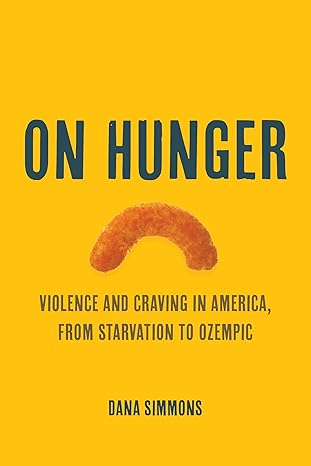
Dana Simmons’s new book, On Hunger: Violence and Craving in America, from Starvation to Ozempic puts my little pop-culture ditty introduction to shame. The author looks at hunger throughout United States history as a tool – a “technology,” as she calls it – designed to discipline and punish Native Americans, enslaved people, freedpeople, industrial workers, and welfare recipients since the beginning of our great republic.
On Hunger is well-written, lucid, and horrible. Simmons ties together stories we already kind of know about as historians – where do we even begin? General William Tecumseh Sherman learned that you could pacify a people by destroying every element of infrastructure – barns, horses, railroad lines – that kept them alive during the chaos of the U.S. Civil War in the South. Then he took this prized knowledge to the West, during the so-called Indian Wars of the 1870s and 1880s. Kill the bison for no reason whatsoever. Destroy the basis of subsistence: this is what in the twentieth century would become known as “total war.”
The unabashed sadism of what experts and politicians say in Simmons’s story is staggering, but should not be surprising to Americans today if they have been paying any attention at all to mainstream political discourse. Work or starve is the maxim of U.S. political culture throughout On Hunger, whether we’re talking about indigenous communities routinely robbed over and over of every inch of land they’d ever set foot on, or formerly enslaved people figuring out the contours of this narrow thing they could enjoy now called “freedom.” Any rational observer should be able to recognize how the Republican Party’s “big beautiful bill,” passed by Congress in 2025, insists on “work requirements” to receive Medicaid and SNAP benefits. If Simmons has taught us anything, it’s that the stick is always bigger than the carrot.
Simmons’s work is thorough and commendable, but this book is admittedly a hard read. The author spends quite a bit of time on Edward Thorndike’s experiments starving cats in the early twentieth century, as one of the foundational figures in the field of psychology, because to him hunger provided a measure that “could be controlled on an objectively measured scale, hours of deprivation” (p. 27). A rival psychologist, Robert Yerkes, insisted that Thorndike’s methods were inhumane and unethical, preferring to use electric shocks on monkeys in his own experiments. (Three years ago, Yerkes’s name was removed from the Emory National Primate Research Center because of his eugenicist views.). Yerkes is somehow the good guy in this story, but, as they say, it’s hard to be a saint in the city.
Most historians – and especially historians of science and intellectual history – are well aware of the dangers of ahistorically importing our own values into the past and condemning people for not living up to them. But honestly, one has to wonder what was going on with people like Thorndike and Yerkes, who were fixated on finding new and innovative ways to torture animals. You have to ask the question.
Simmons threads this story through the rest of the twentieth century in a striking way, linking everyone from cat-torturer Thorndike to civil rights activist Fannie Lou Hamer to prisoners wasting away on garbage non-food in Maryland and Oklahoma penal facilities. The crowning jewels of the story are, of course, Ozempic and Wegovy – the drugs that promise miraculous weight loss. For a culture that prizes slenderness and associates heaviness with lethargy, indulgence, and failure, it looks like the magic key has been unlocked. But what Simmons shows us is that from post-Civil War plantations to coal mines in Appalachia in the Depression and the welfare lines in the 1980s, work or starve has been the ethos of the United States. All of our values about virtue and decency and responsibility are bound up, somehow, in these measures of how you look, and how much you weigh – and how many cookies you’re allowed to take from the cookie jar.
As much as I admire this book, I was somewhat surprised by what Simmons left out. She nods a bit to this theme, but the hunger research of Thorndike was happening at the same time as Frank and Lillian Gilbreth and Frederick Taylor’s time-and-motion studies on industrial workers. To my mind, it seems pretty clear that the same sadistic and controlling impulse that gave rise to Taylorism and “scientific management” was being practiced on these poor kittens, rats, and monkeys from the 1900s to the 1920s.
Moreover, Simmons does not mention Amartya Sen – the Harvard economist and philosopher who has argued that famines basically don’t happen in democracies. Where democratic mechanisms are in place, Sen has proposed, food allocation happens on what we might think of as semi-reasonable lines. (He, of course, had in mind the unimaginable cruelties that the British and other empires visited on their colonial subjects.) What Simmons suggests is that a slow-motion famine has been going on for most of U.S. history – and even today at her place of work, the University of California at Riverside.
What is famine, then? Is it what at least a half or even two-thirds of her students at Riverside are experiencing, skipping meals to stretch their budget and avoid taking on more debt? Is it what my disabled aunt will experience once SNAP and Medicaid start enforcing work requirements, when she is literally not able to work? Is it the life of the young person who suffers from anorexia? Is it the prisoner in Oklahoma who has to eat the most degraded slop because incarcerated people in the U.S. are not considered to have a right to any kind of decent life? They say you gotta stay hungry.
About the Reviewer
Alex Sayf Cummings is a professor of History at Georgia State University. She is the author of Democracy of Sound (Oxford, 2013) and Brain Magnet (Columbia, 2020), a co-editor of the anthology East of East (Rutgers, 2020), and senior editor of the history blog Tropics of Meta.
0