
The Book
Why Everyone Hates White Liberals (Including White Liberals)
The Author(s)
Kevin Schultz
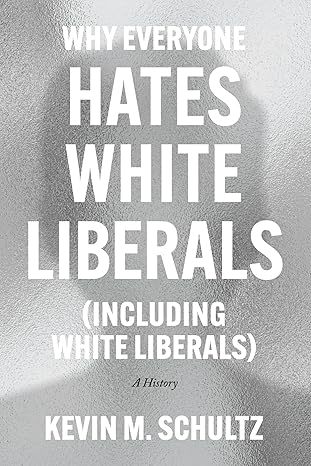
In Why Everyone Hates White Liberals (Including White Liberals), Kevin Schultz covers well-tread ground but offers an arresting way to frame his material, efficiently captured by the catchy title. He relates a story familiar to anyone with even a casual interest in either contemporary politics or postwar American history, covering the rise and fall of the New Deal order and the liberal consensus it rested on. Surveying the ruins of liberalism, Schultz offers a clear argument in response to the question the title proposes: “The short answer, then, as to why so many people hate white liberals is that it was an assassination.”[1] Attacks came from all sides, and under this onslaught the New Deal coalition collapsed.
Schultz chooses a reasonable place to begin this tragedy, declaring Franklin Delano Roosevelt “the first white liberal.”[2] This starting point has the virtue of identifying exactly what historical manifestation of liberalism Schultz is concerned with, which in today’s confused political discourse is worth clarifying. The chapters that follow make for precise, accessible reading, and they relate the basics of the post-60s political realignment reliably enough. Unfortunately, Schultz refrains from any deeper investigation, leaving his argument about assassination to simply be assumed correct, it appears, on the basis that sure enough!, many people said many mean things about white liberals.
This surface-level story telling characterizes the book from the start. Two-thirds into the first chapter, Schultz settles on a quote from Eleanor Roosevelt as his working definition of liberalism, an idea which, she says, is a “spirit,” which “rests on neither a set of dogmas or a blueprint,” and while flexibly applied to different contexts, is nonetheless “unchanging – a deep belief in the dignity of man and the power of free inquiry, a high sense of individual responsibility for oneself and one’s neighbor, a conviction that the best society is a brotherhood that enables the great numbers of its members to develop their potential to the utmost.”[3]
That this is a flattering definition is not necessarily a problem; however, that it keeps things quite vague is. Whatever liberalism is or isn’t, it certainly is not merely a “spirit,” or a mood, or a set of inclinations. That would describe an aesthetic or perhaps a musical style, but liberalism is a political ideology, and as such, it posits some fairly reliable positions on the fundamental questions of power and society. Most importantly, it is a political ideology of capitalism that, while recognizing the need to mitigate its worst effects, ultimately argues for its preservation.
Interestingly, it is in this same chapter that Shultz clearly, and repeatedly, acknowledges this. This makes sense, as he is obliged, given the context of the Great Depression and Roosevelt’s efforts to curb the abuses of “economic royalists,” to explain where New Deal liberalism came down on the question of capitalism. Yet it is equally striking because after Chapter 1, the term nearly disappears, and Schultz returns to a more opaque understanding of liberalism, referring to it once again as a “spirit.”[4] Chapter 1 marks the first and the last time that Schultz himself engages with deeper, structural definitions of liberalism – after this, we are simply informed when the critics of liberalism get it wrong, but not why they get it wrong.
And perhaps that would be fine if Schultz was writing an explicitly political book, with his only subjects as right-wing reactionaries, and his audience entirely liberals and leftists that, it could be safely assumed, do not need to have it explained to them that William F. Buckley, or Spiro Agnew, or Rush Limbaugh did not work with a historically grounded definition of liberalism. However, Schultz not only assumes the voice of the historian (as opposed to the partisan), but he also covers left wing critiques of liberalism, and by and large treats them with the same disinterested dismissal. Readers without a good knowledge of the civil rights movement or left-wing thought are left with the impression that, like the bigoted and anti-intellectual conservatives, left-wing radicals attacked liberalism illogically and without sound evidence.
This is most egregiously the case with Schultz’s chapter on the black radical critique. What is so stunning about his treatment here is not that he misrepresents or distorts the critique itself – on the contrary, the perspectives of black critics are faithfully relayed. In fact, Schultz even grants them the most generous concession he offers to liberalism’s critics in the entire book when he acknowledges that liberalism did indeed reject “more radical demands for equality.”[5] Yet instead of considering this a legitimate basis for a very real political conflict, Schultz proceeds as if the black critique was part and parcel of the unjust “assassination” on white liberals. After reviewing the critiques of James Baldwin, Martin Luther King, and Malcolm X, he declares: “The myth of the white liberal was set.”[6] But in what sense was it a myth? Why, in Schultz’s mind, did King “fall back” on this supposed myth out of disorienting frustration rather than rationally conclude it was, in fact, largely accurate?[7] When Stokely Carmichael dismissed liberals as allies, was it because he treated them as “the imagined oppressor” or because they actually were part of his oppression?[8] Schultz criticizes black radicals for adopting an “oppositional politics” towards liberals, but what other sort of politics are you supposed to adopt towards those who explicitly reject your agenda?[9] Schultz never answers these questions, because they’re not even asked; rather, Schultz allows his readers to assume the obvious and inherent unreasonableness of the black radical perspective, and presents white liberals as the victims.
Let me be clear: my criticism is not that Schultz and I clearly disagree about the accuracy of the black critique of liberalism. My criticism is that he does not even bother to mount an honest defense of his own, clearly subjective, read on the question. This is typical of the entire book. He does occasionally briefly gesture towards the merits of left-wing or historical critiques, but this engagement is limited to throwaway phrases which he never explains or unpacks.[10] Moreover, because he treats his own conclusions about these critiques as self-evident, he also refuses to engage with a whole body of scholarship which has been growing in size and significance for the past 20 years. Where, here, are the insights of Naomi Murakawa, who showed how Democratic liberals started the construction of the carceral state in the 1960s? Where is the (now widely accepted) understanding of racism without racists as deconstructed by Eduardo Bonilla-Silva? What about Elizabeth Hinton’s From The War on Poverty to the War on Crime, which complements and reinforces Murakawa’s thesis?[11]
A hint of an answer can be found in the introduction, where Schultz asserts that those who agree with the work of James Baldwin or Ibram X. Kendi harbor “perceptions [which] hardly have anything to do with liberals themselves.” While discussing the New Left perspective, Schultz also notes that it didn’t matter to leftists that “no self-respecting liberal would agree” with their criticisms, or that “real-life liberals” would define their ideology differently.[12] Does Schultz believe that the adherents to an ideology or political practice possess a final say, or effective veto, on the historical meaning of that ideology? It is not clear because again, Schultz doesn’t engage with questions that peel back the smooth surface of the narrative he is pursuing.
But the question is relevant, because postwar historians have been debating the question of “sincerity” (or self-understanding) for years now. Indeed, the problem of right-wing politics right up to the present moment revolves partly around explaining the success of a politics clearly drenched in racism, sexism and xenophobia without explicitly declaring itself proudly racist, sexist or xenophobic.[13] (Can they be fascists if they don’t call themselves fascists?) If we are not obliged to accept the self-understanding of say, J.D. Vance at face value, why are we obliged to take the self-understanding of Daniel Bell, Hubert Humphrey, or Daniel Patrick Moynihan at face value? And if we are, why is that? Perhaps because, as Schultz casually asserts several times, liberalism rests on a “rational basis” and “works best” when people engage in “reasonable debate”?[14] But is positing your protagonists as the (exceptional!) reasonable ones really a serious basis for historical analysis? Per Schultz, I’ll allow you to fill in my response.
This problem of refusing to pose or answer rather important historical questions persists throughout the book’s final third. Here Shultz rightly focuses on the toxic rhetoric of right-wing politics, which he acknowledges was overwhelmingly more historically consequential than any left-wing critique. Schultz does a commendable job of accurately summarizing the key talking points of the Right and their success in turning the term “liberal” into a caricatured accusation so tarnished that even liberals themselves sought to avoid it. But by and large, Schultz writes around the question of why conservative rhetoric proved so compelling to so many white Americans. The deep structural questions of power that most historians feel obliged to engage with do make brief appearances, but then are quickly brushed under the rug. So, although Schultz notes how the “feminization” of liberals was a part of the conservative attack from the start, neither the deeply gendered politics of McCarthyism or the backlash to the women’s movement are discussed.[15] Likewise, he concedes that “white exhaustion with civil rights and the sacrifices white people believed that they were being asked to make on its behalf,” played a role in the rise of Reagan Democrats, yet simultaneously argues that “race only played a part” in the white working class feeling abandoned by liberals; indeed, “perhaps even just a peripheral part.”[16] White Americans voted for George Wallace because he “voiced their frustrations and spoke plainly,” but “not because his politics were theirs.”[17] Exactly how we parse those two things so neatly – frustration with the civil rights movement and the politics of racism – is never clarified.
Even more sophisticated takes on the failures of liberalism are not honored with a serious examination. We learn that Theodore Lowi’s theory of regulatory capture “placed the blame squarely on liberalism,” but not whether or not Schultz thinks Lowi’s theory holds water.[18] On the chapter on neoliberalism, Schultz rightly characterizes neoliberal policy as first and foremost, a project of the Right, and relates how many liberals responded to age of Reagan by insisting that Democrats, too, needed to adopt more market-friendly policies. And yet the extent to which this was the case (as once again, a recent and large body of scholarship shows) is underplayed, and liberals once again end up looking like victims of a process they had no control over and possessed no agency to resist. Rather, liberals were “forced to own” neoliberalism.[19] As he puts it, “Poor liberals could never win.”[20]
This is not the entirety of Schultz’s argument, however. Why Everyone Hates White Liberals can also be understood as the latest entry in a long tradition of commentary that posits that something other than politics – as classically and commonly understood as a struggle over how power and resources are distributed – can still somehow explain American politics. From George Lakoff’s books about the psychology of the “political mind,” to Sean Wilentz’s attempts to tell a better story about the Democratic Party, to Daniel Rodgers’ story about a mysteriously contagious dynamic of “fracture,” liberals have thirsted for an explanation of the supposed false consciousness of Republican voters that will allow them to avoid ugly conclusions about the culture of the country.[21] In Schultz’s conclusion, this tradition makes its appearance in his promotion of the discussion of tribalism common since Donald Trump’s first presidential victory. In this telling, there is no rhyme, reason, or even dark human passions (the ‘isms’ of bigotry) behind the rise of MAGA – it is an empty vessel that propels itself solely on the glee of “owning the libs.”[22] To be clear, applying the dynamics of tribalism to our current predicament does have its merits; but if so many Americans are addicted to resentment, the next question to ask should be, why does our country produce so many people who can’t resist being assholes? On its own, the tribalism thesis simply posits a dynamic of human nature which, while undeniable, can be called on to explain events as diverse as MAGA and the destruction of Rome by Germanic peoples. One would think you would need to get a bit more historically specific. In a history book, at least.
But whether or not Schultz has written a history book is open for debate. That this book relates things that happened and relates them accurately is undeniable. But whether it succeeds in making a causal argument about why those things happened is, well, arguable. Schultz never dives below the surface of the rhetorical moves and discourse he maps, and so manages to write 200+ pages on the last 100 years of liberalism without saying much of anything about the fundamentals of American political culture. Maybe I’m just old fashioned – or a leftist! – but I think that should always remain the goal which historians set for themselves.
[1] Kevin M. Schultz, Why Everyone Hates White Liberals (Including White Liberals) (Chicago and London: The University of Chicago Press, 2025), 4.
[2] Schultz, Why Everyone Hates White Liberals, 11.
[3] Schultz, Why Everyone Hates White Liberals, 27.
[4] Schultz, Why Everyone Hates White Liberals, 137.
[5] Schultz, Why Everyone Hates White Liberals, 92.
[6] Schultz, Why Everyone Hates White Liberals, 96.
[7] Schultz, Why Everyone Hates White Liberals, 93.
[8] Schultz, Why Everyone Hates White Liberals, 97.
[9] Schultz, Why Everyone Hates White Liberals, 97.
[10] Alinksy “may have been on to something,” the late 1950s critique of corporate liberalism was “solid,” (although he qualifies this by referring to liberalism’s “‘supposed’ embrace of corporate capitalism”), “there was a kernel of truth in the left-wing critique against postwar liberalism,” the New left initially had an “admirable and pointed critique of postwar liberalism,” Michael Harrington wrote a “thoughtful” column on “liberalism’s inherent conservativism,” and Mike Davis worried about business friendly Democrats “not without reason” (63, 65, 70, 79, 149, 175). In all of these cases, Schultz never explains his qualifiers and immediately resumes his narrative.
[11] Naomi Murakawa, The First Civil Right: How Liberals Built Prison America (Oxford University Press, 2014), Eduardo Bonilla-Silva, Racism Without Racists: Color-Blind Racism and the Persistence of Racial Inequality in the United States (Lanham: Rowman & Littlefield Publishers, 2010), and Elizabeth Hinton, From the War on Poverty to the War on Crime: The Making of Mass Incarceration in America (Cambridge: Harvard University Press, 2016). This of course is a very small list; pages could be filled with works in just the last 15 years that should, collectively, make Schultz’s breezy and just-so understandings of liberalism untenable.
[12] Schultz, Why Everyone Hates White Liberals, 8, 61, 79.
[13] I weighed in on this question almost a decade ago on the S-USIH blog; see Robin Averbeck, “Sincerity Is Not The Same Thing As Accuracy,” December 3, 2015. Accessed: https://s-usih.org/2015/12/sincerity-is-not-the-same-thing-as-accuracy/#comments, and again the next year in “Sincerely and Seriously Wrong,” April 21, 2016. Accessed: https://s-usih.org/2016/04/sincerely-and-seriously-wrong/#comments
[14] Schultz, Why Everyone Hates White Liberals, 122, 84.
[15] Schultz, Why Everyone Hates White Liberals, 44, and the issue of feminization briefly reoccurs on pages 47 and 54. The literature being ignored here is, once again, last, but the flagship studies in regard to both gender and McCarthyism and backlash to feminism are David K. Johnson, The Lavender Scare: The Cold War Persecution of Gays and Lesbians in the Federal Government (Chicago: The University of Chicago Press, 2004), and Susan Faludi, Backlash: The Undeclared War Against American Women (New York: Crown Publishing Group, 1991).
[16] Schultz, Why Everyone Hates White Liberals, 131, 130.
[17] Schultz, Why Everyone Hates White Liberals, 132.
[18] Schultz, Why Everyone Hates White Liberals, 147.
[19] Schultz, Why Everyone Hates White Liberals, 208. The most important book on the Democratic abandonment of the working class is, in my mind, Judith Stein’s Pivotal Decade: How the United States Traded Factories for Finance in the 1970s (New Haven: Yale University Press, 2011).
[20] Schultz, Why Everyone Hates White Liberals, 181.
[21] I’m thinking here in particular of this body of work as pointed out by Alan Taylor in his review of Sean Wilentz’ The Rise of American Democracy, “Democratic Storytelling,” The American Prospect, October 23, 2005. Accessed: https://prospect.org/culture/democratic-storytelling/ Daniel T. Rodger’s book came out several years later; Age of Fracture (Cambridge: The Belknap Press of Harvard University Press, 2011).
[22] Schultz, Why Everyone Hates White Liberals, 208-210.
About the Reviewer
Robin Marie Averbeck received a Bachelor of Arts in Political Science (Political Theory) and History from UC San Diego in 2006. In 2013 she completed her PhD in American History at UC Davis. Her book, Liberalism Is Not Enough, was published with UNC Press in 2018. She has also published essays with Jacobin, Democracy, The North Meridian Review, and the Boston Review. Since 2018, she has been a lecturer in the History Department at CSU, Chico. Since 2020, she has been the Membership & Organizing Chair for the Chico Chapter of the California Faculty Association (CFA), the union for all faculty members across the CSU system. Since summer of 2024, she has been on the Steering Committee of the Caucus of Rank and File Workers (CREW), an unofficial caucus within CFA working to democratize the union.
0