
The Book
Nothing Less Than Equality: The Battle over Segregated Education in the Nation’s Capital
The Author(s)
Tikia K. Hamilton
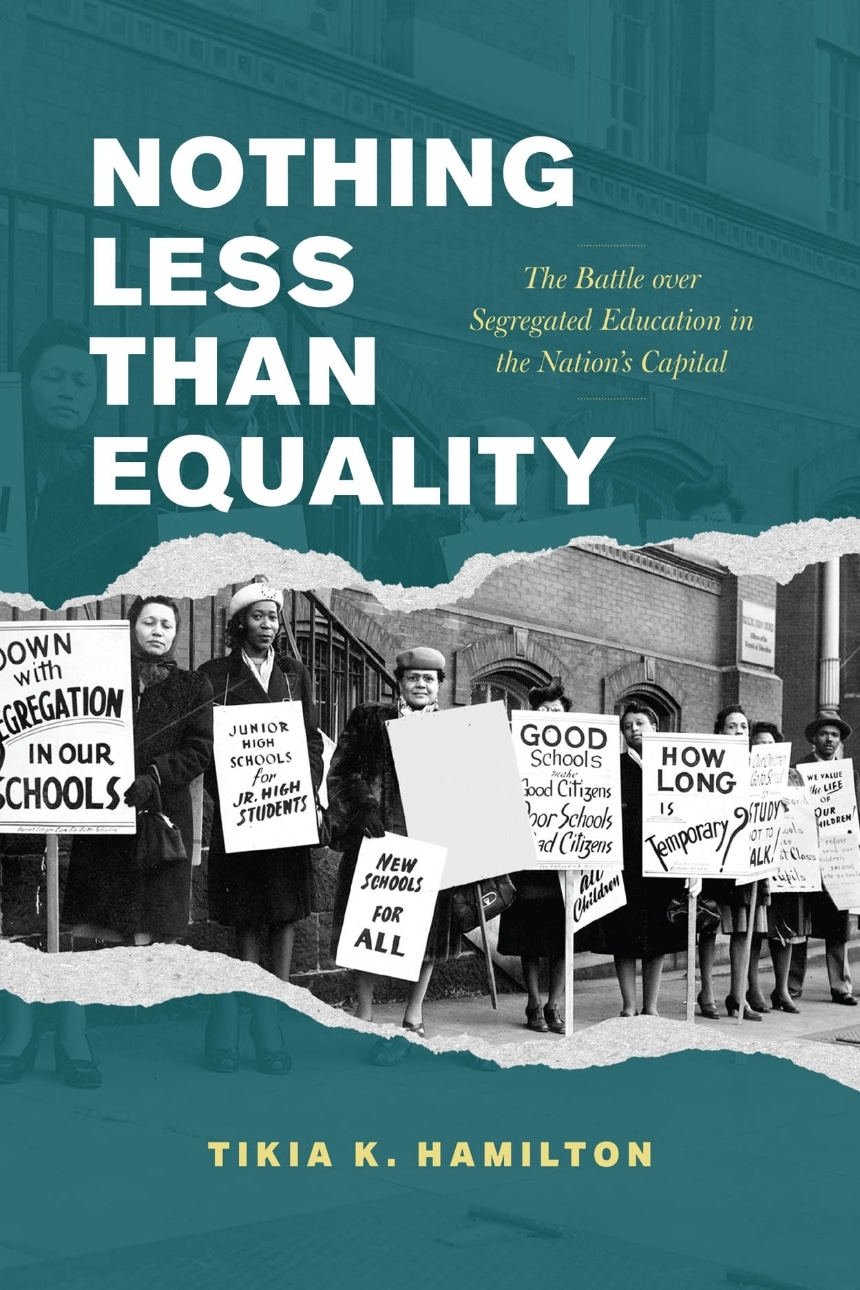
In Nothing Less Than Equality: The Battle Over Segregated Education in the Nation’s Capital, historian Tikia K. Hamilton offers a detailed history of Black segregated schooling in Washington, DC. Much has been written about the famous M Street High School and Dunbar High School and their tradition of excellence, but the field of African American educational history has lacked a comprehensive study of Black schools in DC. Hamilton addresses this void by examining events behind the scenes and telling intriguing stories about DC schools that most of us have never heard. In this brief review, I will discuss three chapters from the book.
The book includes an introduction, seven chapters, and an epilogue. Hamilton’s introduction immediately gets to her point and argument: “The idea that Washington’s school system served as a ‘model’ for segregation was ironic, especially coming from the ‘chief architect of legal desegregation’” (p. 1). Hamilton offers more than a descriptive narrative of who did what, where, and when; instead, she promises to interrogate the idea of the ideal “model” of segregated education, implying her offering of more than a social study of schools. The book is also a study of ideas–intellectual history.
Chapter 1 notes that free public education was not generally supported in Washington, DC in the early years of the republic. Further, during the antebellum period, public schools in Washington, DC, were dilapidated and not a priority of local government. Despite lax support for schools, Black Washingtonians persisted in establishing good schools for themselves. During the antebellum period and the nineteenth century, Hamilton shows African Americans’ strong advocacy for education–so much so that they educated themselves in their churches, homes, and other spaces in the community. Hamilton further notes: “In the early nineteenth century, African Americans gained well-established authority over the District’s expanding number of Black schools. In doing so, they laid the foundation for public education in the post-Civil War era, much like their counterparts in the American South.” (p. 22). The details provided in the chapter push beyond the somewhat cliché notion of racial uplift of the period and explicitly show Black Americans’ pragmatic politics and activism to secure education for Black people.
Chapter 3 is another standout chapter. I was unaware of the Marian Anderson story pertaining to African American education. A famous African American opera singer, Anderson was denied an opportunity to sing at Constitution Hall and later Central High School because of her race. Ultimately, Anderson sang at the Lincoln Memorial. Hamilton shows us how the event illuminated larger issues of school segregation and educational opportunity around the district’s refusal to allow Anderson to perform at Central High School. Hamilton notes: “few have explored how an increasing groundswell of African American residents strategically leveraged the events as an opportunity to broadcast the city’s widening educational disparities.” (p.84)
Chapter 6 also offers excellent analysis. Hamilton begins with the story of African American student Roberto Whisonant’s attempt to enroll at the all-white Central High School. The segregated Black high schools, such as Cardozo, were overcrowded and dilapidated. Despite its conditions, Cardozo was known as an excellent school. By the late 1940s, the school was in a crisis. Hamilton notes that faculty scrambled to find spaces within the school to teach their classes. School equipment was outdated or non-existent in some cases, which contributed to the school’s increasing dropout rate. This incident was an example of the challenges Black people faced regarding their education well into the twentieth century.
Nothing Less Than Equality is a fresh empirical study of African American education with segregated schooling in Washington, DC. As a case study, the book operates on two levels. First, it provides an up-to-date examination of Black history in Washington, DC, offering an excellent contribution to the recent scholarship in the area. Second, the book provides a much-needed addition to the historiography in African American history and education. The content of the book is outstanding, and Hamilton’s use of an array of archives and primary sources and her methodology is informative for historians desiring to do this type of highly extensive and efficient scholarship. Hamilton’s endnotes are a smorgasbord of data on Black education and provide further evidence of her command of the topic. The book is destined to become the authoritative study on Black education and schooling in Washington, DC and we have Professor Tikia K. Hamilton to thank for gifting us this treasure.
About the Reviewer
Derrick P. Alridge is retired from the University of Virginia, where he is the Philip J. Gibson Professor Emeritus of Education. An educational and intellectual historian, Alridge has authored books and articles on U.S. education, history, and intellectual life. In retirement, he pursues independent scholarship, creative writing, and work with the newly formed Teachers in the Movement Institute, which builds on his earlier Teachers in the Movement Project and documents the lives, work, and intellectual contributions of teachers from 1980 to the present.
0