
The Book
Thy Will Be Done: George Washington’s Legacy of Slavery and the Fight for American Memory
The Author(s)
John Garrison Marks
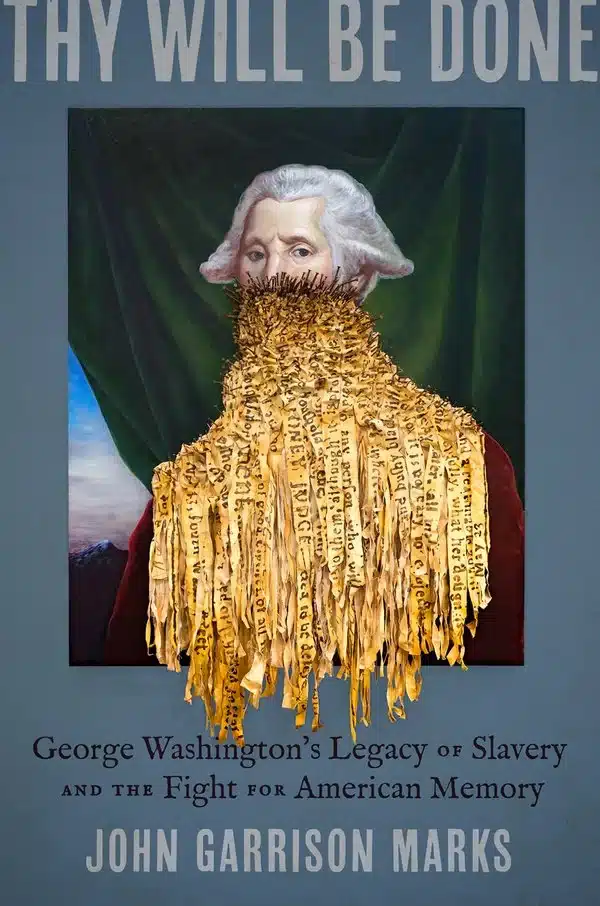
George Washington’s career as an enslaver does not yet loom large in American public memory. More than a million visitors—including hundreds of thousands of school children—now swarm the beautifully curated grounds of his plantation home Mount Vernon every year, framing evocative images of the “father of his country” at every turn. In marked contrast, the hundreds of enslaved people who made the place work are conspicuously absent, spectral images in a nostalgic haze. But this is beginning to change, thanks to the hard work of the League of Descendants of Slavery, the commitment of the Mount Vernon Ladies Association (MVLA), and important new scholarship by Henry Wiencek, Erica Dunbar, Matthew Costello, and MVLA historian Mary Thompson and her colleagues. John Garrison Marks’s new book reviews and contributes to this new literature, most notably by reconstructing the families and tracing the histories of the enslaved people Washington emancipated in his will.
As a public historian, Marks also focuses on the present moment, surveying the ways in which Americans through history have understood (and overlooked) Washington as an enslaver (and emancipator) in order to “better understand the past’s most challenging questions and collaborate to build a more just future.”[1] Thy Will Be Done thus chronicles an ongoing work-in-progress, animated by the author’s ardent hopes and shadowed by profound anxieties that his—and America’s—project might very well fail. Can the Washington emerging from contemporary critical scholarship, in the company of the people he once claimed to own, serve as a focal point of a renewed, more inclusive, and “more just” national narrative? Can the “will” of Marks’s title—alluding to the enduring legacy of Washington’s last words, his will and testament—be finally “done” and the “unity of the new nation” he so cherished be preserved?[2]
“When it comes to Washington and slavery,” Marks writes, “Americans have been mostly running in circles for two centuries.”[3] But the first president’s slaveholding was not an urgent problem for most of those years. The “profound” and “enduring ambiguity of Washington’s legacy” is more a function of our post-revisionist moment than an apt description of his image in the American mind.[4] What we know now, thanks to the good work of Marks and his colleagues, understandably troubles us. Yet contemporaries who were well aware of Washington’s status as a slaveholder—and posthumous emancipator—had little critical to say about Washington in the years after his death: even as the sectional crisis over the future of slavery threatened the union’s survival, he remained a “unifying national symbol,”[5] Abolitionists might criticize the “slave hunter” who sought—and failed—to recover Ona Judge, his self-emancipated human “property,” but were more likely to burnish his credentials as an emancipator.[6] Anticipating the war to come, some even invoked the commander-in-chief’s recourse to “violence to secure human liberty” in the American Revolution as a spur to antislavery mobilization.[7] When the war came, northerners mobilized to preserve (or restore) a union that enslavers like Washington and Jefferson had helped create, embracing the exalted principles that supposedly animated them, and ultimately justified slavery’s destruction.
The first half of Thy Will Be Done lacks a clear narrative arc. Washington’s relation to slavery and his enslaved people did not figure significantly in the national imaginary until the twentieth century. Marks’s story only begins to take shape in chapter five, with the formation of a national commission to commemorate the bicentennial of Washington’s birth in 1932. Seeking to spur civic renewal at a moment of deepening national malaise, commissioners promoted research, interpretation, and celebration of anything and everything connected with the life and times of the country’s father figure. Biographers, editors, and curators fed a growing popular appetite for what we now call “public history,” previewing the current efforts of Marks and fellow workers in the field. Not surprisingly, however, the bicentennial commission’s comprehensive approach failed in one, increasingly conspicuous respect, by not focusing on the enslaved people who made Washington’s life and lifestyle possible. That failure was made conspicuous by Black intellectuals and activists, including W. E. B. Dubois—who organized a critical counter-commemoration—and Walter H. Mazyck—author of Geoge Washington and the Negro (1932), a path-breaking scholarly monograph that “made the stakes of the commemoration clear.”[8] In effect, the official commemoration invited a dialogue, or “conversation” that set the stage for our emerging understanding of Washington, race, and slavery. Engaged Blacks found and focused their patriotic voice; efforts to bring Washington back to life, in his “real world,” gave them their platform.
In another world, the ongoing progress of this conversation would be an inspiring, redemptive story of how “Americans” came to understand themselves as a progressively more inclusive people. But another, less civil conversation pitting “heritage Americans” in the MAGA movement against defenders of diversity threatens to drown out—and so silence—Marks’s progressive narrative. Yet beneath the din, public historians still discern progress. Inspired by the Civil Rights Movement, revisionist scholarship on race and slavery made the period of 1960s to 1980s the “pivotal moment for the dissemination of more diverse perspectives” in American classrooms; ongoing interest and investment in the letters and papers, artifacts, homes, plantations, and communities—free and enslaved—within which slaveholding founders moved has enabled public-facing historians and interpreters to bring those perspectives home, literally and metaphorically.[9] Summarizing research on visitor response to the new interpretative regime, Marks reports that “Americans express a desire to learn the whole history of the country,” concluding that Mount Vernon (and other historic sites), “can place slavery at the center of its story.”[10] We cannot know if they will do so, given the determination of right-wing culture warriors, chronicled by Marks in illuminating chapters on the educational and historic house battlefronts, to cancel the hard-won achievements of scholars and activists.
Marks’s fundamental engagement is in the trenches, with front-line interpreters of our national narrative at places like Mount Vernon. Undoubtedly there is more to be done in the ongoing negotiations with the League of Descendants and other interested parties, and Marks acknowledges that he struggles to take “the right approach or whether a ‘right approach’ really exists at all.”[11] But he also recognizes that this dynamic, open-ended uncertainty is itself the predicate of the public discourse that animates democracy. So too, “there is no better place than Mount Vernon for conversations about the complex and often ambiguous legacy of Washington and slavery.”[12] Yet I wonder about Marks’s oft-expressed “ambiguity.” There’s nothing ambiguous about the status and life experiences of enslaved people at Mount Vernon—though we wish we knew more. Nor should there be any ambiguity about “Washington’s contributions to the nation”—though, again, there’s more to be known. Marks wants us to “balance” those contributions “with his involvement in slavery.”[13] I suggest instead that we need to incorporate them in the same story—our national history—as we unambiguously confront and never forget the horrors and injustices of racial slavery. Balance is a zero-sum game, which each side will seek to win at the other’s expense. Given the contemporary alignment of forces, a strong defensive posture is indicated: academic and public historians must continue to tell the stories most Americans need (and want) to hear.
[1] John Garrison Marks, Thy Will Be Done: George Washington’s Legacy of Slavery and the Fight for American Memory. Chapel Hill: University of North Carolina Press, 2026), 11.
[2] Ibid., 5.
[3] Ibid., 10.
[4] Ibid., 39, 81.
[5] Ibid., 55.
[6] Ibid., 112.
[7] Ibid., 115.
[8] Ibid., 154.
[9] Ibid., 173.
[10] Ibid, 218.
[11] Ibid, 226.
[12] Ibid., 227.
[13] Ibid.
About the Reviewer
Peter S. Onuf is the Thomas Jefferson Memorial Foundation Professor Emeritus in the Corcoran Department of History at the University of Virginia. A specialist in the history of the early American republic, Onuf was educated at Johns Hopkins University, where he received his A.B. in 1967 and Ph.D. in 1973, and has taught at Columbia University, Worcester Polytechnic Institute, and Southern Methodist University before arriving in Virginia in 1990. In 2008-2009 Onuf was Harmsworth Professor of American History at the University of Oxford; in 2014, he was elected to the American Academy of Arts and Sciences.
Onuf’s early scholarship, focusing on federalism and territorial expansion, includes The Origins of the Federal Republic: Jurisdictional Conflicts in the United States (University of Pennsylvania Press, 1983) and Statehood and Union: A History of the Northwest Ordinance (Indiana University Press, 1987). He collaborated with his brother, international relations theorist Nicholas G. Onuf, on Federal Union, Modern World: The Law of Nations in an Age of Revolutions, 1776-1814 (Madison House, 1993) and Nations, Markets, and War: Modern History and the American Civil War (University of Virginia Press, 2006), and is the author, coauthor, editor, or co-editor of numerous other publications.
Onuf’s work on Thomas Jefferson’s political thought, culminating in Jefferson’s Empire: The Language of American Nationhood (University Press of Virginia, 2000) and The Mind of Thomas Jefferson (2007, also Virginia), grows out of earlier studies on the history of American federalism, foreign policy, and political economy. He and co-author Annette Gordon-Reed published Most Blessed of Patriarchs: Thomas Jefferson and the Empire of the Imagination (Liveright, 2016); his Jefferson and the Virginians: Democracy, Constitutions, and Empire was published in 2018 by Louisiana State University Press. With Ed Ayers and Brian Balogh, Onuf was founding co-host of the public radio program “Backstory with the American History Guys” (www.backstoryradio.org).
0