
The Book
The Trinity: John F. Kennedy, Lyndon Johnson, and Civil Rights in African American Memory
The Author(s)
Sharron Wilkins Conrad
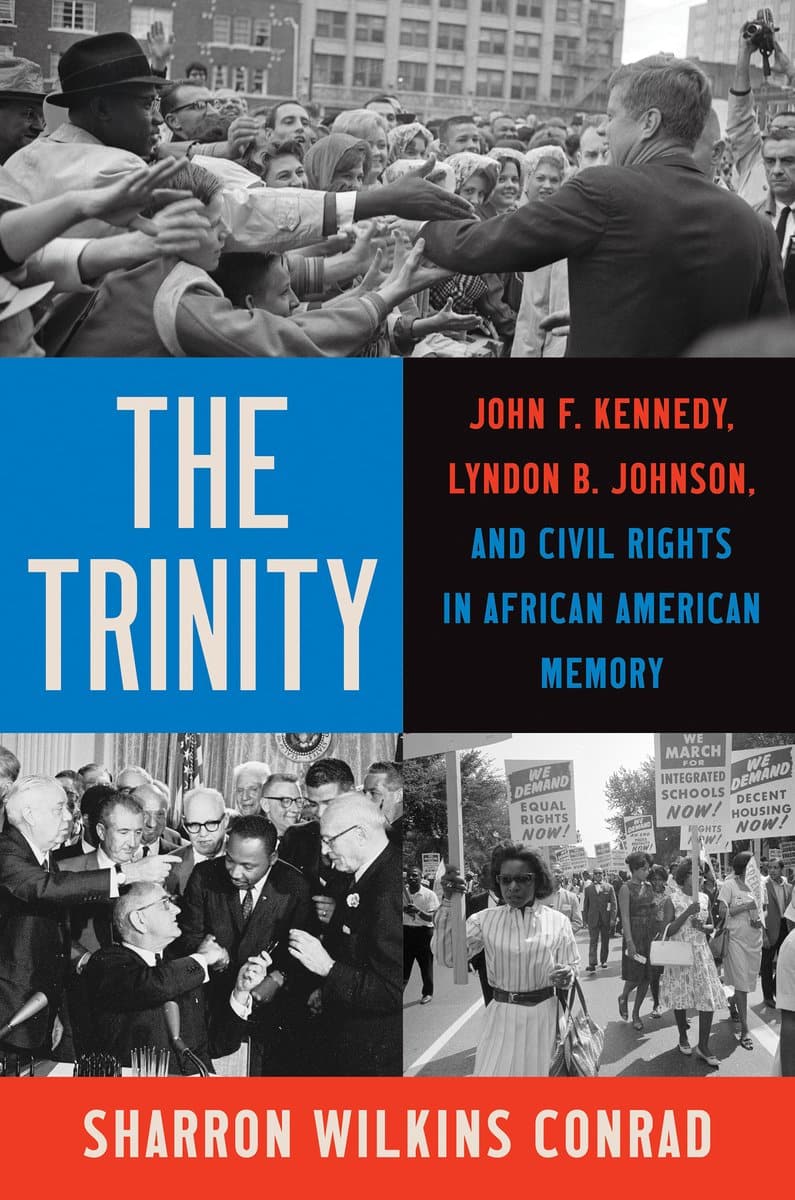
The writing of history and the formulation of memory are both constructed. They differ in that historical interpretation depends on written and oral sources as well as material artifacts. The shaping of memory relies less on hard evidence and more on the fact that individuals and “[s]ocieties construct themselves around narratives they consider important enough to preserve and transmit.”[1] We choose to remember the past in ways that satisfy our needs in the present. When conditions alter, the memories that suited previous generations may be transformed or discarded as no longer relevant. History is supposed to correct memories that have turned into myths. Yet it is not that simple as even historical interpretations shift to accommodate different conditions and perspectives once considered true. In 1959, the distinguished African American novelist and critic, Ralph Ellison, summed up the tension between history and memory: “That which we do is what we are,” he wrote. “That which we remember is, more often than not, that which we would like to have been or that which we hope to be. Thus [,] our own memory and our identity are ever at odds, our history ever a tall tale told by inattentive idealists.”[2]
Sharron Wilkes Conrad seeks to bridge the gap between history and memory as it relates to the civil rights achievements of Presidents John F. Kennedy (JFK) and Lyndon B. Johnson (LBJ). She attempts to explain why in their memories African Americans revere Kennedy while Johnson commands little respect. As she points out, this difference in the evaluation of the two men conflicts with the scholarly consensus that in the field of civil rights Johnson accomplished much more than his predecessor. Conrad’s interest in this paradox springs from her awareness, as a young Black woman, of her godmother displaying on a wall in her home, what she labels the “Trinity”: photographs of Jesus, Martin Luther King, Jr., and John F. Kennedy. In other Black homes, the Trinity may have expanded to include Presidents Abraham Lincoln or Franklin D. Roosevelt, but rarely if ever, LBJ.
To probe the mystery of this omission, the author poses a series of questions. First, how did JFK acquire the reputation as a civil rights hero among Blacks, while Johnson was considered a flawed ally? Second, how do you explain the persistence of the Trinity image sixty years after its creation? Third, what does this say about the relationship between African Americans and the positioning of the presidency in their collective memories?
Conrad provides answers to these questions through the exploration of Black sources. Adopting an interdisciplinary approach, she ranges over works of political science, history, and cultural studies. She draws much of her findings from oral history interviews, letters to the presidents found in White House files, public history (museums and exhibitions), and films and music. Throughout her study, she makes excellent use of evidence culled from Black newspapers. She’s not the first to make use of these sources, but she succeeds in giving them a new twist. Having been the director of education and public programs at the Sixth-Floor Museum at Dealey Plaza in Dallas, Texas, which included oral history projects, she is well qualified to undertake this task. In Trinity, she examines two kinds of oral history. One set derives from the recollections of African Americans who participated in the Kennedy and Johnson administrations. The other concerns the assessments of Blacks who shared their reminiscences at the Dallas museum and other public history sites. These interviews highlight the gap between the reality that LBJ’s civil rights record exceeded that of JFK and the memories of African Americans that Kennedy deserves more credit, respect, and affection than his successor. Drawing upon insights of the political scientist and anthropologist James C. Scott and the historian Robin Kelley (whom she does not cite), she calls these personal views of Blacks, the “hidden transcript,” generally unseen by whites.[3]
Despite her focus on Black sources, Conrad does not reveal much new about the comparative accomplishments of the Kennedy and Johnson presidencies. This stems from the fact that historians and political scientists have long had access to the abundant sources housed in the Kennedy and Johnson presidential libraries and have used them extensively. Nothing that the author reveals alters the consensus judgement that Johnson, not Kennedy, deserves recognition as the “civil rights president.” Kennedy’s assassination may have provided fuel for the passage of the 1964 Civil Rights Act, but it does not match the legislative skills of former Democratic Senate Majority Leader Johnson to turn sentiment into complex law. Kennedy’s sudden death had even less to do with passage of the 1965 Voting Rights Act and the signing into law of the 1968 Housing Act (which ranged far beyond Kennedy’s weak executive housing order in 1962) under turbulent and unfavorable political conditions.
However, in a book focused on Black memory rather than historical reality, Conrad offers significant insights into a difference in perspective among civil rights historians. By concentrating on the Black hidden transcript, she reveals that African Americans have had a special regard for the institution of the American presidency and the men who sat in the White House for better (JFK, LBJ, Bill Clinton) and for worse (Ronald Reagan and Donald Trump). This devotion was cemented in the elections of Barack Obama.
This Black faith in the presidency moves in the opposite direction of the interpretive road taken by civil rights scholars who have decentered the presidency and Black leaders like Dr. King in favor of local people in Black communities whose names have gone unrecorded for too long in standard history textbooks. While Conrad restores attention on the national side of the civil rights movement, she misinterprets what historians have been doing. She claims that scholars have focused on federal officials and national Black leaders and neglected “the views of African American leaders, intellectuals, and everyday citizens.”[4]This has not been true for decades, as historians increasingly stressed the importance of grassroots history in works like John Dittmer’s Local People.[5]
Conrad ignores another critical change in civil rights movement history: the significance of women in the struggle, like Ella Baker, Daisy Bates, Fannie Lou Hamer, and Unita Blackwell to name a few. She makes a glancing mention of some of these but fails to emphasize that the Trinity in its original and expanded version excludes women. This makes sense as long as she accentuates African American preoccupation with the presidency. Her book calls for the uniqueness of Black memory, but it begs the question of how Black women fit into an analysis that foregrounds presidential politics and a male-centered Trinity. While the election of Kamala Harris to the presidency in 2024 might have changed this, the memory of women’s critical roles in the movement do not depend on a women sitting in the White House.
This brings us to the original question: why did LBJ not find his way into the Trinity? Conrad explores several possible answers, two of which are most persuasive. First, Johnson was a white southerner who, as a legislator, supported racial segregation and opposed civil rights bills. Although his views on racial equality changed significantly over time, many Black southerners remained skeptical of the sincerity of his transformation. He could not shed his southern accent or crude social behavior, and many Black observers continued to see him, as Ralph Ellison put it in Conrad’s quotation, as “the flawed white southerner.”[6]Why southern Blacks, raised in a church tradition of forgiveness and redemption, did not extend those values to LBJ remains unexplored and unanswered.
Second and more importantly, LBJ survived and JFK did not. Like Jesus, Abraham Lincoln, and Martin Luther King, Jr., Kennedy became a martyr. In his final months in office, he took a moral, and not just political, stand on achieving civil rights. Many African Americans viewed his assassination as a martyrdom for racial equality. Johnson, despite displaying his own moral position toward civil rights in a notable speech to Congress on behalf of the Voting Rights and another address at Howard University in 1965 in support of affirmative action, could not claim such martyrdom, which excluded him from theTrinity.
Conrad’s blend of political, cultural, and social histories will appeal to many scholars. Along with other recent researchers, she uncovers a transcript in Black history that is no longer hidden.[7] In fact, African Americans do not need to hide their memories and dreams as historians of the civil rights movement have made their thoughts and actions visible. At the same time, Conrad restores some balance in civil rights historiography by demonstrating the importance of the presidency in shaping the memories of ordinary African Americans and emphasizing the interaction between the local and the national, the great leaders and the foot soldiers.
[1] Lola Lafon, When You Listen to This Song: On Memory, Loss, and Writing, trans. Lauren Elkin (New Haven: Yale University Press, 2025), 77. This is a memoir by a French writer who seeks to understand the physical and psychological challenges of Anne Frank in her attempt to hide from the Nazis during World War II.
[2] Sharon Wilkins Conrad, The Trinity: John F. Kennedy, Lyndon B. Johnson, and Civil Rights in
African American Memory (Chapel Hill: University of North Carolina Press, 2026), 1.
[3] Robin D. G. Kelley, “‘We Are Not What We Seem’: Rethinking Black Working-Class
Opposition in the Jim Crow South,” Journal of American History 80, no. 1 (June 1993): 75-112.
[4] Conrad, The Trinity, 9-10
[5] John Dittmer, Local People: The Struggle for Civil Rights in Mississippi (Urbana: University of Illinois Press, 1994). Even before Dittmer, historians had been producing community studies. For example, see William H. Chafe, Civilities and Civil Rights: Greensboro, North Carolina and the Black Freedom Struggle (New York: Oxford University Press, 1980).
[6] Conrad, The Trinity, 182.
[7] For example, see Lawrence W. Levine, Black Culture and Black Consciousness: African American Folk Thought from Slavery to Freedom (New York: Oxford University Press, 1977; Emilye Crosby, A Little Taste of Freedom: The Black Freedom Struggle in Claiborne County, Mississippi (University of North Carolina Press, 2005, and Hasan Jeffries, Bloody Lowndes: Civil Rights and Black Power in Alabama’s Black Belt (New York: New York University Press, 2009). The literature on this subject is too numerous to enumerate here.
About the Reviewer
Steven F. Lawson is Professor emeritus in History at Rutgers University, New Brunswick. He is the author of books and articles on the civil rights movement, voting rights, and Black politics.
0