
The Book
Illiberal America: A History
The Author(s)
Steven Hahn
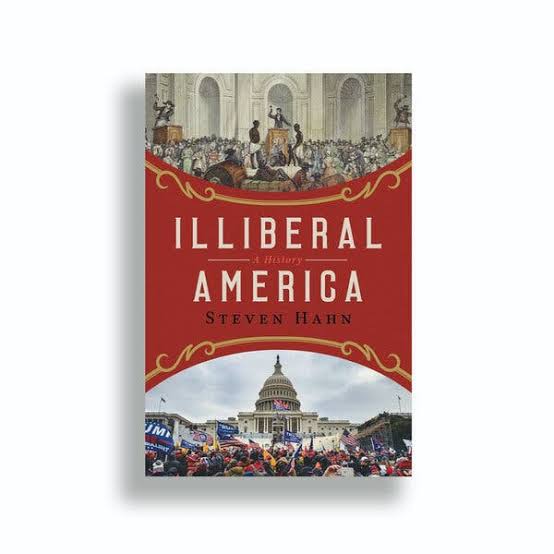
The timing of Steven Hahn’s latest book, Illiberal America: A History, is no coincidence. Published in 2024, the same year Donald Trump was elected president a second time despite instigating an insurrectionist riot at the White House on January 6, 2021, Illiberal America is a book that bears the indelible mark of the Trump era. It is an admirable attempt to comprehend and explain what has seemed incomprehensible and inexplicable to most good liberals: How could Donald Trump, the definitive illiberal figure of our times, win the presidency (twice) in a liberal nation like the United States?[i]
Illiberal America should be counted as one book among the rapidly growing body of Trump Studies literature. This includes new books in the field of U.S. intellectual history, such as Kevin Schultz’s engaging Why Everyone Hates White Liberals (Including White Liberals): A History, which helps readers come to terms with how Trump accrued political capital by “owning the libs.” It turns out that hating liberals has a rich, diverse, and instructive history that pre-dates MAGA by sixty years or more. Another recent entry in this genre is David Austin Walsh’s Taking America Back: The Conservative Movement and the Far Right, a well-executed historical study of what William F. Buckley poignantly called “the right-wing popular front,” the sometimes turbulent, often effective alliance between the conservative movement and the far right since the 1930s. Before Trump, liberal pundits often assumed the conservative movement and the Republican Party shunned far-right extremists. Walsh’s book demonstrates, in contrast, that Trump’s ability to unite the right is not an aberration. Molly Worthen’s Spellbound: How Charisma Shaped American History from the Puritans to Donald Trump, is, as the title suggests, yet another book that should be placed on the Trump Studies shelf at your favorite bookstore. Worthen argues that charismatic political figures such as Trump emerge at those points in history when regular institutions, especially religious ones, fail to capture the trust of the masses.[ii]
Illiberal America fits snugly in the Trump Studies category. Hahn patiently shows that illiberalism of the Trumpian sort has existed in America since the colonial era. In fact, illiberalism is as American as apple pie. By extension, Hahn implies that liberalism is the more likely deviation from American political norms, the thing that needs historical explanation. And yet, since a zombified Cold War liberalism that asserts the United States has always had a liberal consensus continues to police the parameters of political discourse, Hahn’s book is a necessary corrective. Since most pundits have remained beholden to the Cold War liberal paradigm (even well after lots of historians broke free of its ideological constraints), the title of Hahn’s book will seem to many a “contradiction in terms.”[iii] Illiberalism apparently needs historical explanation—even though it has always been with us.
Hahn does not offer readers an authoritative definition of liberalism. This is not a weakness of the book, since liberalism’s genealogy, with roots in the seventeenth century, is even more contested and perplexing than most political ideologies. For much of its history, liberalism was about the rights of individuals to freely enter into social contracts, and about economic and political freedom from state intrusion. These definitions link liberalism to the emergence of capitalism as a liberating new social order. The modern liberalism that took hold in the United States with Franklin Roosevelt and the New Deal was less about liberation from a prior social order and more about achieving freedom within dangerous new constraints created by capitalism. This twentieth-century version of liberalism was about how a commanding, more centralized state administers power by balancing the interests of assorted groups and by ensuring a modicum of welfare for all its subjects.
Hahn does not say precisely which liberalism he defines illiberalism against, but he does offer a thorough list of illiberalism’s features: “the overriding will of the community, the suspicion of outsiders and quick resort to expulsion, the recognition of rights and standing chiefly in local or limited arenas, the abiding desire for cultural homogeneity often enforced coercively, the resistance to some forms of authority (often of the state) together with easy submission to those of place and faith, and the embrace of hierarchies of status and power.”[iv] If liberalism establishes a universal basis for rights (in theory, at least), illiberalism limits the sources of rights in accordance with place, hierarchy, status, identity, and more. As with Corey Robin, who argues conservatism, or what he calls “the reactionary mind,” evolves alongside revolutionary contexts and practices, Hahn contends illiberalism changes in conjunction with liberalism. “Illiberalism should be understood as ever-developing constellations of ideas, relations, and practices that become more complex as it defines itself against or becomes intricately entangled with liberalism.”[v]
Most of the illiberal characters featured in Hahn’s book are people we would now categorize as conservative—people such as Pat Buchanan, to name but one well-known figure of recent right-wing vintage. Illiberalism, Hahn argues, is almost always associated with movements and figures traditionally connected to the political right (although, as we shall see, one of the more striking aspects of Illiberal America is learning about the illiberal tendencies of many avowed liberals). Hahn does not waste our time by digging into left-wing illiberalism, maintaining that, in an American context, very little of it exists. Across the history of the United States, Hahn writes, “movements of the left, even those organized around the rights and empowerment of specific ethnic or racial groups, have rarely if ever argued for limiting the rights of other groups or individuals.”[vi] The left might have an anti-liberal history, but this does not make it illiberal, since the left, at least in the United States, has often been critical of liberalism for not being liberal enough, for not living up to its loftiest standards. C. Wright Mills argued, for instance, that Karl Marx took nineteenth-century liberal ideals like freedom and liberty more seriously than liberals did, because Marx extended these ideals to “the lower depths of liberal society,” aka the working class.[vii]
After his thorough historiographical thrashing of Cold War liberalism, Hahn turns his attention to the colonial and early national periods, which were strongly shaped by residues of feudalism. At that time, liberal values like free expression and universal education were uncommonly expressed desires. William Berkeley, who served as governor of colonial Virginia from 1660 until his death in 1677, was content to preside over his colony’s elitist social structure. “I thank God,” Berkeley proclaimed, “there are no free schools nor printing, and I hope we shall not have these for a hundred years; for learning has brought disobedience and heresy into the world.”[viii] Even the colonial constitutions written by John Locke, the era’s most renowned liberal thinker, were not very liberal, highlighting one of Hahn’s more pronounced themes: American liberalism has not always been very liberal. As opposed to the liberal ideal about people being born free with inalienable rights, early America was saddled by a spectrum of dependencies, chattel slavery chief among them. Due to systems and customs established to ensure hierarchy, including slavery, patriarchy, debt, property, and more, most people were either servants or masters. And of course, the least liberal quality of early America, in addition to chattel slavery, was the Euro-American population’s murderous campaign to expel the indigenous population from the land.
In highlighting the illiberal origins of the United States, Hahn continues his quest to bury the Cold War liberal paradigm “in a deep, deep hole with nuclear waste,” to borrow one of Leo P. Ribuffo’s typically mirthful phrases.[ix] In his analysis of American westward expansion, Hahn is also doing battle with Frederick Jackson Turner’s “frontier thesis,” that old saw that helped shape the midcentury liberal consensus. For Turner as well as Cold War liberals, the frontier acted as a petri dish for liberal experimentation. By forging the land of the vast North American continent, early Americans internalized the tight relationship between independence and freedom. Hahn responds to this longstanding just-so story of American democracy with a kernel of historical wisdom: “it is best,” he writes, “to look outward from the seventeenth century than backward from our own time.”[x] Put another way, it is only in hindsight that early American history seems like a precursor to liberalism. Upon closer inspection—after applying the historical thinking skills that insist upon seeing people and events from the past in their actual contexts—the relentless American pursuit of land is prima facie evidence of illiberalism. Native Americans had very little choice in determining their fates.
There is some truth in the claim that liberalism developed along the frontier, often in resistance to the British Empire and its feudal remnants. However, that history is more complex than the American mythmakers would have us believe, highlighting the complicated kinship between liberalism and illiberalism. Hahn writes about this paradox:
The contradictory currents of eighteenth-century backcountry rebellions are important to recognize as context for the early democratic discourses that could emerge in their midst. And they help us see the political and cultural baggage that would be passed down. There can be no doubt that settler resistance to the neo-feudal dreams of many proprietors or the speculative schemes of landed elites shaped the economic landscape and political sensibilities of British North America and the early American republic. Ideas about the nature of property, the legitimacy of representative government, and the very notion of ‘popular sovereignty’ developed in these violence-laden conflicts as they had done in the midst of the English Civil War. Yet in their construction of the savage threat as well as in their autonomy of what they regarded as their communities, they left debilitating and illiberal legacies for many decades to come.[xi]
The most famous example of a backcountry rebellion that fueled early American democratic dreams is, of course, Shays Rebellion. By revolting against the albatross of debt, and more importantly, against the oppressive landed elites who kept them indebted, unruly farmers sought to expand the democratic envelop. This in turn spurred on a feudalistic backlash by the nation’s founders, who designed a constitution that shifted power to a centralized government, helping them more easily tame the “democratic excesses at the grassroots.”[xii] Yet the liberal versus illiberal lines were not as clear cut as it might seem. Early American plebes were on the side of liberalism in relation to the elites who worked to constrict their rights, but they were also on the side of illiberalism when it came to the nation’s expulsionary impulses. Early American democracy—Jacksonian democracy—was a militantly democratic movement for the expansion of white male political rights. It also bellicosely pushed for Indian removal.
Opposition to Andrew Jackson’s Democratic Party emerged among northeast elites who largely constituted the leadership of the Whig Party. Many historians of the nineteenth century United States have argued that the Whigs, for all their anti-democratic faults, tended to be the lesser of two evils for the indigenous population. Alexander Saxton convincingly made this argument in his classic 1990 book, The Rise and Fall of the White Republic. The more democratic the United States became for white men, Saxton contended, the less free it was for non-whites, especially American Indians.[xiii]
Hahn does not necessarily dispute Saxton’s historiographical intervention, which has been influential in pushing back against Cold War liberal interpretations, such as Arthur Schlesinger, Jr.’s famous 1945 work, The Age of Jackson, which drew a direct line from Jackson’s Democratic Party to FDR’s.[xiv] But Hahn does make clear that the expulsive tendencies of nineteenth-century Americans were not limited to Democrats. Even Abraham Lincoln, the nation’s most heroic nineteenth-century liberal, a member of the Whig Party who despised slavery from a young age, believed the nation would be better off without black people, which is why he joined the American Colonization Society. Eventually Lincoln embraced a more egalitarian vision of the nation, a tribute to his liberal mind, and to the efforts of black people to convince the first Republican president of their worth. But during a war that resulted in emancipation, one of the greatest liberal triumphs in the history of the United States, Lincoln also ordered the execution of 135 Sioux Indians, thus engraving his name as one of the nation’s most barbaric Indian killers. The nineteenth century was an epoch of exclusion. In addition to the native population, other groups were subjected to expulsion, including Mormons and the Chinese. If more people are to understand the anti-immigrant nastiness motivating Trump and MAGA, this history should be included as part of the narrative taught in schools.
One other thing that readers of Illiberal America should not forget is that liberalism has often been rife with illiberal tendencies. Regarding 1865, the year of emancipation and a moment when liberalism probably should have overtaken illiberalism as the American creed once and for all, Hahn addresses the dark clouds on the horizon. “What would freedom mean” to the new nation, he asks, “and to what extent would the liberal self be generalized?”[xv] Even after slavery was abolished, and even after passage of the hyper-liberal 13th, 14th, and 15th Amendments, plenty of Americans disagreed with the implication that all labor should be free. There were few objections, for instance, to the convict-lease system of unfree labor that became the norm in southern states and beyond. And there were even fewer objections to an industrial system that compelled most people to sell their labor under exploitative conditions or else starve, a system that mocked the liberal free labor ideal.
Hahn does not shy away from the implications of liberal illiberalism, writing that “the historical actors who should compel our attention are those who regarded themselves as Enlightened humanists; who came to find slavery and servitude abhorrent; who believed that all people should be equal in the eyes of the law and were capable of reform and self-improvement; who seemed most attuned to liberal ideals as to rights, political practice, economic activity, and progress; who looked forward in anticipation instead of backward with fear or longing. They should compel our attention because they were creating and shaping institutions designed to navigate a rapidly changing world, and while they were confident about human efficacy, they could also be blind to the deployments and meaning of power.”[xvi] In other words, even some of the most liberal Americans sought to arrange society in ways that ended up having illiberal consequences.
Early-twentieth-century progressive reformers have been hailed for seeking to modernize various aspects of government and industry, but what gets forgotten is that such modernizing efforts were often anti-democratic. In the name of non-partisan efficiency and good governance, and to curtail the power of urban political machines, progressives passed various civil service laws. A class of professionals replaced political appointees, which might seem like a way to remove bias from governance, but it had the more tangible effect of placing a check on the urban, immigrant, working class franchise. “Illiberal solutions,” Hahn writes, “always seemed the resort for liberal-detected problems.”[xvii] Liberalism in its earliest iterations could be defined as the politics and culture of the bourgeoisie. For the proletariat, then, liberalism was experienced as illiberalism.
Just as liberalism’s class bias constricted its universality, so too did its support for American empire. The list of examples of liberalism foundering on the shoals of empire, from the Philippines to Vietnam to Iraq, is too long to list. One example that Hahn uses to illustrate his case is the creation of the Panama Canal Zone and its accompanying promise of bringing democracy to a blighted people, about which President Theodore Roosevelt and other progressives waxed poetically. Secretary of War Elihu Root had more realistic assessment: “the Constitution indeed followed the flag, but it doesn’t quite catch up.” Let’s just say that living and working in the canal zone was not like living and working in a liberal utopia.[xviii]
The hypocrisies of liberal imperialism form the core premise of the historian William Appleman Williams’s body of work, as well as the whole Wisconsin school of U.S. historiography that followed in Williams’s formidable path. Hahn writes that “the Wisconsin historians sought to make readers aware of the deep history of American empire and the price it would continue to exact. But their works did not challenge the idea of an ideological consensus around capitalist values and dispensations; rather, they warned that America’s liberal democracy both produced and would eventually be threatened by the need for empire.”[xix] In other words, Williams and the New Left historians he inspired did not disagree with Cold War liberal historiography about the liberal roots of the United States. Rather, they disagreed about those origins being a good thing. For the Wisconsin school, liberalism was the problem. Hahn partly agrees with this historical formulation. He recognizes that American empire is often a liberal project, and that it has inevitably illiberal consequences. And yet, Hahn disagrees with the Wisconsin School’s recapitulation of the Cold War liberal theory about America’s liberal past. America’s past, for him, is more illiberal than we might admit. Hahn also, unlike Williams, appears to think liberalism is a good political philosophy, if only we might find a way to achieve its promises. To paraphrase Gandhi’s apocryphal quote about Western Civilization, Hahn thinks liberalism “would be a good idea.”
During the twentieth century, when liberalism made more substantial inroads into American political culture, new illiberal tendencies emerged to threaten any such progress. With Trump undoubtedly on his mind, Hahn does not blink by calling such political tendencies fascism. This new and extreme form of illiberalism taking Europe by storm had American equivalents, such as the Ku Klux Klan, which sprang back to life in the 1920s, this time as a national rather than a merely southern movement. The second iteration of the Klan was enormously popular, particularly in the Midwest and across the prairie. Many Americans of this illiberal ilk sympathized with the Italian fascist dictator Benito Mussolini, who came to power in 1922, and later with Adolf Hitler. European fascists returned the admiration. Hahn touches on the fact that Hitler looked to Jim Crow laws as inspiration for his antisemitic Nuremberg laws. It is important to note the existence of American fascists, about whom Leo Ribuffo and David Austin Walsh have written excellent books.[xx] It is also important to recognize that American fascism, and its semi-popular appeal, is yet another way to discredit the wrongheadedness of Cold War liberalism, which considered any political ideology to its far right and far left beyond the pale of American norms. Clearly illiberalism of most sorts, including twentieth-century fascism, is a very American phenomenon. But in his search for illiberalism in every nook and cranny of American history, Hahn overstates the importance of the far right in the long annals of American illiberalism.
A much more central force for illiberalism has been, quite simply, capitalism, the very economic and social system from which liberalism arose. Or to put it another way, people in US history who have been committed to both capitalism and liberalism have usually prioritized the former over the latter. Neoliberalism, a relatively recent innovation of modern liberalism that contends the good society is better achieved by capitalist markets than by the state, has been a much more pervasive force for illiberalism than even the fascist far right. Although Hahn does not go that far in his argument, he does recognize the “illiberal impulses at the heart of neoliberalism.” He writes that, “embedded in the neoliberal vision were reservations about political democracy and an openness to coercive, if not expulsive, measures to ‘ring-fence’ the workings of the market economy against potential threats and enable the accumulation of capital.”[xxi] This is consistent with Quinn Slobodian’s argument that libertarians—the more extreme ideological representatives of neoliberalism—were not anti-statist but rather thought the purpose of the state was to encase capitalist markets, to shield them from intrusions, such as democracy.[xxii] Free-market capitalism could not have taken off in a nation like Chile, for example, if it were not for an anti-democratic military coup sponsored by the CIA. As Henry Kissnger declared while contemplating how the United States might aid the right-wing dictator Augusto Pinochet, who eventually overthrew the democratically elected Salvador Allende on September 11, 1973, “I don’t see why we need to stand by and watch a country go communist because of the irresponsibility of its own people.”[xxiii]
Creating a ring-fence around democracy has proved less dramatic in the United States, where elites do not need to resort to political coup to disenfranchise the masses. Another effective way to limit democracy is to lock up the rabble. By warehousing the excess population that capitalism no longer finds useful, the behemoth prison-industrial complex, one of the most illiberal institutions in contemporary American society, is a representative feature of the neoliberal age. Neoliberalism, we might say, is the political philosophy that rationalizes a downsizing industrial workforce. Prisons are a new form of expulsion, and expulsion has a long American history, a long liberal history.
Hahn concludes his book with a warning and a modicum of hope. “Illiberalism’s history is America’s history,” he writes.[xxiv] But it need not be out future. We must fight for a better one. I will add that if we want a more liberal future, it cannot be a capitalist future. The most powerful forces for illiberalism, at least since the abolition of slavery, have been manifestations of capitalism.
[i] Steven Hahn, Illiberal America: A History (W.W. Norton and Company, 2024).
[ii] Kevin M. Schultz, Why Everyone Hates White Liberals (Including White Liberals) (University of Chicago Press, 2025). David Austin Walsh, Taking America Back: The Conservative Movement and the Far Right (Yale University Press, 2024). Molly Worthen, Spellbound: How Charisma Shaped American History from the Puritans to Donald Trump (Forum Books, 2025).
[iii] Hahn, Illiberal America, 1.
[iv] Hahn, Illiberal America, 4.
[v] Corey Robin, The Reactionary Mind: Conservatism from Edmund Burke to Donald Trump, 2nd ed. (Oxford University Press, 2018). Hahn, Illiberal America, 5.
[vi] Hahn, Illiberal America, 9.
[vii] C. Wright Mills, The Marxists (Penguin Books, 1962), 28.
[viii] Hahn, Illiberal America, 45.
[ix] Leo P. Ribuffo, “Cultural Shouting Matches,” S-USIH Blog (January 18, 2016) (https://s-usih.org/2016/01/are-the-culture-wars-history-part-v/).
[x] Hahn, Illiberal America, 64.
[xi] Hahn, Illiberal America, 80-81.
[xii] Hahn, Illiberal America, 93.
[xiii] Alexander Saxton, The Rise and Fall of the White Republic: Class Politics and Mass Culture in Nineteenth-century America (1990; Verso, 2003).
[xiv] Arthur Schlesinger, Jr., The Age of Jackson (Little Brown & Co., 1945).
[xv] Hahn, Illiberal America, 114.
[xvi] Hahn, Illiberal America, 172-173.
[xvii] Hahn, Illiberal America, 173.
[xviii] Hahn, Illiberal America, 203.
[xix] William Appleman Williams, The Tragedy of American Diplomacy revised and enlarged version (1959; A Delta Book, 1962). Hahn, Illiberal America, 27.
[xx] Leo P. Ribuffo, The Old Christian Right: The Protestant Far Right from the Great Depression to the Cold War (Temple University Press, 1983). Walsh, Taking America Back.
[xxi] Hahn, Illiberal America, 287.
[xxii] Quinn Slobodian, Globalists: The End of Empire and the Birth of Neoliberalism (Cambridge, MA: Harvard University Press, 2018).
[xxiii] Peter Kornbluh, The Pinochet File: A Declassified Dossier on Atrocity and Accountability (The New Press, 2003).
[xxiv] Hahn, Illiberal America, 351.
About the Reviewer
Andrew Hartman is the author of Karl Marx in America (University of Chicago Press, 2025), winner of the 2026 S-USIH Annual Book Prize.
0