
The Book
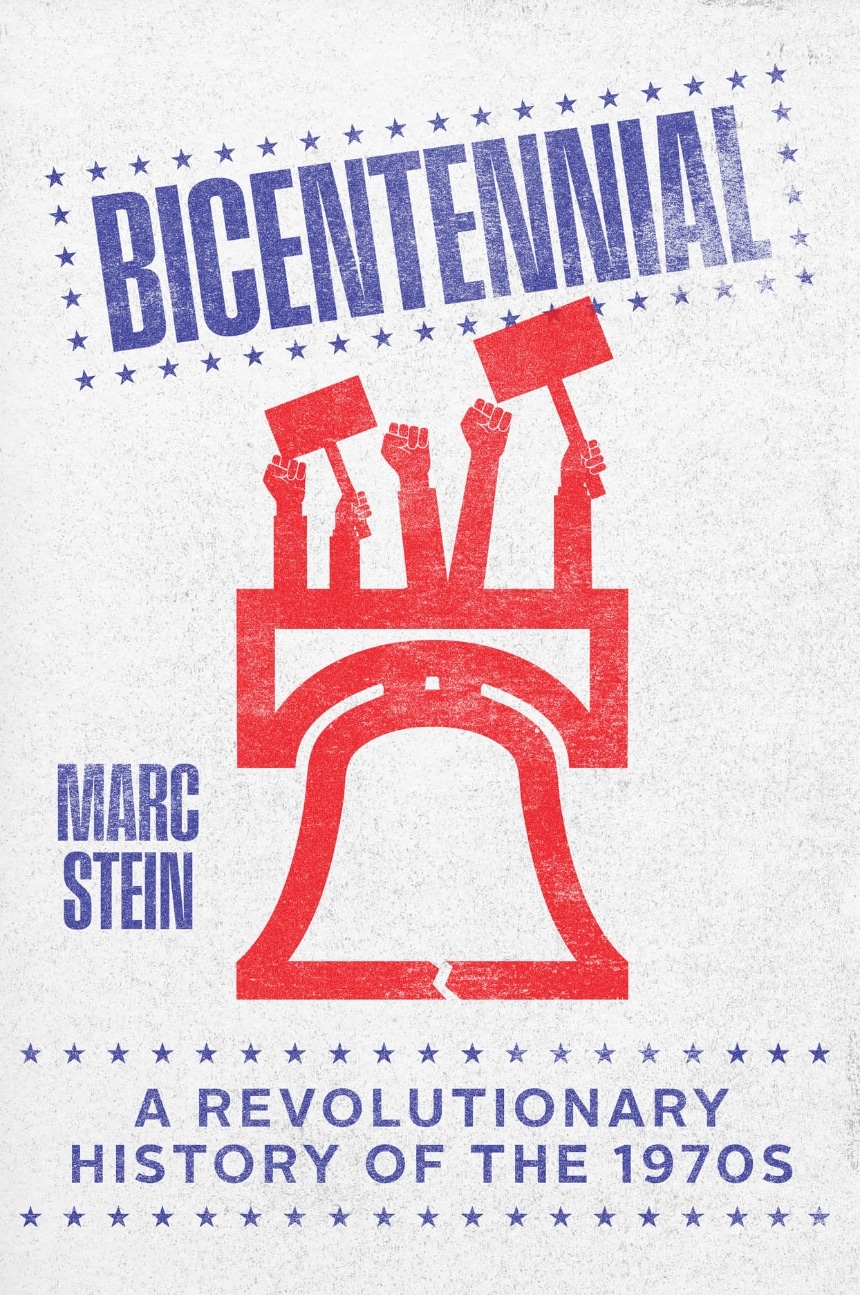
Bicentennial: A Revolutionary History of the 1970s
The Author(s)
Marc Stein
Oh, Philadelphia freedom, shine on me, I love ya…
Philadelphia freedom, don’t you know that I love you?
-
-
-
-
-
-
-
-
-
-
-
-
-
-
Elton John/Bernie Taupin, “Philadelphia Freedom”
-
-
-
-
-
-
-
-
-
-
-
-
-
Just in time for the semiquincentennial (or the sestercentennial, if you prefer) of the United States, Marc Stein has delivered a well-researched, thoughtful exploration of the 1976 bicentennial celebrations. Joining a growing historical literature on that event fifty years ago, Stein, the current president of the Organization of American Historians, argues that we should see the bicentennial as more than a nostalgic, over-commercialized affair.[1] It was not just simply a series of Betsy Ross flags or red, white, and blue parades on Main Street or endless patriotic product placements, or nationalistic speeches. It was also more than merely a coverup for the various crises of the 1970s: Nixon’s Watergate, the US loss in the Vietnam War, the energy and oil crisis, stagflation, and other ills. Instead, we should understand the bicentennial era as a period of intense confrontations with the stakes of the American past. As Stein describes it, the bicentennial generated “sustained, meaningful, and wide-ranging debates about the nation’s history and its future.”[2]
One challenge historians face in studying the bicentennial is that it was a sprawling affair. It took place in myriad locations across the U.S.—and even internationally.[3] There was a decade-long buildup to it. So too, its repercussions lasted a long time. To find a way into the many places, details, stories, controversies, moments, and aspects of the bicentennial, Stein zeroes in on one location: Philadelphia. This is a smart choice since, in early bicentennial planning, Philadelphia was one of the cities vying to host an international exposition. Eventually, both the city and the federal government abandoned the idea of concentrating the commemoration in one place. The bicentennial splintered into a far more geographically dispersed affair. To be sure, Bicentennial: A Revolutionary History of the 1970s includes details far beyond the City of Brotherly Love and aspires to tell a larger story, but Stein gives his main attention to Philadelphia itself. There, Stein traces three key aspects of the bicentennial: national politics as they intersected with local political affairs; the continued questions of urban renewal and city planning in the post-World War II decades; and a robust “counter-bicentennial” protest movement. The story of Philadelphia’s failure to become “Bicentennial City,” the central site for the event, is part of why its story matters. When history does not go according to plan, we can learn a lot about the stakes and significance of what did happen.
Stein is a public historian and a scholar of gay history. His writing becomes acutely more clever, compelling, and interpretively provocative when the book concentrates on these topics, in particular. In other sections of the book, the danger of long lists of details emerges. They threaten to overwhelm the narrative energy of Stein’s investigation. While clearly written and chock full of fascinating aspects of the bicentennial, these other parts of Stein’s study sometimes start to feel more like a dry chronicle than an animated evaluation—more annals than analysis.
This is not the case, however, when Stein turns to public history or to issues of queerness or to the important legacy of mid-1970s LGBTQ activism. Given that the bicentennial catalyzed the field of public history itself, Stein’s writing about how bicentennial commemorations altered the very practices of historical inquiry itself becomes quite potent. “If the bicentennial had encouraged greater public awareness of the ‘rewards of historical inquiry,” Stein writes, borrowing a phrase from a Washington Post editorial and noting the fierce debates historians themselves conducted about the bicentennial’s implications for historical study, “there was indeed something to celebrate” about the bicentennial moment.[4] The dramatic broadening of what counted as history, who could study it, and the value of a more diverse set of perspectives when it came to the past matter to Stein immensely in our present, vexed moment. He notices their origins in the bicentennial era—and perhaps even romanticizes the public history turn of that time, to some extent, as it relates to today’s challenges for historical study in the face of reaction, censorship, defunding, and intimidation.
Stein is also quite innovative on the queer qualities of bicentennial politics. This arises right at the start of the book, in analysis of what he calls, cleverly, “the queer courtship of Richard Nixon and Frank Rizzo.”[5] What a fabulous idea, and one ably demonstrated by Stein’s adept wielding of his primary sources! Nixon was, of course, a Republican presidential candidate, and eventual victor, in the 1968 race for the White House. He was keen to “court” Rizzo, the ex-Philadelphia police chief and conservative Democratic mayor of the city, both in 1968 and in Nixon’s 1972 re-election campaign. Rizzo identified as one of the working-class “ethnic white” city dwellers who began to desert the New Deal coalition in the 1970s for Nixon’s Republican Party. In this political dalliance, Nixon dangled federal funds before Rizzo’s eyes. As the “Bicentennial City,” Philadelphia would receive a “substantial dowry.” The flirtation between Nixon and Rizzo intensified in portrayals of their relationship. The two spoke of a “special friendship.” One journalist described their interactions as an “affair” Rizzo was “carrying on,” quite the “brazen move” for a Democratic mayor.[6] Another editorial described a “love story” between the two that suggested how “the ongoing love affair between Mayor Rizzo and President Nixon” had “reached the heights of public passion.”[7] The queerness of the language was everywhere. One Nixon official wrote of Rizzo “making overtures” to the president, who himself “was smitten with the idea of Rizzo supporting him….”[8] All innuendos and metaphors, of course, but the sexualized language is worth noticing, Stein argues, particularly given Rizzo’s infamous homophobia. Straight white male anxiety suffused the 1970s, as the gay rights movement took off, and the bicentennial was caught up in these dynamics.
Unfortunately, Stein largely leaves aside this “queer” reading of the bicentennial in the rest of his book to focus on a wider set of stories. He includes many wonderful tales and factoids, from the strange saga of the national government’s efforts to administer the bicentennial to the presence of the event in American popular culture, but one sometimes wishes that he would return to the queerness theme and develop it more fully. If he were to do so, his book might valuably extend Natasha Zaretsky’s reading of the bicentennial—and the entire 1970s—as a decade when a crisis of the American family ran in parallel, perhaps even overlapped, with a crisis of the American nation. Questions of homosociality and homosexuality, framed so much around the language used to describe straight male politicians—courtships, affairs, and unlikely marriages—might link up in fascinating ways to Zaretsky’s sense that the bicentennial commemorations registered a twin predicament of family and country in the United States.[9]
To do so would take the book away from its overview of the bicentennial as a whole, but it would sharpen its argument. Nonetheless, Bicentennial has value as a synthetic study. By pivoting to a broader description of the 1976 celebrations, it moves more toward the territory of Tammy S. Gordon’s excellent 2013 study, The Spirit of 1976: Commerce, Community, and the Politics of Commemoration.[10] While Gordon noticed that a multitude of different Americans, from politicians to profiteers to community activists, all wanted to get in on “the spirit of ’76.” Stein toggles more carefully between the specificity of one place, Philadelphia, and the larger panoply of events, stories, and people. In doing so, he misses an opportunity to explore the stakes of “queerness” in relation to Zaretsky’s thesis, but by going to the larger, more sweeping story of the bicentennial, Stein is able to make a different intervention in how we characterize US politics and culture during the 1970s. He contends that we need to rethink the dominant interpretation of the left during the era. Most political historians assume that the 1970s marked the fragmentation of the social movements of the 1960s into “identity politics.” Groups fought for their own rights, but not for everyone’s rights. This helped to give rise, historians then conclude, to the New Right. It prepared the ground for conservatives by allowing the Republican Party to consolidate power in the 1980s. Building on Nixon’s surprising victory in 1968, the narrative goes, Ronald Reagan and his conservative coalition eventually triumphed in the 1980 presidential election by peeling off elements of a fractious, disunited Democratic Party.
Stein disagrees with this teleology of New Left breakup leading to New Right resurgence. In his view, “counter-bicentennial activist formed broad-based and multi-issue coalitions, belying the notion that the left collapsed and divided in the 1970s.” [11] These cross-group alliances are at the heart of his “democratic history of a democratic bicentennial.” [12] His contention is that “we routinely miss the roles that the bicentennial played in stimulating the development of social justice coalitions and supporting the democratization of the left.” For him, “we do not typically see the bicentennial as helping to broaden the study of history by encouraging greater attention to colonized peoples, ethnic groups, immigrant communities, Indigenous people, LGBTQ people, people of color, people with disabilities, religious minorities, women, and working-class people.” Instead, “our macrohistorical narratives often jump from Vietnam and Watergate to the Reagan Revolution, skipping over the bicentennial.”[13]
Stein chronicles how activists opposed the official bicentennial’s exclusions and inadequacies. We learn about the African American opposition to various Bicentennial city planning proposals that would have negatively affected predominantly Black neighborhoods in Philadelphia and elsewhere. We also hear about efforts by women’s rights activists, Indigenous activists, and others to get their voices heard above the patriotic din (and sometimes contributing to it). And we hear more about New Left-descended group focusing on economic inequality such as the Peoples Bicentennial Commission, which “brought together multiple constituencies that were critical of corporate America.”[14] At the national level, Stein notes many coalitional aspects in the counter-bicentennial movement. A James Baldwin’s opinion piece about bicentennial political candidates “addressed race and class” as related, intersectional concepts.[15] A project called “The Trail of Self-Determination” “brought together Native Americans and Chicanos.” Many other “counter-bicentennial activists in the women’s and LGBTQ movements formed multiracial and cross-class alliances and linked class, gender, racial, and sexual struggles.”[16]
Stein is also good at noticing the significance of the bicentennial to myriad cultural artifacts in gay history. He points out that not only was Jonathan Katz’s breakthrough study, Gay American History, published in 1976, but also that the bicentennial surfaces in many other books, songs, and films connected to gay history and life. Randy Shilts’ early study of the HIV AIDS crisis, And the Band Played On, begins with the Tall Ships parade in New York City on July 4, 1974. Alice Bechdel’s queer graphic novel, Fun Home, also uses that event as a key part of its story.[17]
Returning to Philadelphia in one of his best interpretive moments, Stein points out that Elton John and Bernie Taupin’s pop hit song “Philadelphia Freedom,” released in early 1975, contained slyly suggestive gay lyrics. Stein writes:
Ambiguous enough for mass market success, the lyrics appealed to LGBTQ listeners who enjoyed the coded meanings…. There was the gender-neutral reference to a heart beating for ‘someone’; the allusion to secrecy and silence; the erotically charged image of kneeling in front of a man; the campy invocation of the gay-coded term ‘daddy’; the reference to choosing between city and family home; and the preference for living without family ties. ‘Philadelphia Freedom,’ performed by a gay superstar in a decade that witnessed the mass mobilization of LGBTQ movements, made a case for including gender and sexual liberation in the bicentennial’s broader celebration of freedom.[18]
Of course, John and Taupin were not Philadelphians themselves, they were British. They had written the song, Stein explains, in celebration of John’s friend Billie Jean King, the tennis superstar who played for the Philadelphia Freedoms, a franchise of the World TeamTennis league. She was a feminist icon, however, winning the infamous “Battle of the Sexes” tennis match against Bobby Riggs in 1973. She would also become a gay activist in subsequent decades. The song folded her story into a broader bicentennial anthem, going to the top of the charts, and reasserting Philadelphia’s centrality to the event. It not only lyrically mentioned the city, but John also paid musical homage to the “Philly Sound” of African American producers Gamble and Huff with his arrangement. “Philadelphia Freedom” brought together all the elements Stein wants us to notice: leftwing social activism folded cleverly into larger coalitions; Philadelphia as a key city in the larger national commemoration; and a bicentennial moment that was far more than just a steppingstone on the way to the Reagan New Right in the 1980s.[19]
It is LGBTQ activists in Philadelphia itself whom Stein wants us to notice pursuing freedom most dynamically. They were, he argues, particularly coalitional, not only with each other in the emerging cluster of LGBT and Q activism, but also in relation to a wider range of social justice movements during the 1970s. As the Dykes for an Amerikan Revolution (DAR, a nice play on the conservative Daughters of the American Revolution) put it when they chose to conduct a solo protest in the Philadelphia suburbs rather than join the main protests in Philadelphia itself on July 4, 1976, “Although we chose to be elsewhere on July 4th, our love and strength were also with sister and brothers marching in Philadelphia.”[20] The LGBTQ threads woven into the broader bicentennial patchwork quilt emerge brightly in the Philadelphia focus of Stein’s book. In 1973, for example, gay rights activist Mark Segal staged a dramatic protest at Independence Hall in Philadelphia. He objected to the lack of liberty for homosexual Americans by handcuffing himself to a railing in the building after being chased by police throughout the hall. One year later, in 1974, the Philadelphia Inquirer’s Today magazine published a story on “Gay Philadelphia” titled “The Gay Revolution in the Cradle of Liberty” featured, as Stein described it, a campy cover photograph of “two powdered men in eighteenth-century white wigs and pink colonial drag.” This nicely brings together Stein’s twin themes of queerness and the emerging gay rights movement in connection to the bicentennial. “Homosexuals,” the article declared, were “not apologizing as they demand that the Bill of Rights that was signed here nearly two centered ago finally be applied to them, too.”[21] In 1975, continuing the connections, activists signed a “Gay Declaration of Independence” during Gay Pride Week. The Advocate newspaper called activist Segal, who had staged the dramatic 1973 protest, “the John Hancock of the movement.”[22] By the bicentennial year itself, trans celebrity Rachel Hanson appeared as a judge for the annual Beaux Arts costume ball in the city, participating in its futuristic “tricentennial” theme. Looking back to the revolutionary founding of the United States in 1776 provided a way of looking forward to expanded forms of more inclusive American liberty that might come to exist by 2076. Philadelphia freedom, indeed.
In 1776, the original John Hancock supposedly wrote his name so that it was “large enough for the King of England to read it without his glasses.” The colonies were pushing Mother England away. By 1976, however, the Queen of England, Elizabeth II, happily visited the United States. She went to Philadelphia, where she enjoyed taking in the new location for the Liberty Bell, now hanging in a large pavilion rather than its previous, much smaller exhibition space in Independence Hall.[23] The Liberty Bell received lots of attention during the bicentennial, but one should remember that did not have that name when the colonies originally broke away from England. At that time, it was merely called the State House Bell. Only later did it receive its more well-known moniker. Who came up with the name? Proving the point of Stein’s focus on social movements in relation to American national commemoration, it was the abolition movement that gave the iconic Philadelphia bell its famous title. The abolitionists did so during the 1830s, right around the time when the bell itself suffered the first of its cracks. It could no longer ring out after that, making it a rather queer bell; yet, as Stein helps us hear, the metaphorical tones of the Liberty Bell still vibrated very much in 1976.
When we consider American nationhood today, during the 250th anniversary of the country, one wishes we could reinvigorate the spirit of coalitional criticality that Marc Stein documents fifty years ago. This might allow for a semiquincentennial commemoration that not only slams us to the ground with a celebratory callousness, but also wrestles more meaningfully with the ongoing challenges the United States faces in the twenty-first century. This year, more than ever, we need these reminders of earlier times, such as 1976, when America’s revolution itself was remembered in multitudinous ways during yet another moment of vexation and difficulty. The captivating choruses of coalitional politics found in Stein’s focus on the City of Brotherly Love are well worth the relisten. Lurking in the refrain, perhaps a resurgence? Philadelphia freedom, don’t you know that I still love you?
[1] See, among other essays and books, John Bodnar, “Celebrating the Nation, 1961-1976,” in Remaking America: Public Memory, Commemoration, and Patriotism in the Twentieth Century (Princeton University Press, 1991), 206-244; Christopher Capozzola, “It Makes You Want to Believe in the Country”: Celebrating the Bicentennial in an Age of Limits,” in America in the Seventies, eds. Beth L. Bailey and Dave Farber, eds. (University Press of Kansas, 2004), 29-49; Natasha Zaretsky, “The Spirit of ’76: The Bicentennial and Cold War Revivalism,” in No Direction Home: The American Family and the Fear of National Decline, 1968-1980 (University of North Carolina Press, 2007), 143-182; Tammy S. Gordon, The Spirit of 1976: Commerce, Community, and the Politics of Commemoration (University of Massachusetts Press, 2013); M.J. Rymsza-Pawlowska, History Comes Alive: Public History and Popular Culture in the 1970s (University of North Carolina Press, 2017); Jason Tebbe, “The People’s Bicentennial Commission and the Spirit of (19)76,” Tropics of Meta, 26 July 2021, https://tropicsofmeta.com/2021/07/26/the-peoples-bicentennial-commission-and-the-spirit-of-1976/; Thomas Cryer, “‘Brilliantly Devised, Grossly Packaged Confusion’: Eames’s ‘World of Franklin & Jefferson’ Exhibition and Reclaiming Revolution during America’s Post-Traumatic Decade,” JHI Blog, 24 January 2022, https://www.jhiblog.org/2022/01/24/brilliantly-devised-grossly-packaged-confusion-eamess-world-of-franklin-jefferson-exhibition-and-reclaiming-revolution-during-americas-post-tr/; Michael D. Hattem, The Memory of ’76: The Revolution in American History (Yale University Press, 2024); and Thomas Cryer, “Thinning the Nation? The 1976 Bicentennial and the Politics of Revolutionary Memory in a Neoliberal Age,” Modern American History, June 2026, 1–24.
[2] Marc Stein, Bicentennial: A Revolutionary History of the 1970s (University of Chicago Press, 2026), 6.
[3] Michael J. Kramer, “How the World Celebrated America’s 200th Birthday,” New Lines Magazine, 3 July 2026, https://newlinesmag.com/essays/how-the-world-celebrated-americas-200th-birthday/.
[4] N.A., “The Future of History,” Washington Post, 31 December 1976; quoted in Stein, 258.
[5] Stein, 11.
[6] Tom Fox, “The Bambino and the President,” Philadelphia Daily News, 25 January 1972; quoted in Stein, 19.
[7] N.A., “Love Story,” Philadelphia Daily News. 8 April 1972; quoted in Stein, 19.
[8] Egil Krogh, Jr., quoted in Edward Jay Epstein, Agency of Fear: Opiates and Political Power in America (Putnam, 1977), 226; quoted in Stein, 20.
[9] Zaretsky.
[10] Gordon.
[11] Stein, 8.
[12] Stein, 8.
[13] Stein, 314.
[14] Stein, 191.
[15] James Baldwin, “A Challenge to Bicentennial Candidates,” Los Angeles Times, 1 February 1975; quoted in Stein, 182.
[16] Stein, 191.
[17] Stein, 310.
[18] Stein, 92-94.
[19] Stein, 92-94.
[20] Stein, 277.
[21] Stein, 95-96.
[22] Stein, 94-95.
[23] Stein, 278.
About the Reviewer
Michael J. Kramer specializes in modern US cultural and intellectual history, transnational history, public history, digital humanities, and cultural criticism. The author of The Republic of Rock: Music and Citizenship in the Sixties Counterculture (Oxford University Press, 2013) and the digital exhibition The Berkeley Folk Music Festival and the Folk Music Revival on the US West Coast (July 2021), he also edits The Carryall, an online journal of US cultural and intellectual history, and he blogs at Culture Rover: Promiscuous Cultural Criticism. Kramer is an associate professor of history at the State University of New York (SUNY) Brockport. His website can be found at michaeljkramer.net.
0