
The Book
High School Students Unite: Teen Activism, Education Reform, and FBI Surveillance in Postwar America
The Author(s)
Aaron Fountain Jr.
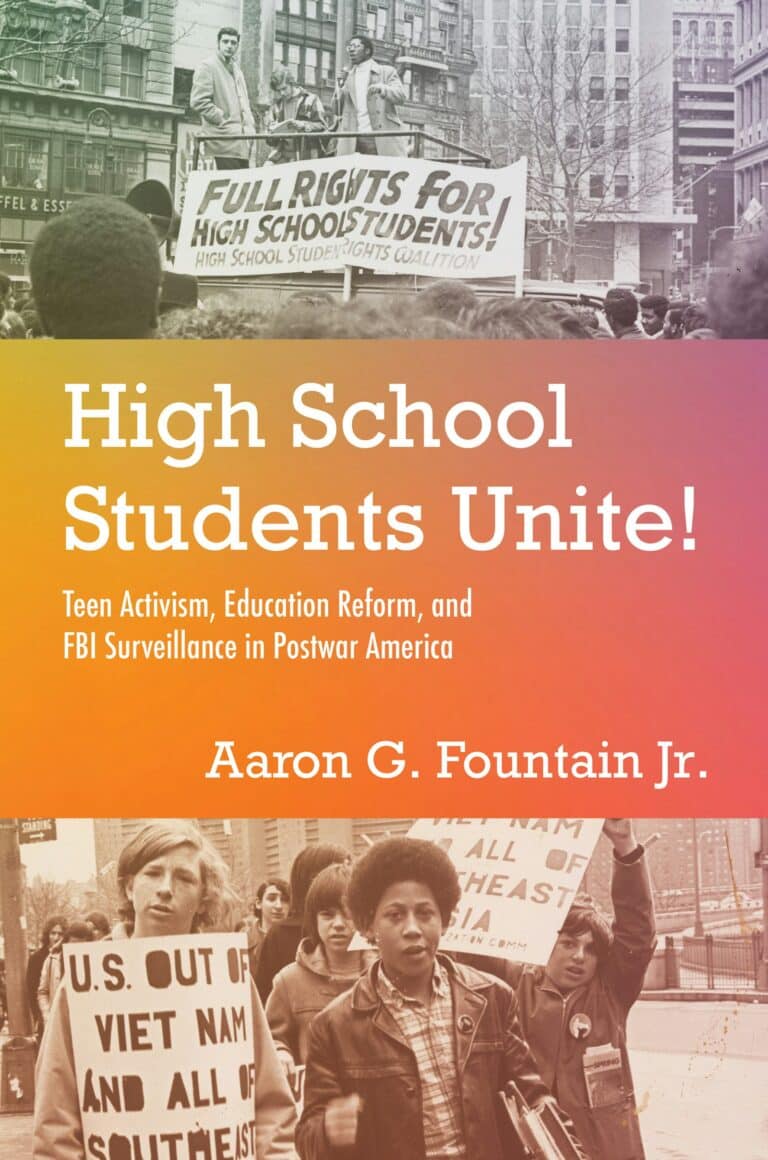
While the 1960s and 1970s are often remembered for activism, high school students’ unique efforts have often been overlooked. Aaron Fountain Jr.’s High School Students Unite documents “how high school students in the 1960s and 1970s spearheaded their own social movement which deserves recognition alongside other grassroots developments of the era.”[1] High school student activists across the United States formed networks that allowed them to fight for, and win, students’ rights. Motivated by the beliefs that high school students were oppressed and that changing high school was key to broader American reform, these young activists secured many wins at both the national level (e.g. Tinker v. Des Moines (1969)) and with more local officials (such as school boards). The significance of these young activists’ work was not lost in the moment, and this movement generated significant surveillance, including FBI investigations and protests being used to justify the presence of police within schools.
Despite these longstanding impacts, the public and academia have largely forgotten these activists’ work. Fountain attributes this to decreased news coverage of high school activists, an emphasis on college student activism, little pre-existing documentation in oral histories and personal accounts about high school activism, and perhaps most importantly, minimal surviving documentation in institutional archives. In addition to demonstrating the perceived threat of high school activists’ work, FBI surveillance created some of the most thorough documentation of these students’ work. Cognizant of misinformation in the FBI documents acquired through Freedom of Information Act requests, Fountain also conducted many oral histories and used the personal collection of the former youth activists. Using these sources, Fountain provides multiple shorter vignettes of youth activists and chapter-length narratives throughout the book, demonstrating that high school student activism occurred in large cities and small towns across the country.
The book is organized into three parts that are each both thematic and chronological. Part one “Politics” outlines both the ideological foundations of the students’ rights movement and shows that it grew separate from, though related to, the Civil Rights and anti-Vietnam War movements. Chapter one illustrates that in the mid-1960s, high schools became politicized around their identity and rights and students. Groups such as the Students’ Organized Education and Action League in San Francisco began arguing that despite their adolescence, they deserved the same speech rights as adults. This shift in political orientation marked a departure from previous youth activism which had centered on school desegregation as part of the Civil Rights Movement. In the second chapter, Fountain highlights the role of the antiwar movement in motivating the students’ rights movements. High school students were the “backbone and organizers” of the anti-Vietnam War struggles as they planned and executed protests in their communities, despite the overall unpopularity of their stance among their peers.[2] While operating relatively independently back home, many high school activists became involved in the nationwide Student Mobilization Committee (SMC), which provided youth activists with a broader sense of community as they rallied against the Vietnam War. Relationships to adult-run activist organizations, however, were not always supportive. Chapter three highlights how the New York High School Student Union had to operate independently of other adult organizations, such as the teachers’ union, to side with the Black Brooklyn residents and then advocate for their own needs, such as not suspending students. Fountain uses this story to demonstrate that while remaining in touch with adult activists, high school students started creating their own independent organizations in the late 1960s. Still, some adult-led organizations changed to become more cognizant of student needs. For example, in Cleveland, the local SMC worked with students to pass a high school bill of rights that protected students’ free speech rights and gave students more control over their education. Part one concludes with a history of high school underground newspapers. Starting with the Southern Student Organizing Committee, which ran a high school newspaper for around six months in 1969, these papers provided an outlet for students to share their ideas and activities. Most notable, however, was the Cooperative High School Independent Press Syndicate (CHIPS), which ran from various location across the US and operated for nearly a decade, teaching students how to run an underground newspaper and providing insight into the student movement across the US (and sometimes internationally).
Part two “Race” addresses the unique needs and efforts by Black, Latina/o/é, Asian, and American Indian students. Because of racial inequities in college access, there were more student protests around racial issues at the high school level than colleges. These students’ efforts were central drivers in the high school movement, combining critiques of racial oppression with inequities they faced on account of their status as students. Chapter six focuses on Mission High School in San Francisco, where an initial conflict between some Black and Latino students led administrators to bring in the police. Students and parents came together to protest the police presence in the school as well as other issues, such as the academic tracking of students along racial lines. Chapter seven focuses on that Black, Latina/o/é, Asian, and American Indian students’ vision for students’ rights. Focusing on Philadelphia, and Susan Bailey, a young Black woman activist, Fountain contends that Black, Latina/o/é, Asian, and American Indian students were more concerned with issues of racist teachers, inequitable disciplinary procedures, and tracking than their white peers. Chapter eight moves back to Cleveland where Black youth at Collinwood High School were forced into activism, not necessarily because they wanted to participate in the broader students’ rights movement, but because racial violence in their community spilled into the high school. Responding to regular physical attacks by white students and neighbors, some Black students began calling for increased police presence, hoping to quell the violence, in contrast to the broader movement trend that worked against police in schools.
The final part “Surveillance” discusses the FBI surveillance of high school student activists that “coincided with the punitive turn in public education.”[3] Chapter nine explains that the FBI viewed high school student activism across the country as a threat and surveilled many organizations to various extents, often informed by school administrators and parents. High school activists were surveilled as part of COINTELPRO-New Left, formed after the Columbia University protests because the FBI’s (and many other adults’) prevailing theory was that high school activists were puppets for the Black Panther Party and Students for a Democratic Society. The final chapter focuses on parents who acted as FBI informants. Raised to celebrate the FBI, these parents turned to the Bureau to squash student activism and “save” their children from the influence of perceived outside disruptors.
Overall, High School Students Unite provides a compelling case for an independent high school movement in the 1960s and 70s. Fountain provides ample examples of urban and suburban student protests across the United States and delineates the boundaries of this distinct movement. Though more discussion of the movement in rural areas would be valuable for establishing its ubiquitousness and understanding the ways that geography influenced students’ concerns and administrators’ responses, even the references to places like Aberdeen, South Dakota and Swan Quarter, North Carolina and two appendixes listing every known independent high school organization and underground high school newspaper in the US during the time demonstrate an impressive reach of the movement and Fountain’s research. Truly national in scope, this book serves as further evidence that youth activism has been a major driver in reform and must continue to be taken seriously.
[1] Aaron Gregory Fountain, High School Students Unite!: Teen Activism, Education Reform, & FBI Surveillance in Postwar America (The University of North Carolina Press, 2025), 9.
[2] Fountain, High School Students Unite!, 47, 49.
[3] Fountain, High School Students Unite!, 217.
About the Reviewer
Callie Avondet is a PhD student in Education Policy, Organization and Leadership at the University of Illinois Urbana-Champaign. Her work centers on Black community organizing in Utah in the 1960s and 1970s.
0