
The Book
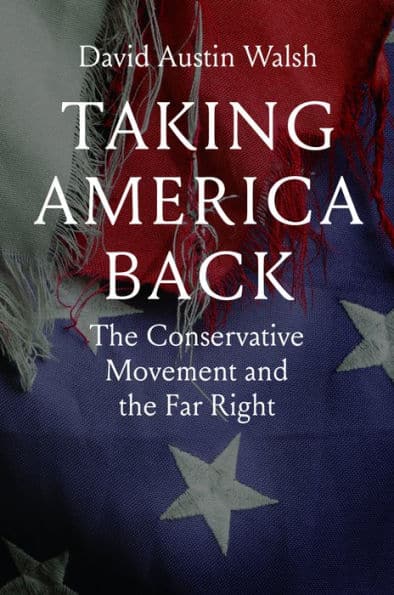
Taking America Back: The Conservative Movement and the Far Right
The Author(s)
David Austin Walsh
The historiography of the U.S. modern conservative movement has long been rooted in presentist imperatives. When Alan Brinkley identified the “Problem of American Conservatism” in his influential 1994 essay of the same name, he was writing from what we can now observe as a distinct historical conjuncture in which so-called “fusionist” conservatism was ascendant, with neoliberal economic orthodoxies at its bipartisan edge.[1]
Brinkley’s essay inspired a massive boom in historical research on the right.[2] But in explaining the rise of fusionism (a historically specific articulation of neoliberal economic theory, traditional moral philosophies that validated social hierarchies, and militant anti-communism), many of these works foregrounded the winners of internal movement conflicts, reifying the tactical exclusions of modern conservative movement activists themselves.[3] Historians, thus, often unwittingly aided the respectability politics of conservative activists like William F. Buckley, Jr., depicting them as principled underdogs who fought and ultimately marginalized the “far right” to vanquish the New Deal order.
Trump’s rise to prominence and power within the Republican Party in 2015–2016, championing ideas and rhetorical flourishes more commonly associated with the putatively sidelined paleoconservative wing of the party exemplified by Pat Buchanan, rubbed against the grain of the then-prevailing historiographical metanarrative.[4] This friction has, itself, been productive. Recent years have seen a flourishing of new works reconsidering the “losers” of internecine movement conflicts in the twentieth century and unpacking their persistent influence at and beyond the movement’s margins.[5]
David Austin Walsh’s Taking America Back contributes to an ongoing reassessment of the history of modern conservatism in response to the rise of Trump and what is often termed the “MAGA New Right.”[6] The book’s primary intervention is depicting the modern conservative movement as a “right-wing popular front,” a term Walsh borrows from Buckley’s own private correspondence with the John Birch Society leader Robert Welch.[7]
The term “popular front” more commonly refers to leftist coalitional politics of the 1930s–1940s, when U.S. communists, socialists, and liberals joined in common cause against fascism and in support of organized labor and the struggle for Black freedom. Given the modern conservative movement’s penchant for tactical borrowing from its opponents on the left, not to mention the steady rightward migration of ex- and anti-Stalinist socialists in the late 1940s and 1950s, the notion of a “right-wing popular front” is an intriguing one.
It does make sense to consider modern conservatism as a sort of mirror reflection of the original popular front: a coalitional politics against communism, opposed to organized labor and the struggle for Black freedom. Although, one might take issue with the term ‘popular’ given that conservatism’s persistent unpopularity from the New Deal through the 1970s was itself a driving force of modern conservative movement and media building.[8]
Unfortunately, the “right-wing popular front” concept goes mostly undertheorized by Walsh. The book is notably lacking in the sort of clear argumentation that helps a reader navigate the broader historiographical stakes, instead opting for detailed anecdotes that foreground the interpersonal connections and tensions between various movement personalities. Insofar as this approach captures the movement’s messiness, its internal disputes and contradictions, it is helpful. But the cost is conceptual clarity and a sense of how exactly to build on or engage with Walsh’s many implicit arguments.
On the one hand, Walsh uses “right-wing popular front” as a framing device for narrating the considerable fluidity between the “far right” and more mainstream conservatives like Buckley, helpfully illuminating continuities between the so-called Old Right of the pre-war New Deal period and the post war “modern” conservatives. On the other hand, Walsh’s entire premise is a rejection of the original formulation of the “right-wing popular front,” which Buckley used in 1960 as a pejorative to distinguish his elite-focused political strategy from Welch’s more populist approach.
Walsh’s “principal protagonists,” including Merwin K. Hart, Russell Maguire, George Lincoln Rockwell, Revilo Oliver, Pat Buchanan, and Joe Sobran were all connected, variously, to Buckley.[9] The book is loosely structured around narrating those discrete relations, although Hart functions as a sort of Forrest Gump figure, popping up now and again but mostly engaged in failed ventures. If Buckley claimed to oppose maintaining coalitional politics with the “far right,” Walsh shows how, time and again and long after his supposed “purge” of the Birchers in the 1960s, he maintained interpersonal and political connections with many of its most ardent, if now somewhat obscure, figures.
Rather than a matter of principal or strategy, in Walsh’s telling Buckley seems equally motivated by a class-driven obsession with status. “Buckley was, throughout his life, an unremitting elitist who was attracted to men—and they were almost always men—who had what he perceived to be good breeding and intelligence,” Walsh writes.[10] This seems true enough, but it (and the book as a whole) raises unanswered questions about where Buckley’s personal impulses end and the movement begins. There is little-to-no mention of the New Right of the 1970s, for instance, presumably because it extended beyond Buckley’s orbit.
While John Huntington, in Far-Right Vanguard, notes that the “difference between the radicals and the respectables was one of degree, not kind,” by placing Buckley as the central node connecting an array of “far right” figures, Walsh perhaps unwittingly imposes a binary onto what Huntington correctly argues ought to be thought of as a spectrum.[11]
Antisemitism is the primary dividing line between the “far right” and conservatism, in Walsh’s telling. He distinguishes between “crude” or “right-wing” antisemitism, or the hatred of Jewish people, and ‘conspiratorial antisemitism,’ or “the belief in a global Jewish conspiracy, usually connected to international communism, to subvert and destroy America.” He argues that both were rampant across the U.S. right from the 1930s through the 1960s, with mostly the conspiratorial form lingering in “respectable” conservative circles in the decades since.[12]
Indeed, the book’s most consistent through-line is how the right variously dealt with, or declined to deal with, antisemitism within their coalition. Walsh mostly treats figures who distanced themselves from antisemitic rhetoric, organizations, or personalities as conservative, while figures who refuse to assert such distance are often depicted as “far right.”[13]
Throughout the book this narrative use of antisemitism creates contradictions, paradoxes and ironies. Buckley maintains ties with and defends some antisemites while distancing himself from others. Jewish conservatives variously denounce and collaborate with antisemites. Walsh notes these tensions but refrains from theorizing them. I would suggest that these contradictions are less historically puzzling than artifacts of reducing the complexities of conservative respectability politics to the question of antisemitism alone.
Walsh, further, contends that right-wing antisemitism (hatred of Jewish people) was responsible for the “decline” of the right-wing popular front in the 1960s.[14] It is unclear what he means by “decline” outside of Buckley’s personal distancing, especially in light of the latter half of the book when Buckley continues to maintain connections with various proponents of antisemitic ideas and rhetoric. Both “crude” and “conspiratorial” forms of antisemitism persist within the right-wing coalition, indeed Walsh notes they are resurgent in the Trump era.[15]
The book’s foregrounding of antisemitism as an analytic seems rooted in presentist imperatives. Walsh starts and ends by litigating tedious contemporary debates over whether or not ‘fascism’ is an appropriate term for explaining the politics of Trump and the MAGA New Right.[16] Throughout the book, various right-wing figures bristle at being associated with fascism or Nazism, especially following news of the Holocaust. By showing the ubiquity of antisemitism and claims thereof across the “right-wing popular front,” Walsh suggests that modern conservatism has maintained a close proximity to fascism all along. But in winning yesterday’s Twitter debate he has created a somewhat muddled account of the complicated coalition between modern conservatism and the “far right.”
[1] Alan Brinkley, “The Problem of American Conservatism,” American Historical Review 99 (April 1994): 409–429.
[2] Kim Phillips-Fein, “Conservatism: A State of the Field,” The Journal of American History 98, no. 3 (2011): 723–743.
[3] A.J. Bauer, “The Alternative Historiography of the Alt-Right: Conservative Historical Subjectivity from the Tea Party to Trump,” in Far-Right Revisionism and the End of History: Alt-Histories, ed. Louie Dean Valencia-García, 121–137 (Routledge, 2020).
[4] See Rick Perlstein, “I Thought I Understood the American Right. Trump Proved Me Wrong,” New York Times Magazine, April 11, 2017.
[5] See especially John S. Huntington, Far-Right Vanguard: The Radical Roots of Modern Conservatism (University of Pennsylvania Press, 2021) and Nicole Hemmer, Partisans: The Conservative Revolutionaries Who Remade American Politics in the 1990s (Basic Books, 2022).
[6] Laura K. Field, Furious Minds: The Making of the MAGA New Right (Princeton University Press, 2025).
[7] David Austin Walsh, Taking America Back: The Conservative Movement and the Far Right (Yale University Press, 2024), 3–4.
[8] A.J. Bauer, Making the Liberal Media: How Conservatives Built a Movement Against the Press (Columbia University Press, 2026).
[9] Walsh, Taking America Back, 7.
[10] Ibid., 168.
[11] See Huntington, Far-Right Vanguard, 7–8.
[12] Walsh, Taking America Back, 7.
[13] Walsh uses this analytic throughout. For an illustrative example see his treatment of conservative broadcaster Fulton Lewis, Jr. and Sen. Joseph McCarthy on pp. 108–115, especially p. 114. See also his concluding remarks on p. 239.
[14] Walsh, Taking America Back, 7.
[15] Ibid., 238–239.
[16] Ibid., 1–2, 235–239. To be fair, Walsh did not initiate these debates. For an example of their contours see Daniel Steinmetz-Jenkins, ed., Did It Happen Here? Perspectives on Fascism and America (W.W. Norton, 2025).
About the Reviewer
A.J. Bauer is an Assistant Professor in the Department of Journalism and Creative Media at the University of Alabama. He is author of Making the Liberal Media: How Conservatives Built a Movement Against the Press (Columbia, 2026) and co-editor of News on the Right: Studying Conservative News Cultures (Oxford, 2019).
0