
People love to sing ballads, songs that tell stories. Some of them have been sung for centuries, passed along by countless singers who loved the words or the tunes. In studying these songs, we are in touch with an art form that was created and embellished by ordinary people who were likely soothed and comforted, enthralled and delighted, or sometimes horrified and upset by the stories told in an earlier age. We often may not know exactly how old the ballads we sing are–we only ever know the date when someone finally wrote them down–but they are usually the earliest forms of poetry that we have in any language.
The journeys these songs made across oceans and continents, across borders and across centuries, are one way of tracking movements of people and cultures around the world. Changes in words can reveal cultural change in the people who sang them in different settings. In American versions of British ballads, kings and queens and lords and ladies fade into the background, replaced by characters whose lives are more legible to commoners. Supernatural elements are dropped or rationalized.
Anna Gordon of Old Aberdeen (1747-1810), later known as Mrs. Brown of Falkland, is a foundational figure in ballad history. She was the earliest named source to be collected, and the greatest, artistically, with a lasting influence on the whole subsequent history of the form. She was a Scottish woman who learned her large repertoire of ballads as a young girl from the women in her family and their servants sometime in the middle of the eighteenth century. When her father, who was a professor at one of Scotland’s universities, told a scholarly friend that his youngest daughter knew a lot of these old songs, historians, antiquarians, musical patriots and collectors besieged her and one another with requests for manuscript transcripts of her repertory.
Anna Gordon and her nephew committed to paper the words and tunes of a generous selection of songs, and these papers were eagerly passed around among a number of writers and scholars, including Walter Scott, Joseph Ritson, and Robert Jamieson.
One striking example, “Lamkin,” formerly little-known outside Anna’s native village in Scotland, gives an example of her influence. It concerns a brooding master mason who has built a castle for a local lord and takes violent revenge when payment is refused. The name, Lamkin, is Flemish, and reflects the presence of Flemish settlements on the east coast of Scotland from the fourteenth century onwards. Interestingly, there are no European counterparts of it, although by the late eighteenth century versions of it were circulating widely in Scotland.
Lamkin and his accomplice, called the “false nurse,” get the mistress of the family into their clutches by torturing her baby so that she is forced to come downstairs to see why it keeps crying. They brutally murder mother and child, the mason being incited by the nurse who cries “kill her, Lamkin / For she was ne’er good to me.” They debate whether to catch her blood in a silver basin for she comes of “noble kin.” On the lord’s return, both are executed, he by hanging, she by burning at the stake. This ballad is unusual in Anna Gordon’s repertoire for most of her ballads end happily and few are gory or death-dealing. Indeed, her repertoire is interesting as a whole as a collection from a woman.
But that is not the end. What happened to this ballad, when carried across the Atlantic to Virginia, also makes for a fascinating story.
Anna Gordon had an older sister who eloped with an American, John Scott of Virginia, and ended up becoming the mistress of a slave plantation in the South. (This sat uncomfortably with her father’s condemnation of slavery in the Aberdeen Philosophical Society.) We know that Elizabeth Gordon Scott must have learned something of the same repertoire of ballads from their mother and aunt, and would have carried these songs with her to the New World.
In the early twentieth century, a version of “Lamkin,” was collected in the Black community, in the very county that had held Elizabeth Gordon Scott’s plantation a hundred years before. Given the plot of “Lamkin,” it is not surprising that people who were never paid for their labor and who were required to care for the children of others while neglecting their own, would have been drawn to this ballad of revenge and retribution. But the lyrics have been altered and softened; we see no torture of the baby or stabbing the mistress, no blood, no accusations from the nurse. Only a “bright sword” and her “lily-white breast” remain from the violence of the original, and we swiftly pass to the dénouement in which Lamkin and his accomplice are punished. Although this population may have been drawn to the ballad, they appear to have disguised or altered the story to shield their own acute vulnerability.
Thus ballads carry t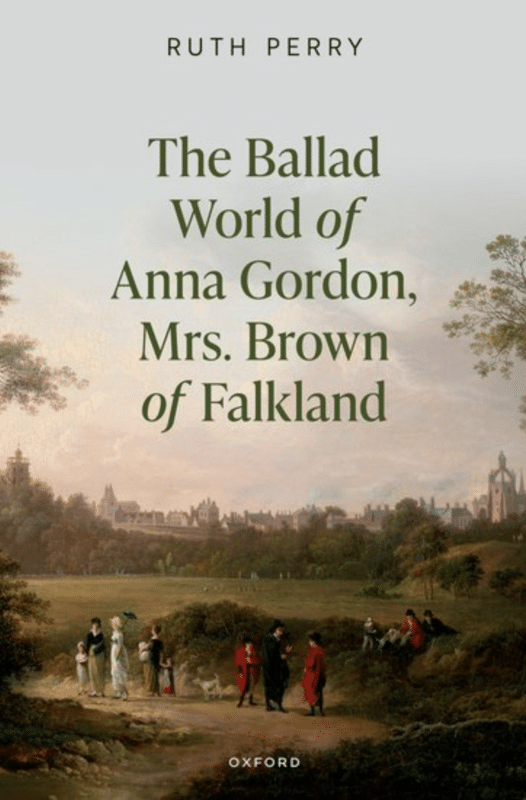 he mark of those who sang them, and meant many things to those who knew them. To the Scots living at home in the eighteenth century, they were historical artifacts valued with national pride; to Scots traveling about the world they reminded the scattered diasporic population of home and their national culture. To cultural theorists, the fact that Anna Gordon’s ballads had been learned orally in childhood from living sources descending from high antiquity played into the controversy launched by Ossian. It saw the Scottish range against English scholars respectively defending and attacking the primacy of oral over written and printed sources. To ballad collectors they were content for new books—a chance to publish and make some money. To singers and listeners from that day to this, they were wonderful stories sung to mesmerizing tunes.
The Ballad World of Anna Gordon, Mrs. Brown of Falkland tells the story of Anna Gordon’s far-flung family, the importance of song and vocal culture in seventeenth and eighteenth-century Scotland and the particular richness of her native Aberdeen as a musical center. It explains the creation of her several manuscripts and their use by early collectors and editors. It describes the importance of balladry to the philosophers and historians of the Scottish Enlightenment. Finally, it shows the importance of women to the form, and the social reality that underlay this: namely, the advantageous position of a woman growing up in eighteenth-century Scotland compared with women in England, legally, socially and educationally.
Notes
Ruth Perry is Ann Fetter Friedlaender Professor of the Humanities, Emerita, at MIT. She is a scholar of eighteenth-century British literature, women’s cultural history, and oral tradition, and the author of The Ballad World of Anna Gordon, Mrs. Brown of Falkland (Oxford University Press, 2025).
0