
The Book
The Development Film in the Americas
The Author(s)
Molly Geidel
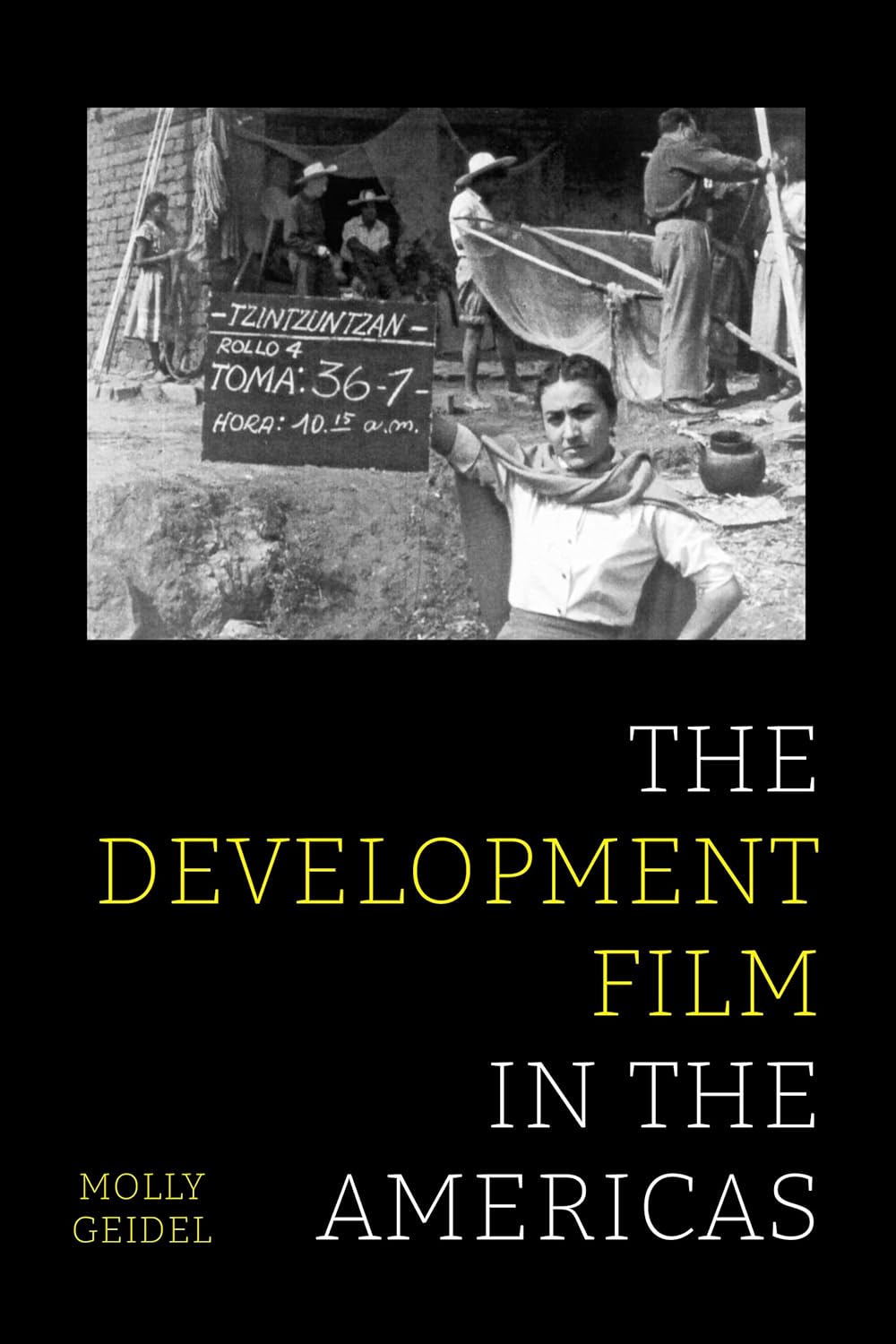
Molly Geidel’s The Development Film in the Americas presents a somewhat chronological account of the influence of the United States’ discourse of development on the elaboration of documentary practices in Latin America from the 1940s to the 1970s. The book argues that American documentary filmmakers had an outsized influence on Latin American conceptions of progress, and social and economic development because of their work in local governments and NGO’s educational campaigns. The Development Film in the Americas also argues that the documentary films produced in Latin America (and the US) during these decades make evident the tension between local communities’ traditional practices and government policies that valued capitalist and scientific conceptions of progress.
Through an analysis of a selected group of educational films, Geidel details how New-Deal-inspired discourses of development became official government positions that came to define what development looks like or how it is understood in Latin America. That is, the book argues that local government and US-funded initiatives cemented a hegemonic vision of development as necessarily tied to capitalism, infrastructure, and science. Additionally, Geidel contends that, somewhat ironically, these capitalist and homogenizing discourses were mostly propagated by American documentarist that had previously been associated with more progressive socialist initiatives in the US that sought to dignify and uplift the poor.
Although The Development Film in the Americas purports to be a book about documentary practices in Latin America, it is actually a book about US documentarist and US discourses that shaped a global perspective of what development looks like. The book mostly concentrates on US-trained and US-based filmmakers rather than on local Latin American practices, and indeed some of its descriptions of local Latin American film production initiatives are somewhat superficial. Consequently, rather than offering a historical account of educational films in Latin America, the book’s greatest strength is its discussion of how US discourses are propagated through seemingly benign or altruistic campaigns. That is, more than an account of Latin American cinema, The Development Film in the Americas offers a detailed discussion of the role of American cultural rhetoric in shaping global relations and establishing power dynamics.
I found the book’s fifth chapter, Brutal Pedagogy in the Kennedy Years, to be its most fascinating section. In this chapter, Geidel describes the contradictory discourses of development during the Cold-War years that sought to simultaneously promote assisting the poor at the same time that it suppressed the left and imposed austerity measures. In this section Geidel presents a compelling argument for how development films and other types of campaign constructed the developing world as simultaneously naturally doomed and in need of salvation. Overall, The Development Film in the America’s most important contribution, in my estimation, is its detailed discursive analysis of how American-sponsored educational films helped to create a hegemonic vision of what development means, especially for the so-called “third world.”
About the Reviewer
Naida García-Crespo is an Assistant Professor of English at the Universidad del Sagrado Corazón in Puerto Rico. Her work has appeared in Film History, Early Popular Visual Culture, and CENTRO Journal, among other journals and essay collections. She is the author of Early Puerto Rican Cinema and Nation Building (1897-1940): National Sentiments, Transnational Realities (Bucknell University Press, 2019).
0