
The Book
Nations Apart: How Clashing Regional Cultures Shattered America
The Author(s)
Colin Woodard'
Intellectual history can save American democracy. Colin Woodard maintains that in Nations Apart. He argues that American political divides on hot-button issues stem from our existence as “American nations,” a collection of fragile leaves or “underlying regional cultures” on one flowerhead.[1] Woodard uses an organic method of drawing “original data and polling results” from American counties to prove that those brittle regional intellectual ‘leaves’ exist.[2] He and other experts in fields from sociology to history to anthropology interpret that data, showing the existence and power of the “nations”—particularly the individualist-oriented ones—in the loose confederation we think of as a unified American nation.
Woodard claims understanding the ideological roots of our divided nations demonstrates the need for a shared supra-nations story. He names this story the “civic national narrative” and presents two variants of it: a standard and “conservative” one.[3] Woodard offers the “Great Promise” of the “American Experiment” interpretation or “bringing America’s people and regional cultures together around the ideals” in the Declaration of Independence as that narrative’s core.[4] This is the triumph of the Experiment’s twin central ideas: liberty and equality.
Woodward begins analysis with ideas—a historically-grounded sliding scale of how the various nations started with grades of a communitarian or individualistic culture. That culture still influences state political patterns. Thus, Woodard maps the nations in the American federation (seen in the picture) and briefly summarizes the history of their cultures. Next, he elucidates the splits on hot-button issues which stem from the nations. Woodard demonstrates how gun culture and ideology in each region germinates the levels of gun violence there. He states healthcare disparities branch out from differing levels of state-developed healthcare institutions.[5]
The nations’ branching in the “history wars” also stems from the myths that undergird and control each nation’s public memory, such as the communal divine mission of Yankeedom (that spread to the Midlands) or the “Herrenvolk tradition” of the Deep South and Tidewater sections.[6] Woodard also asserts an intellectual history answer to the question of who ‘belongs’ in a nation: “big ideas about how the world should be run” coming out of each region were the solution.[7] For Woodard, those ideas are, at root, two clashing ones: the united front of the Deep South’s “Herrenvolk tradition” and Greater Appalachia’s ethnonationalism versus the “Great Promise” narrative explicated by Yankeedom and New Netherland.[8] He furthermore shows how the nations’ divide on abortion stems from religious belief about it but how publics in the nations seek a remedy for climate change though their elites differ on it.[9]
Woodard, perhaps unconsciously, weaves elite power through his chapters on democracy and authoritarianism. He traces the roots of Donald Trump’s anti-democratic rise to power to the outsized influence of Tea Party activism in the oughts. Then, Woodard links Trump’s 2024 electoral success to the desire for his ethnonationalist authoritarianism in Greater Appalachia, Deep South, New France, rural Midlands, and countryside Yankeedom. Woodard suggests Americans have an evolutionary need for belonging that the nation—not the nations—now fulfills. Moreover, Woodard presents evidence of this. He quotes interviews with diverse citizens across the various nations that demonstrate their yearning for a unified national narrative.[10]
Woodard frames that story as a “civic national narrative” with two variants: one with more liberal democratic language and imagery, the other containing conservative wording and imagery.[11] Woodard proposes one more remedy: “a healthy, democratic, center-right party on the national stage.”[12] He believes this would purportedly draw the “pro-democracy conservatives” a MAGA-inflected Republican Party continually sidelines and allow for a coalition that includes centrists now also alienated from MAGA.[13] Overall, Woodard uses a rich loam of data to support his case for our wilting democracy.
Yet, Woodard misplaces the wilt’s source. He consistently and openly claims the public in various nations support or reject authoritarianism but latently asserts that elites shape their publics. Elites continually craft individualistic culture and regional myths for economic and political dominance, outlaw abortion where the people desire less restriction, and lead pro-environmental or anti-environmental political projects.[14] The American people thus actually lack the political willpower he ascribes to them. This suggests Americans should challenge and overcome elite political, cultural, and economic dominance. Then, ideological unity is possible.
Moreover, Woodard assumes cultural persistence in the various nations across centuries of historical change (84, 93).[15] That emerges in his mini-history of the communitarian or individualistic origins and trajectory of the various nations.[16] That cultural tenacity seems overstretched. For example, one wonders how Yankeedom kept its communitarianism between the demise of its Congregationalist religio-political orientation and the contemporary New England town hall.[17] Additionally, Woodard works toward his goal of rejuvenating the “American Promise” through controlling the tone of the “civic national narrative”: “we could optimize the language to inspire and mobilize people” and “we found some alternative wording [for the narrative] more effective” with a “right-leaning audience.”[18] One thus creates a unitary story by manipulating words for different nations. It seemingly devalues the story’s truth and sidelines debates about that truth Americans should have.
Discussion, though, perhaps remains far from Woodard’s mind. He uses culturally-regnant institutions—such as the Public Religion Research Institute or the Democracy Fund Voter Study Group, both prominent Washington, DC-based think tanks—to shape consistent messaging for Americans.[19] That surrenders democratic citizens’ reasoned analysis in locales to elite control of public opinion. Woodard also consistently downplays other non-cultural explanations of his data. He devalues “half the American public” for their support of Trump based on their concerns over “post-consumer price inflation”; they should be more concerned with “the survival of American democracy.”[20] On the contrary, democratic citizenship rests upon economic stability. Woodard also attributes poor health outcomes and food insecurity to the small degree of government-led economic development in the Greater Appalachia and the Deep South.[21] That neglects a more expansive explanation. Shifting foodways and property-owning practices in those regions resulting from the rise of fast food and finance capitalism might also help explain bad health and a dearth of food.
Despite deemphasizing economics, Woodard provides a compelling statistical argument for a college-educated readership. His solution of extending the “Great Promise” of liberty and equality will satisfy many intellectual historians, though they will balk at his narrow definition of culture that downplays economic realities. Readers and teachers seeking a renewed grand narrative for American history and civic education will delight in Woodard’s attempted “civic national narrative.” However, his body of evidence supports his thesis about our fractured federation better than it does his idealistic solution. We need more ground-up, local cultural and economic renewal to realize the “Great Promise”; messaging alone cannot unify our federation.
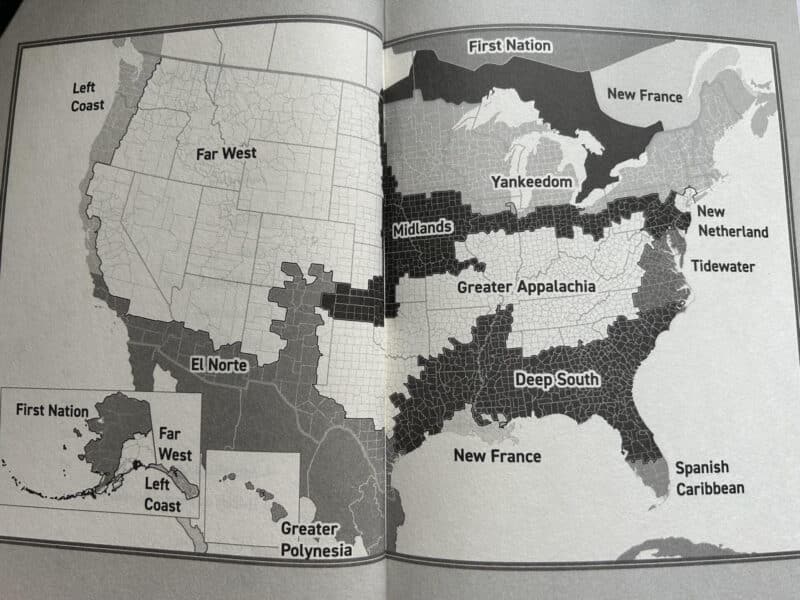
Figure 1: American Nations. 2025, by John Liberty, Motivf Corporation. From Colin Woodard: Nations Apart: How Clashing Regional Cultures Shattered America. New York: Penguin Random House, 2025.
[1] Colin Woodard, Nations Apart: How Clashing Regional Cultures Shattered America (New York: Penguin Random House, 2025), 6.
[2] Woodard, Nations Apart, 47.
[3] Woodard, 299-301.
[4] Woodard, 3.
[5] Woodard, 18-46, 69, 73-74, 82, 106.
[6] Woodard, 109-118.
[7] Woodard, 146.
[8] Woodard, 180.
[9] Woodard, 204, 224.
[10] Woodard, 236-247, 249, 250-257, 275, 285-296.
[11] Woodard, 296-300.
[12] Woodard, 227.
[13] Woodard, 227.
[14] Woodard, 99, 109, 183, 223-224.
[15] Woodard, 84, 93.
[16] Woodard, 18-21.
[17] Woodard, 19-20.
[18] Woodard, 286, 298.
[19] Woodard, 191-193, 208, 264-265, 269.
[20] Woodard, 226.
[21] Woodard, 91-93, 96-97.
About the Reviewer
Jacob Hiserman is a historian of American ideas, religion, and higher education and a high school humanities teacher at Thales Academy Rolesville. Jacob received his PhD from The University of Alabama in 2024. He is currently drafting a book manuscript and articles on liturgy, nineteenth-century southern colleges, and moral philosophy. When not writing and teaching, Jacob enjoys gardening and other outdoor activities with his family.
0