
Editor's Note
Ty Cashion (Sam Houston State University, retired) is author of Lone Star Mind: Reimagining Texas History (University of Oklahoma Press, 2018). His article, “How Scholars Lost the Culture War over Texas History,” appeared in the Texas Observer in September 2025.
With acknowledgment for the blog’s philosophical interest in the culture wars, I’d like to offer some observations from Texas regarding the contested ownership of the state’s past on either side of the COVID pandemic. [1] If Texas has become a proving ground for launching conservative ideas, intellectuals in other fields should be wary of the political and ideological gamesmanship beyond the study of history that steered events into a one-sided contest that is continuing to develop. The traditional past in Texas is becoming increasingly relevant in the public’s perception, in part at the expense of scholars and the work they produce. The orchestration of a conservative resurgence in Texas history has included alchemic YouTube attacks by grassroots activists, lawsuits and threats of lawsuits, and wide-ranging, sophisticated initiatives requiring the cooperation of public and private interests. [2] Also of immediate concern to scholars should be the weighty rebranding of the conventional past that represents a sea change they have scarcely acknowledged. It has expanded the scope of history for traditionalists, venturing beyond the state’s formative development and into the present age. At its heart lies a portable idea that should caution every American historian—the construction of a usable Texas past that informs the fundamental views of conservatives.
By contrast, the academy in Texas, despite producing exemplary scholarship that has contributed mightily to related fields, such as the Borderlands and Latinx and women’s studies, has clearly lost ground to traditionalists on this side of the pandemic. And not all of it can be attributed to the state’s authoritarian turn. University-trained historians have been reluctant to let go of attitudes and practices that characterized the field’s philosophical interests before the pandemic, which left them unprepared for a MAGA-like takeover of the field and slow to formulate responses since. They have instead remained locked into what physicist-cum-sociologist Thomas Kuhn described as philosophical “certainties” that frame their research interests. [3] For Texas historians, those certainties included some atavistic elements of social history that are over three decades old: eschewing traditionalists, a general bottom-up approach, and a mistrust of metanarratives. The reluctance to engage anything beyond those self-imposed boundaries has meant a loss of perspective on almost everything that would help us understand the rhetorical contest that is transforming the intellectual landscape of Texas history.
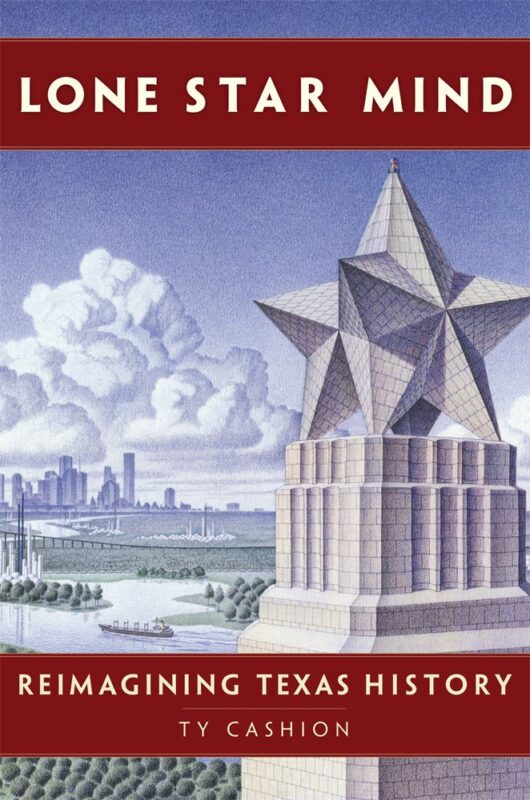
Ty Cashion, Lone Star Mind: Reimagining Texas History (University of Oklahoma Press, 2018)
Evaluating the field eight years ago, I ventured that, “However noble the cause might be that compels scholars to pursue knowledge for the sake of pushing the limits of our intellectual boundaries, the interpretive mainstream appears to have drifted so far from popular conceptions of history that the two cannot be reconciled, short of reassessing notions of ‘who owns the past.’” [4] Traditional history, inextricably bound to an octogenarian metanarrative that declared, “true Texans wrested the land from the wilderness, the Indians, and the Mexicans,” had grown out of touch with contemporary realities. Even so, traditionalists felt the same way about scholarship, dismissing the academy’s focus on political identity as a misguided obsession with victimization studies. Texans and their relationship with history, I argued, were then at a pivotal moment, a “tipping point,” where they had become “detached from a collective sense of identity defining who its people are and how they got that way.” The field was “not doing its job,” I concluded, and predicted that it would be “a condition not likely to remain static.” [5]
Before the COVID outbreak, if we had to throw up a “You Are Here” sign, Texas history would have been inching toward a new orthodoxy, where one of the challenges of fashioning a new usable past relevant to all Texans would be reconciling scholarship with traditional history. Yet rather than adopting a Hegelian approach that would have engaged traditionalists and establish ownership of Texas history beyond the academy, research historians insisted on maintaining exclusive spheres. The idea of a logical triad—orthodoxy, antithesis, and new orthodoxy—insists that evolution of thought depends on cultivating a give-and-take between the contending sides. Scholars, however, saw no merit in engaging a traditional approach that resembled folklore more than history. Even so, objective observation suggests that neither were they willing to detach themselves from the consciousness of victimization. Most of the innovative scholarship that research historians produced was in fact a response to the record of insensitivity endured by the groups they wrote about; those subjugated, marginalized, and shouldered aside by the true Texans who drove the traditional metanarrative. [6]
The body and quality of the sustained response by research historians was imminently capable of flipping the script on a conventional past that pitched the state’s long formative development as the only part of Texas history that truly counted. Fundamentally, traditionalists presented a record of Anglo males consolidating their gains and protecting them against all comers. Research historians could have brought Texas history to the present by reframing their past as the record of how those “comers” have fought for the same rights and privileges that Anglo males appropriated for themselves after winning an eighteen-minute battle at San Jacinto in 1836. Yet, because scholars expressed antipathy toward the concept of metanarratives and turned their historiographical curiosities to other fields of which Texas played a part, historians writing about the state’s past focused generally on political identity without an overarching statement encapsulating what it all means and why it is so important. [7]
In a scenario where research historians would have been interested in a reconciliation on their own terms, the challenge facing traditionalists would have been remaining relevant at a time when the momentum of progressive change in society appeared to be eclipsing the Anglo, male-centric views of a mostly one-dimensional nineteenth-century past. My feeling was that despite what either side was saying about the other, they were reconcilable. For the dominant culture within a society to expect their
worldview to represent the point of reference for the experiences of every group and individual is understandable. By that same logic, when the ascendant culture loses its preeminence, it would also be natural for a society to seek new frames of reference for understanding the past. I had ventured that because the momentum driving social change was epochal changing in scale, the traditional past would continue making sense only to those unwilling to concede that irresistible social forces were shifting the cultural terrain beneath them. [8]
Then came the COVID pandemic. Without the compulsive distractions of sports and entertainment as well as the jolt of having conventional rhythms of day-to-day life upturned, 330 million Americans ordered to stay in place were left to wrap their minds around such abstract contradictions as worthless oil and precious toilet paper. But more consequentially, in the hindsight of my own reconstruction of events, that same sense of bewilderment influenced progressive views concerning the deep-rooted realities of social and material inequality that drew new lines between haves and have-nots that were virtually invisible just weeks earlier. After a year and more of protests and demonstrations amped up by the toxic political theater attending every situation, the calculus of American life had changed in ways that all but eroded the middle ground where people of different minds could meet to exchange thoughts more out of intellectual curiosity than through political filters.
The power elite, concerned by the revolutionary overtones arising from protesters during the pandemic, responded with the kind of urgency that regarded the progressive surge like another contagion for which Americans needed inoculating. [9] Collectively, these decision makers as well as the traditionalists they encouraged, regarded “woke history” as a threatening view of the past, built on dishonest progressive constructions. Traditionalists believed the approach was based on insincere and self-righteous political correctness; the power elite viewed the manifestation of wokeness itself as an existential threat to the conservative social order. If, as those who have studied the power elite have asserted, “culture as much as politics or economics is central to maintaining power,” then a traditional version of history that had lost much of its utility due to its narrow nineteenth-century focus, surely presented a conspicuous vulnerability. [10]
Coincidentally, the state’s few university-trained traditionalists were already reenvisioning Texas history before the COVID pandemic began. The pattern for their new arc is cut from the same cloth as the declaration that “true Texans wrested the land from the wilderness, the Indians, and the Mexicans.” Yet, sanitized and deceptively less whitened, it proposes that “Texas history presents a record of opportunities and obstacles.” [11] These traditionalists acknowledge the same multi-ethnic society as their peers, but with an emphasis on the accomplishments of society, rather than groups of marginalized Texans and their efforts to gain the same rights and privileges as Anglo men.
Subsuming this view of a narrative history that continues into the present century is the belief that the work of research scholars focusing on political identity presents a dishonest construction of history that diminishes Texas society’s great accomplishments. The approach, moreover, is capable of informing the historical consciousness of the conservative leadership in politics and business. Heretofore, traditional history and the popular culture were virtually interchangeable. It was an adventure tale that lacked the complexities to inform the decisions of business leaders and politicians who must function in a society where a gunsmoke and horseshit grasp of history would jeopardize their decisions.
If research historians continue to stay in their own lane, they will eventually find themselves in a cul de sac with no exit. Their bottom-up approach and insistence on separating themselves from traditionalists has already left them struggling with relevance issues. The challenges that lie ahead will certainly involve demonstrating why a society conditioned to view Texas history as a record of opportunities and obstacles should take their work seriously. Ultimately, scholars must decide whether this new arc of
traditional history is anti-intellectualism draped in the trappings of scholarship, or a valid construction that deserves attention. Either way, they will have to deal with the dire consequences that lie ahead. [12]
Notes
- “Ownership” in the sense that Eric Foner discussed the concept in his volume, Who Owns History? Rethinking the
Past in a Changing World (Hill and Wang, 2002). - Ty Cashion, “How Scholars Lost the Culture War over Texas History,” Texas Observer, Sept/Oct 2025.
- Thomas S. Kuhn, The Structure of Scientific Revolutions (University of Chicago Press, 1962).
- Ty Cashion, Lone Star Mind: Reimagining Texas History (University of Oklahoma Press, 2018), 132.
- Cashion, Lone Star Mind, ix.
- Catherine Malabou, The Future of Hegel: Plasticity, Temporality, and Dialectic, trans. Lisabeth During (Routledge, 2005), 143–54; Jon Stewart, Hegel Myths and Legends (Northwestern University Press, 1996), 301–5; Cashion, Lone Star Mind, 16.
- Walter L. Buenger, “Beyond Big Tex: The Past, Present, and Future of the Southwestern Historical Quarterly,” Southwestern Historical Quarterly 125, no. 4 (April 2022): 338-44.
- Cashion, Lone Star Mind, 154-7.
- C. Wright Mills, The Power Elite (Oxford University Press, 1956); William Domhoff, Who Rules
America? Challenges to Corporate and Class Dominance, 6th ed. (McGraw-Hill College, 2010); Cashion, Lone Star Mind, 227. - Lawrence B. Glickman, “The Cultural Turn,” in Eric Foner and Lisa McGirr, eds. American History Now
(Temple Univ. Press, 2011), 221-41; Cashion, Lone Star Mind, 22. - Cashion, “How Scholars Lost.”
- Ben Alpers, “Has Intellectual History Had a Kuhnian Revolution?” Blog post, The Society for U.S. Intellectual
History, Aug. 20, 2012.
0