
The Book
Plantation Goods: A Material History of American Slavery
The Author(s)
Seth Rockman
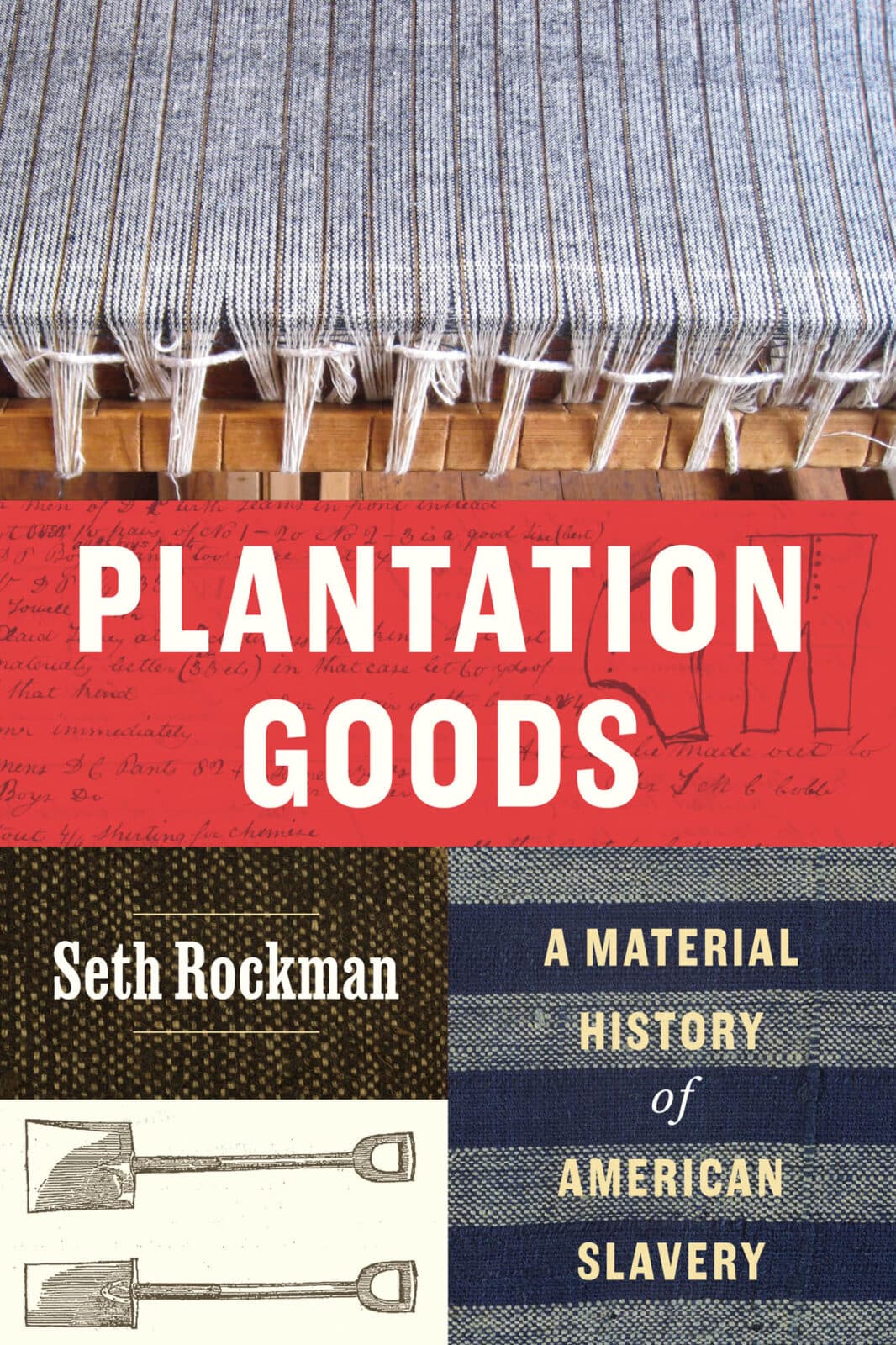
Seth Rockman’s work, Plantation Goods: A Material History of American Slavery offers a tantalizing display of historical craftsmanship that should appeal to historians of material culture, antebellum-era scholars, and intellectual historians alike. What Rockman sets out to do is craft a “material history of American slavery, national in scale” but never losing site of local particulars within the broader institution (4), What results is a work of scholarship that makes it clear that there is still much to be written about how slavery in the United States touched everyone in the nation, not just individuals living and working in the U.S. South.
Rockman’s previous works, which include Scraping By: Wage Labor, Slavery, and Survival in Early Baltimore (2009), and co-editing Slavery’s Capitalism: A New History of American Economic Development (2016) with Sven Beckert, showcase how he repeatedly grappled with the relationship between slavery and the growth of modern capitalism. Plantation Goods takes this analysis to a new level. Rockman uses the idea of “Negro cloth,” for example, to remind readers that the enslaved, their enslavers, and the producers of such material in New England and elsewhere all had different relationships to the materials that buttressed the institution of slavery. Rockman reminds readers in his introduction that he is simply adding to a larger historiographic turn: “the recognition of slavery as a geographically un-bounded institution,” as he describes it (11).
What follows is a critical analysis of what slavery looked like, how it felt, and how it was endured by the enslaved via the clothes they wore and the tools they used. The book is divided into three sections: Part One, titled “Production,” gives an important perspective on the producers of material used on plantations in the south. Part Two, “Distribution,” examines the middle men of American slavery, the agents and salesmen who sought to profit off of the materials that were a critical cog in the engine of slavery. Finally, there is Part three, “Consumption,” which describes in great and important detail how these materials produced across the nation were utilized within the broad system of slavery.
I would argue that each section, on its own, would merit a monograph. But one of the strengths of Rockman’s writing is his ability to link these disparate parts of the material culture of slavery into a strong, compelling, and cohesive narrative. The narrative is helped by various interludes that Rockman has dispersed in each part—sections that are not part of a chapter, but are instead brief essays on an individual piece of material culture. Such sections bring to life the lessons Rockman wants to impart about how the system of slavery in the United States touched virtually everything in that society. For example, his essay on “the Newark whip” emphasizes the history of one of the most notorious “tools” of enslavement, the whip. For abolitionists, a group in the book often struggling to make other Americans aware of their involvement in the system of enslavement, the whip was “a compelling artifact of national complicity” (291). But for others, especially those involved in the buying and selling of whips, it was merely a business matter.
The final chapter, “Coerced Consumers,” is an intriguing look at how to write about slavery from the point of view of the enslaved themselves. This chapter details how the enslaved understood their place within the broader slave-based economy, especially when it came to consumption of goods. “It may seem jarring to think about slaves as consumers, in light of their status as property,” Rockman concedes (320). But due to this being difficult, the chapter is rich in how it shows the enslaved navigating early capitalism via the clothes they wore and the tools they used—and how they made clear to enslavers what products they preferred and why. Rockman writes, “plantation goods shaped what it was like to be a slave and what it meant to be enslaved,” and this is a through-line for the entire book.
Plantation Goods is a strong, remarkable work of history that should offer more food for thought when it comes to writing and teaching about American slavery. How people create and consume products is a critical reflection of that society’s priorities, cultural mores, and moral blind spots. Plantation Goods reminds us that this is nothing new in American history.
About the Reviewer
Robert Greene II is an Associate Professor of History at Claflin University. He is co-editor, along with Tyler D. Parry, of Invisible No More: The African American Experience at the University of South Carolina. Dr. Greene II is also the President of the African American Intellectual History Society, and Managing Editor for the journal Global Black Thought. He also serves as the Lead Instructor for the Modjeska Simkins School of Human Rights for the South Carolina Progressive Network. Dr. Greene II also co-hosts the award-winning podcast, Our New South. He has also written for various publications, including The Nation, Dissent, Jacobin, and Oxford American. Currently, Dr. Greene II is working on his book, The Newest South: African Americans and the Democratic Party, 1964-1994, which details how the Southern leaders of the Democratic Party in the post-Civil Rights era crafted strategies to attract, and hold onto, the Black vote across the nation.
0