
The Book
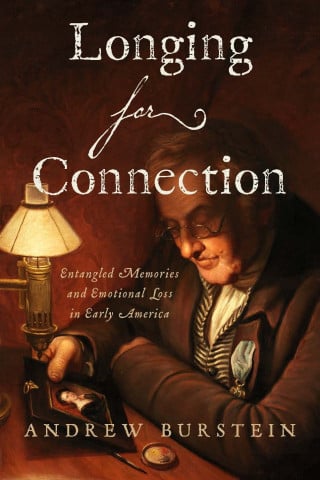
Longing for Connection: Entangled Memories and Emotional Loss in Early America
The Author(s)
Andrew Burstein
It has become a commonplace among observers of American society that, at least since the end of the Second World War, the populace suffers from a profound sense of anomie, perhaps brought on by the rapidly increasing pace of economic and social change and the loss of a common purpose brought about by the war’s end. This trope of the isolated American perhaps first emerged in the person of Tom Rath, the businessman (and veteran) protagonist of Sloan Wilson’s 1955 novel, The Man in the Gray Flannel Suit, where Tom ultimately rejects climbing the corporate ladder in favor of more home life. Outside the home, a decline in the institutions of civil society is the dominant theme of political scientist Robert D. Putnam’s seminal 2000 study Bowling Alone: The Collapse and Revival of American Community. Then, of course, we need only consult our individual and collective memories of the profound sense of social isolation that many endured during the COVID-19 pandemic. The pervasiveness of this condition invites the question of whether, perhaps, the condition itself is an older feature of American culture that has merely drawn more attention since World War Two.
Enter the eminent early American historian Andrew Burstein and his 2024 Longing for Connection: Entangled Memories and Emotional Loss in Early America. In considering a sweeping arc of public memory and private emotion in early America ranging from the Revolution to the mid-nineteenth century, Burstein concludes that the need to fashion new national narratives and to find common ground in such literary phenomena as reading classic poetry and letter writing represent a broader phenomenon that Burstein introduces as “the two-sided coin of felt connections and uncomfortable separations.”[1] Burstein takes as cultural touchstones during this era the evolving legend of Revolutionary martyr Nathan Hale, the poetry of Alexander Pope, and the plays of William Shakespeare—a rather diverse inventory, to be sure, and one that helps Burstein to draw up a list of wide-ranging phenomena that highlight the tensions between isolation and belonging in his thesis: “martyrdom, betrayal, rationalization, cultural conceit, and unfulfilled longing,” all of which have “coexisted in the grand narrative of the United States” and, he notes, “in the souls of citizens.”[2]
Burstein’s fusion of a broad arc covering so much of the first century of American independence with his interest in the emotional and psychological features common to the Revolutionary generation and those who inherited their works is impressive, as is the sheer number of texts that he cites. Diaries, letters, newspapers, and literary works, both British and American, all feed into his thesis. One might argue, indeed, that perhaps his narrative is a bit too ambitious. Given the vast body of literature by eighteenth-century authors on the subjects of the emotions and sociability, for instance, one does wish that perhaps Burstein had provided a bit more background for the history of those authors in shaping the culture of the British Atlantic from which the first generation of Americans (a term Burstein uses with little consideration of its Revolutionary-era contingency) declared their secession. Aside from a sidebar reference to John Locke’s Essay Concerning Human Understanding in the early-going, Burstein seems to take human psychology and emotions as remarkably universal and historically despite his stated intent to excavate an alien past for his readers. Also, for a historian deploying so much literary evidence for his thesis, one might suggest that a deeper plunge into the past three decades of work in affect theory in the eighteenth and nineteenth centuries performed by literary historians—most notably in Julie Ellison’s foundational 1999 Cato’s Tears and the Making of Anglo-American Emotion—could have provided some additional context for the social and emotional history of literary composition and consumption during this period.
In addition, given the sheer number of texts that Burstein treats, a few questionable decisions or outright errors emerge that, while they do not derail the argument, do give the reader pause. In the middle of an otherwise-excellent consideration of American letters from the late-eighteenth and early-nineteenth centuries that use the dangers of Atlantic travel as a metaphor for emotional upheaval, Burstein suddenly breaks his chronology to cite Alexander Pope’s use of the same metaphor in his 1733 Essay on Man before resuming the narrative in the nineteenth century. On another occasion he cites a letter to Aaron Burr from Burr’s son-in-law Joseph Alston and notes an allusion therein to Hamlet that certainly seems to this reviewer to be from Macbeth. Likewise, while Burstein’s enthusiasm for Shakespeare’s influence on American culture is much appreciated, the stage history can complicate the reading history. Noting George Washington’s love of The Tempest, which certainly would have been widely available to Washington in Samuel Johnson’s collected works edition (ironically, probably not in Pope’s), Burstein notes that Washington saw it performed in Philadelphia in 1787 during the Constitutional Convention. George O. Seilhamer’s late-nineteenth-century History of the American Theatre, compiled largely from playbills and newspaper advertisements, however, records that performance as being the John Dryden and Sir William D’Avenant “revision” from 1667. This would almost certainly have been the case for most American stagings before the British actor William Charles Macready restored the original text to the stage in London during 1838.
Burstein’s thesis is provocative and will no doubt inspire future work about public memory and emotion by Americanist historians of the eighteenth and nineteenth century, and the sheer number of texts cited across multiple genres is praiseworthy. Those who attempt to replicate his feat, however, might consider that Alexander Pope’s dictum, “A little learning is a dangerous thing,” has its limits.
[1] Andrew Burstein, Longing for Connection: Entangled Memories and Emotional Loss in Early America (Baltimore: Johns Hopkins University Press, 2024), 10.
[2] Burstein, 14-15.
About the Reviewer
Jason Shaffer is Professor of English at the United States Naval Academy. The views expressed in this review are those of the author and do not reflect the official policy or position of the Department of Defense or the U.S. Government.
0