
In honor of President’s Day, historical lessons for politicians getting ready for the November Midterms, with the sitting president not on the ballot but on the minds of most voters.
’24 Wave Red, ’25 Wave Blue. The Appeal of Tough Talk is How One Party Grew
Does a little blue wave of Democratic Party election victories in November 2025 signal a bigger blue wave in the midterms this year? The public craving for practical responses to problems could benefit Democrats or either party ready to seize on this political trend.
President Donald Trump grasps public attention with immigration crackdowns, abrupt application of tariffs as tools of foreign policy, and military interventions threatened and ordered. Most news focuses on these actions with debates revolving around claims for buttressing strength and security versus charges of imposing tragedies and unprecedented concentrations of power.
The presidential “Master of Selective Attention” focuses on the appeal of toughness. Republicans supporting Trump are counting on voters rallying to policies of aggression. But before that can turn into a wave of support for their party in the November 2026 elections, they will have to contend with another wave recently surging, the hope for practical ways to address a host of problems. Which way will most voters turn?
Founder of American psychology William James offers a suggestion. He directs our attention to the ways each person’s experience is based on what they “agree to attend to.” Which narrative, for aggression or for practicality, will seize the attention of most citizens?
The wave supporting tangible results is less dramatic, but it has an opportunity to overwhelm the wave for tough stances. A craving for practicality has support from both recent history and further reaches into the American past. But it’s not a sure bet. As James would say, “it feels like a real fight.”
At this political boxing match, politicians are at ringside, rallying their partisans. In the next row sit the journalists tallying the scores on each side. Behind them, historians look for trends, some starting as ripples. Recent events suggest some lessons for both major parties about how they are appealing to voters and how that appeal could shrink or grow into the next wave.
My fellow Americans, let’s begin with the Republicans, the contenders in power in the White House, in both houses of Congress, with the sympathies of most Supreme Court Justices, and with control of 26 state governor’s offices, including in 23 states with a Republican trifecta of governorship and majorities in their legislatures.
The Republican Appeal, Toughness
Especially with Trump’s blunt style, a big part of voters’ support for Republican policies is through the party’s forceful approach to political questions. They sound practical. Many liberal critiques include charges about the impracticalities of Trump’s impulsive policy reversals and the potential for his concentrations of power to create long-term problems, including erosion of democratic norms. Yet those important points do little to address support for Republican policies because they sound no-nonsense. Trump’s critics ignore those sounds and sentiments beneath the policies at their peril.
For many voters, those critiques bounce right off precisely because of the policy bluntness. To reduce immigration, use military tactics in American cities. For trade deficits, impose high tariffs. With drugs smuggled into the US, bomb boats and kidnap Venezuelan President Nicolás Maduro. These actions leave little room for asking particulars about the actual impact of immigrants, the potential damage from tariffs, or questions to address the legality and effectiveness of destruction without inquiry. And yet, criticisms using these nuances actually contribute to the appeal of claims for practicality with political promotion of forceful action readily set in contrast with what seem like the constraining details of further inquiry and moral concerns. Secretary of Defense Pete Hegseth calls these examples of “tepid legality.”
These issues point to keynotes of Trump’s leadership. He takes leaps of boldness, with comments that for many politicians would be career-ending brutal gaffs, such as a video depicting Michelle and Barack Obama as apes and a comment that Somali people are “garbage.” In focusing on what he says, critics overlook the bluntness of his tone, in the Somali case, with a slur to address some cases of alleged fraud. Clearly, the faults of a few individuals do not justify condemnation of the group, even as some may rally to his words with eagerness to draw a color line around “our country.” Trump not apologizing for either insult adds to his political appeal by presenting him showing that he stands up to critics. The medium of boldness is at the heart of his political brand. For his supporters, brash talk is a refreshing alternative to the indirect language of many politicians, with sweet talk cloaking favors to the powerful.
The boldness polarizes the enthusiastic from the outraged, and Trump shows little interest in persuading his opponents. He seeks enough support to win—in elections, in Congress, and in courts. His “only metric is winning,” as Ben Shapiro states, with close races still more appealing because their drama gains more attention. For this approach, the opposition is useful for supplying objects of ridicule to maintain endorsements from supporters. With avid risk taking and skills developed in business sales and entertainment, Trump remains perennially confident that the future will confirm his choices.
In the case of high tariffs started in spring 2025, after a few months, the president can flaunt his defiance of elites with his policies not producing the worst predictions of most economists. Still, as Cambridge University and University of Pennsylvania economist Mohamed El-Erian points out, that reprieve is likely temporary. Not a problem for Trump’s leadership style. He approaches each short-term gain with hope for a favorable future. But if the long term produces setbacks, he remains ready to enact another bold stroke gaining attention in that future moment.
Republican messages also reckon with some nuance and morality. Witness the funeral of Charlie Kirk, starting with the speech of his wife, Erika. Through her overwhelming grief, she said of “that young man” who brutally murdered her husband, “I forgive him.” She spoke from the religious pillar of the conservative tradition, based upon the Christian principle to love one’s enemies. Then Donald Trump spoke from a more aggressive pillar of that political tradition, saying “I am sorry, Erika.” In place of forgiveness, he asserted “I hate my opponents. And I don’t want the best for them.” These starkly contrasting comments reflect both a gender contrast and a division of spiritual labor characteristic of conservatives with sentimentality at the personal level and toughness on the structural level. Those leanings emerged side by side as symbolized by the embrace of President and widow at the funeral, with impulses for kindness rarely blocking assertions of power.
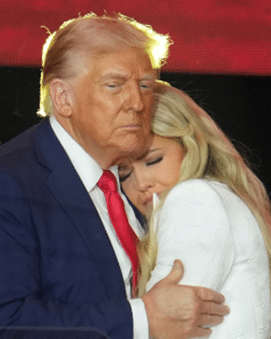
Photo Credit: India Today Global Instagram, September 21, 2025, https://www.instagram.com/p/DO4zuqdk-ZV/
In his same speech, Trump further leaned in on toughness, citing a practical action of his administration. With the stationing of National Guard troops, Trump remarked, “You know, we stopped the crime in Washington. Took 12 days.” He did not mention prior falling rates of crime. And crime continued in the Nation’s Capital, albeit at a lower rate. Was that because of the troops or because of prior trends? Rather than address such nuance, he spoke bluntly with what appealed as a likely story: with crime, apply force against it, end crime. Trump also used his broad thinking and toughness to prod the Likud government in Israel and Hamas in Gaza to agree to a ceasefire. But many particular troubles have continued producing a “ceasefire” with much gunfire and rocket fire.
As of now, Republicans are relying on blunt comments, short-term policy gains, and division of the electorate to continue gaining electoral wins and the dismantling of “the administrative state” with its “bureaucratic managerial … Left ideologues,” in the words of Kevin Roberts of the Heritage Foundation which produced Project 2025, a blueprint for policies in Trump’s second term. In the last few years, the advantage has tipped to the Republicans. Will their current approaches continue to appeal? Will toughness really bring the practical results that most voters want? That might work, but their opposition has different plans.
While the political boxers fight it out every day over each polarizing issue, new trends may be emerging. Stay tuned for the historian’s report from near the ringside in the next essay, “Potential Democratic Appeal, Practicalities.”
Notes
Paul J. Croce is author of Science and Religion in the Era of William James: Eclipse of Certainty, 1820-1880 (University of North Carolina Press, June 1995) and Young William James Thinking (Johns Hopkins University Press, 2018); author interview. In 2013, he served as Lecturer at the William James Center, Universität Potsdam and Presenter on Learning Across Differences, the 2020 History of Psychology Wallace A. Russell Memorial Lecture, American Psychological Association. After teaching History and American Studies in academic classrooms at Stetson University from 1988 to 2024, he now works to bridge the academic world and public life using history to encourage listening across differences in The Public Classroom, https://publicclassroom.substack.com/about.
0