
The Book
The State of Conservation: Rural America and the Conservation-Industrial Complex since 1920
The Author(s)
Joshua Nygren
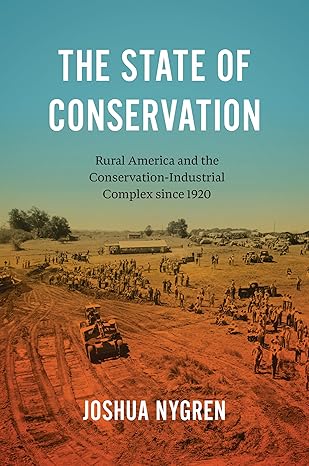
Multiple historians have traced the causes that led to the mass exodus of America’s farm population since the early 1900s, one of the most substantial demographic shifts in twentieth-century US history. In 1920, farmers represented 30 percent of the US population, but by 2000, that number had dwindled to 2 percent. All the while, the average farm size increased from 149 acres to 441 acres. Historians from various disciplines have attributed the disintegration of the nation’s farm population to multiple factors, like the mechanization of agriculture, intensive farming practices, or catastrophic environmental events, like the Dust Bowl. But in The State of Conservation: Rural America and the Conservation-Industrial Complex since 1920, Joshua Nygren argues that soil and water conservation not only contributed to the collapse of the American farmer, but conservation also played a role in the consolidation of the nation’s farmlands into fewer hands.
At the center of Nygren’s argument is what the author terms the “conservation-industrial complex.” Similar to the more well-known military-industrial complex, Nygren’s conservation-industrial complex highlights the symbiotic relationship between the state and private enterprise as departments like the United States Department of Agriculture worked with landowners to combat soil erosion. Nygren focuses on a host of agencies, but the one most important to the thesis is the Soil Conservation Service (SCS). President Franklin Delano Roosevelt created the SCS at the height of the New Deal as a way to conserve the nation’s soils and provide stability for rural Americans. During World War II, however, the “social-justice objectives [of the SCS] fell by the wayside” (54) as the federal government was more concerned with producing more crops for consumption than keeping farmers on the land. After the war, federal policy makers allied with private companies, like John Deere and International Harvester, to redefine conservation as development, and only the largest and wealthiest landowners could keep up with the technological treadmill. Nygren’s narrative thus unfolds, demonstrating that by the inception of the conservation-industrial complex in the late 1940s, “public policy engaged no more in social engineering by buffering people from capitalism than by surrendering them to it” (75).
Chapter one largely focuses on Hugh Bennett, a USDA agent who in 1929 published the circular Soil Erosion a National Menace. By 1935, FDR had appointed Bennett to lead the new Soil Conservation Service. At first, Bennett and the SCS worked with farmers to ensure they remained on their land, but by the end of the 1930s, it was clear to Bennett that the agency must decentralize if they were to remain a permanent institution. This ushered in the rise of soil conservation districts, which soon covered most of the nation’s farmland. These districts excluded sharecroppers, tenants, and farm laborers from participation, leaving landowners with the most power to control conservation programs.
The proliferation of the complex from the 1940s through the 1960s is the focus of chapters two and three. The former delineates the ways in which federal agencies worked with the earth-moving industry so that wealthy landowners could protect their soil, while millions of smaller farmers left their lands because they could not compete with those more closely tied to the conservation-industrial complex. Chapter three shows how watershed conservation, like the SCS’s small earthen dams that soon appeared around the country, remained inconspicuous from antistatist criticisms. The remaining three chapters survey the conservation-industrial complex from the 1960s through the early 1990s. Nygren focuses on programs like the Soil Bank, river channelization, and conservation tillage (no-till agriculture) to demonstrate how these programs benefited those at the grasstops, while also presenting the backlash that the conservation-industrial complex faced from small landowners, African Americans, and environmentalists. The monograph concludes with the ramifications of the 1985 Farm Bill. While some hoped this was the dawn of a new era, this legislation “relied on self-interest and the profit motive, warded off regulation, and reinforced the slow violence of land consolidation and the concentration of wealth, casting them in the light of environmental righteousness” (180).
In an epilogue titled “Ghost Farms,” Nygren outlines the path of the conservation-industrial complex since 1990. Along with the rise of computers and nanotechnology, military contractors began to partner with agricultural companies and the federal government to work on satellite-tracking machinery, connecting the military- and conservation-industrial complexes. These public-private partnerships are nothing new, and they will continue until as many humans are pushed off farms as possible to save capital. The only conclusion, Nygren finds, are ghosts farms, acreages void of any human interaction.
Nygren’s scholarship and research are impressive. The author visited twenty-one archives, across nine states and Washington, DC, and Nygren makes important interventions in political, agricultural, and environmental histories. Most significantly, Nygren offers a powerful argument that “In trying to keep soil from washing to the sea, [the conservation-industrial complex] sold millions of people down the river” (195).
About the Reviewer
Fraser Livingston is an environmental historian who received his PhD in history from Mississippi State University in 2022, with a focus in early and modern United States History, the history of science and technology, and environmental history. His academic interests are in the history of conservation, agriculture, and forest history. The Agricultural Historical Society awarded his dissertation, Losing Longleaf: Forestry and Conservation in the Southern Coastal Plain, the 2022 Gilbert C. Fite Award for Best Dissertation on Agricultural History. Currently, he is a research assistant and writer for a book project about George Bird Grinnell and also serves as the book review editor for Environmental History.
0