
The Book
Global Race War: International Politics and Racial Hierarchy
The Author(s)
Alexander D. Barder
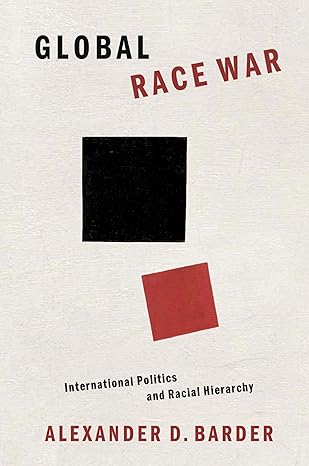
In Global Race War: International Politics and Racial Hierarchy (Oxford University Press, 2024) by Alexander D. Barder the reader is asked to think about race and racism in a new way. For Barder, race, and the advent of a racial hierarchy, is not a primordial phenomenon that arises within all cultural-geographic political arrangements, but rather a global order facilitated by the western imaginary. What Barder conceptualizes as the “global racial imaginary” is at its core imbued with, fueled by, and justified with violence. Violence, and its distinct racial manifestations, emerges with imperial expansion, scientific inquiry, the production and fallout to global wars, and most potently, creates and responds to perceived racial crises. The line between domestic and international spheres is obliterated in Global Race War. Barder rightfully argues that we cannot understand international politics, an understanding of whose lives are valued and whose are discarded, and the hierarchies within the interstate system without a direct engagement with the intersection between the global and local through the contours of roving global white supremacy.
Barder’s arguments emerge from a genealogy of international relations literature that historically minimized, downplayed, and/or ignored the importance of racial analyses. In this regard, the book follows more recent scholarship that seeks to hold fields that specialize in international analyses to account for how race was neglected or inadequately applied. The forthcoming edited volume, Race, Racism, and International Law (Stanford University Press 2025) is one such example. Contributors in the volume expose how race shapes all aspects of global sociopolitical and legal formations. Barder’s conceptual contribution of the “global racial imaginary” is most astute in this regard. The global racial imaginary created by western praxis and discourse imagines the world as racially structured, that races are defined through essentialism and hierarchy, and that races align with and extend beyond state borders. The global racial imaginary is also flexible, shifting across historical periods, reflecting the specific moment’s most pertinent global white racial anxieties and fears. The historical timeline of racial anxiety addressed in the book include the Haitian Revolution, eugenics fear of white racial extinction, American imperial expansion, the supposed “barbarity” of non-white racial violence, communism as a racial plot, non-white state power moves, the global war on terror, and white racial placement. At each moment violence cloaked the domain of interpretation and the design of global power maintenance.
Barder’s chapters on how non-white racialized groups and geographies navigated and responded to the “global racial imaginary” were particularly instructive, as were the chapters that highlighted how communism as a political threat was racialized. The chapters on the Armenian genocide and the global “Yellow Peril” threat underscored how violence perpetrated by racialized “non-white” groups was viewed as a natural outcome of perceived Orientalist racial inferiority. Turkey and Japan responded to being transnationally racialized in complex ways. For elites in these geographies, their global political survivability was often viewed and acted upon within a global calculus where western empires and states exhorted their racial degeneracy but feared the racial retribution they could potentially unleash. Communism similarly operated as a global racial assemblage of discourses and representations. Supposed backward, irrational, and menacing state actors – whether it be Bolshevik Soviets for Nazi Germany or Northern Vietnamese supported by Mao’s China for the U.S. – were constructed as taking the western world to the brink of destruction and thus had to be violently stopped.
Barder ends Global Race War with contemporary examples of how the global racial imaginary moves within a twenty-first century landscape where overt racist appeals are replaced with civilizational, naturalized cultural essentialism that are seemingly detached from earlier racist screeds. Barder shows us how race becomes even more slippery and volatile when the global racial imaginary adapts to these latest racial threats. Through it all, by centering the politics of racial violence in maintaining a global racial order of continued western supremacy over the last several hundred years, Barder extols upon us to not turn away from its constant reproduction and ongoing deadly consequences.
About the Reviewer
Michelle Christian is an Associate Professor of Sociology at the University of Tennessee, Knoxville. Her research focuses on global racial formations and its material and representational processes. She is the author of The Global Journey of Racism (Stanford University Press 2025). Other publications include articles in Sociology of Race and Ethnicity, Ethnic and Racial Studies, Identities: Global Studies in Culture and Power, American Behavioral Scientist, International Sociology, Critical Sociology, and Global Networks.
0