
Editor's Note
The deadline for panel proposals (paper panels, roundtables, and author-meets-critics) has been extended to May 15, 2026.
Society for U.S. Intellectual History Call for Proposals
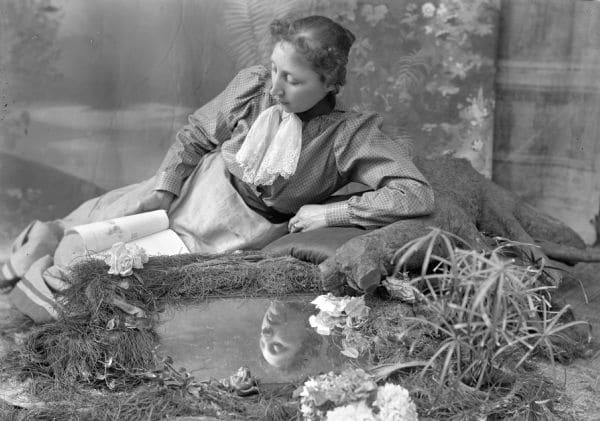
“Woman Gazing into a Pond” by Frank Feiker (1910-1950), Cassville, WI (Credit: Wisconsin Historical Society)
The 2026 S-USIH Annual Conference will be held in Madison, Wisconsin, on November 12-14, 2026, on the campus of the University of Wisconsin-Madison. The theme is “Intellectual Historians’ Toolkits: Methods, Theories, Practices.” Our conference co-chairs are Daniel G. Hummel and Jennifer Ratner-Rosenhagen.
Today’s best examples of intellectual history are defined by their diversity, innovation, and rigor. Diversity in the subjects, sources, and methods employed; innovation in making audible hitherto silent or neglected voices; and rigor in the quality and breadth of scholarship. A previous era of sharp distinctions has given way to variety and interdisciplinarity, to intellectual historians gaining readership in other fields, and to a wide array of scholars from other fields producing intellectual history.
Intellectual history has come a long way in a few decades. But with advancement comes new questions: What are the shared features and practices of our work? How do scholars conceive of their work as intellectual history? Is there any agreement about the unique contributions of intellectual history? What sources do intellectual historians use and what are the questions they bring to those sources? What are some of the shared methods in the variety of approaches we see in the field today? The year 2026, the Semiquincentennial for the United States, offers a symbolic opportunity to assess and renew a shared sense of purpose and vision for the field.
In bringing this conference to bear on this historiographical moment, the conference will encourage examinations of intellectual history itself, both as a method and as a subject of inquiry. Some of the potential topics to address include: defining intellectual history; the ways intellectual history is used in allied fields including economics, religious and cultural studies, political theory, history of science, history of education, and more; methods including conceptual history, commodity history, history of emotions, and environmental history and their overlap with intellectual history; intellectual history as social or political criticism; and historians’ own research and writing practices. Panels might examine a historical subject (such as racial capitalism, literary criticism, or mystical experience) from a variety of intellectual history approaches, or they might address a timely topic (such as the challenge of public-facing scholarship and the growth of A.I. tools) from the unique vantage point of intellectual history.
This conference is currently planned to be entirely in-person with no hybrid options for presentation or attendance. Within those parameters, we plan to facilitate a conference that is accessible and welcoming to all.
Submissions
Note: The deadline for single paper submissions is April 15, 2026 while the deadline for panel, roundtable, and author meets critics sessions is May 15, 2026.
Traditional Panels (3-5 people):
A traditional panel will include a chairperson and three presenters. Presentations should be no longer than 12 minutes/presenter. The panel chairperson may also serve as a commentator, or the panel may include a separate commentator.
Traditional Panel submissions must include the following materials: a title for the panel; a designated chair; names, email addresses, and institutional affiliations (if any) of all panel participants; a 150-word abstract for each paper; a separate 200-word abstract for the entire panel; a one-page CV for each participant. Traditional Panels proposals are due May 15, 2026.
Roundtables (3-5 people):
A roundtable will include three or four discussants. One of the discussants may serve as the roundtable chair/moderator, or the roundtable may include a separate chair/moderator.
Roundtable submissions must include the following materials: a title for the roundtable; names, email addresses, and institutional affiliations (if any) of all roundtable participants; a 100-word description of each discussant’s expected contribution to or intervention in the discussion; a separate 200-word abstract for the entire roundtable; a one-page CV for each participant. Roundtable proposals are due May 15, 2026.
Author Meets Critics (3-5 people):
This session will focus on a recent book in U.S/North American intellectual history (all chronological periods) with one or more scholars presenting their analysis, followed by a response from the author. One of the presenters may also serve as the chair, or the chair may be a separate person.
Author Meets Critics submissions must include the following materials: the title of the book and a 200-word synopsis/abstract of the book; names, email addresses, and institutional affiliations (if any) of all participants; a 100-word description of each discussant’s expected intervention; a one-page CV for each participant. Author Meets Critics proposals are due May 15, 2026.
Single Paper Proposal
Although we will give strong preference to organized panels, we are accepting individual paper submissions. Note that single paper proposals are due earlier than other proposals on April 15, 2026.
All individual paper submissions must include the following materials: a title for the paper; name, email addresses, and institutional affiliations (if any); a 200-word abstract for the paper; a one-page CV. Submissions should also include (1) a hierarchical list of themes, topics, events, and other relevant keywords (related to intellectual history, as much as possible); and (2) the paper’s anticipated chronology. These tools will aid in the creation of sessions. Single paper proposals are due April 15, 2026.
Submission Guidelines
-
The committee is eager to ensure a diverse representation of scholars at the conference. We welcome submissions from graduate students, professional historians, academics working in adjacent fields, scholarly professionals working outside the academy, independent scholars, and high school teachers. We strongly encourage panels that reflect the diversity of our field in terms of gender, ethnicity, sexual orientation, and/or institutional affiliation of panelists.
-
Individuals may appear on the program no more than twice. Those appearing twice must do so in two distinct capacities (paper presenter, panel commentator, roundtable discussant, etc.). Participants may, for example, deliver a paper and be a panel commentator, but may not present two papers.
-
Our conference venue makes the rental of A/V equipment prohibitively expensive, so we ask that panels not rely on access to it.
-
The committee will assume that submission to the conference is an indication that participants will be able to present at any time on November 12-14. If religious practice, teaching schedules, ADA requests, or other obligations limit when you can present, please note such limitations with the proposal.
-
All persons appearing on the program will be required to register for the conference and to become members of S-USIH. You can join or renew here.
-
All documents should be submitted via email to: [email protected] in a single PDF document. The deadline for single paper submissions is April 15, 2026 while the deadline for panel, roundtable, and author meets critics sessions is May 15, 2026. Notifications will be sent to session organizers in June 2026.
2 Thoughts on this Post
S-USIH Comment Policy
We ask that those who participate in the discussions generated in the Comments section do so with the same decorum as they would in any other academic setting or context. Since the USIH bloggers write under our real names, we would prefer that our commenters also identify themselves by their real name. As our primary goal is to stimulate and engage in fruitful and productive discussion, ad hominem attacks (personal or professional), unnecessary insults, and/or mean-spiritedness have no place in the USIH Blog’s Comments section. Therefore, we reserve the right to remove any comments that contain any of the above and/or are not intended to further the discussion of the topic of the post. We welcome suggestions for corrections to any of our posts. As the official blog of the Society of US Intellectual History, we hope to foster a diverse community of scholars and readers who engage with one another in discussions of US intellectual history, broadly understood.
Hello, should we use this comments section to facilitate potential panelist meet ups or is there another (facebook free) place to go for these? Thanks
Great idea, Katy!