
The Book
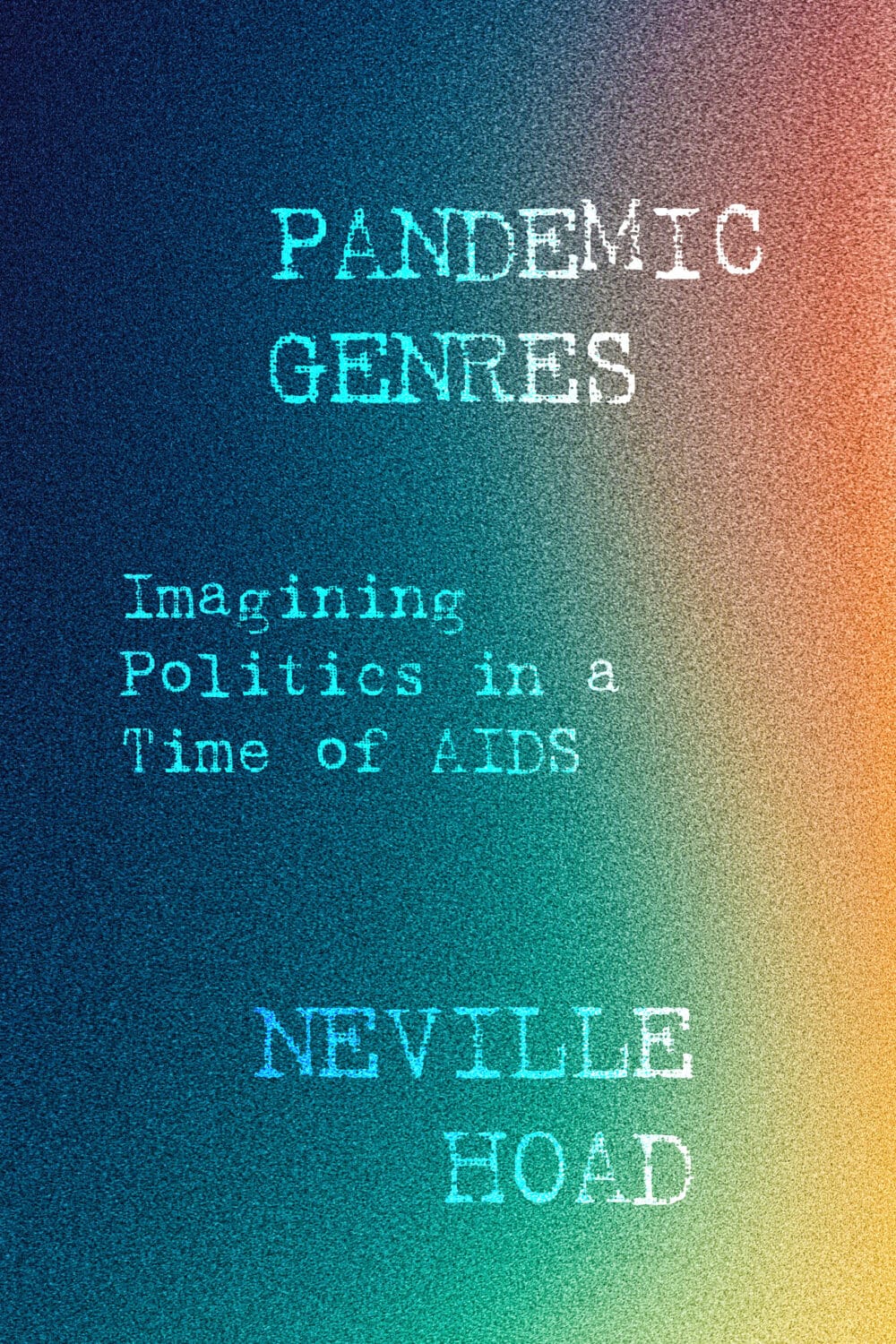
Pandemic Genres: Imagining Politics in a Time of AIDS
The Author(s)
Neville Hoad
‘The world has Aids.’
This statement, attributed in the book’s introduction to Adam Levin, the late South African writer and journalist, is repeated throughout Professor Neville Hoad’s Pandemic Genres: Imagining Politics in a Time of AIDS. The repetition of this statement across the book intentionally encourages the reader to consider the African experience with the HIV & AIDS pandemic as deserving recognition for the continent’s imaginative contributions within a global consciousness of living and surviving through this pandemic. It is a conscious and deliberate positioning through which Hoad recognizes the mechanisms through which the majority of AIDS literary—and probably cultural, social, and political—analysis remains remanded to being imagined and interpreted from the standpoint of the Global North.
Hoad presents the book as one of the first responses to consider the creative representations ‘African AIDS pandemic’: a term that organizes the responses into a collective from a standpoint of geographic and cultural praxis of care and concern, although it could have been more accurately narrowed to Southern and East Africa. Of the continent’s 54 countries under consideration, the selected few are Botswana, Kenya, and South Africa, with some critical analysis dedicated to Uganda. With the exception of an isiZulu film considered in the book, the majority of content under review represents English-language cultural productions.
Understandably, the book’s strengths are full display in the context of South African analysis: the author’s home country. This book easily could have been about South Africa’s creative and cultural productions given the access, authority, and comfort in which he infuses social and political commentary that only emanates from a place of familiarity. Instead, he offers an important and welcome expansion into other countries to continue what the book intends to perform a decisive ‘shift’ from dominant narratives.
In that respect, Hoad is careful and diligent not to lapse into white saviorist, voyeuristic tropes of African suffering, poverty, or trauma, although the book also does not avoid the realities of these complex issues in relation to the realities of AIDS either. Hoad illuminates the need to interpret nuance among cultures, although outside of the South African context; this is constructed along nation-states, rather than culture. The book remains true to its title to pursue the imaginative reach of genre as each chapter is organized around a carefully selected assortment of creative responses to the pandemics—beauty pageants, films, memoir, poetry, youth fiction, and documentary fictions—to understand the complex set of political and cultural entanglements that made the African experience with the HIV/AIDS pandemic distinct.
The book begins and ends, in a sense, with the United States and South Africa. On the one hand, it is a deliberate and important position to take to shift the discourse in global representation of who is affected by AIDS. In the introduction, PEPFAR is introduced poetically, rightly concluding that ‘its imagination of effective policy […] reveals deep commitments to classed and “civilizational” intimate sexual and family, forms and investments’ (16). Indeed, the trajectory of AIDS changed once widespread antiretrovirals became widely accessible across Africa. On the other hand, this construction implicitly presents an argument that much of Africa’s fate—and conversely her creative and literary interpretations—is intrinsically tied to the same Global North dominance that the book claims to distance itself from. Hoad provides ample historical evidence to tie ongoing neoconservatism through policy and public health intervention to the neoliberal agendas that continue to influence the trajectory of the AIDS pandemic. More recent developments that point to this include the recent withdrawal of PEPFAR funding and the closure of USAID under the Trump administration, which occurred after the book’s publication.
The first chapter offers meaningful shift on the ‘figure’ (32) by introducing beauty pageants, an area that I have not seen critical analysis in relation to Africa and HIV & AIDS. The chapter presents an inquiry into ‘Miss HIV’ in the film Zero Patience as a camp figure within drag culture alongside a documentary of Botswana’s Miss HIV Stigma Free. On the one hand, Hoad makes a complex argument that Miss HIV served to ‘deracialize’ representation of the pageant, but also presents the contradiction of an evangelical documentary that insists that the beauty pageant is an effective tool for weaponizing stigma as a force for good in AIDS prevention. This encapsulates the types of nuances that Hoad is exceptional at presenting across this book regarding the political imaginings of race and representation around AIDS creative productions.
Hoad is careful in outlining the various exploitative and suppressive histories of colonialism and race that inform the book’s political underpinnings. Furthermore, the book takes a strong and rightfully cynical approach to the ongoing coloniality over the production of narrative control over African cultural production that may have once begun under colonialism and remains embedded within the humanitarian intervention approach. This is reflected in one of the most unique and bold contributions in chapter five, which explores the ‘NGO-ification’ of AIDS literary productions.
Important sub-critiques that appear elsewhere in the following the chapters offer cultural representations of how public policy converged to present a sense of control of power over creative representations. Chapter 3, “Film,” presents the film Yesterday, which had financial backing from the Nelson Mandela Foundation as a complex narrative that sought to be educational but, Hoad argues, lapsed in its duty to show the complexity around African womanhood beyond tropes of strength and resilience. The chapter offers Hoad’s perception of where the film fails to adequately represent the complexities of African womanhood, patriarchy, and the AIDS struggle, but the ensuing paragraphs on theory demonstrate how this could have been further bolstered.
There is a clear and imperative declaration on the need to shift the global discourse around the AIDS pandemic into a more expansive and inclusive framework. This work succeeds in its creative presentation of the political shaping of genre as a means to contextualize the African creative response. Another commendable aspect of this book is that is exceptionally well cited. A considerable range of sources from government reports, journalism, international agency proceedings, and theory were referenced in the production of this book. However, with the latter point of theory emerges a critical shortcoming in the author’s citational practice; a review of the sources leaves the impression that despite the appeal and breadth of the African imagination, Hoad’s analysis cannot escape the dominance of Global North, largely American, geopolitical power in the theorization around African life and creativity.
If one of the intentions of the book was to facilitate the shift of discourse and analysis, it largely remains heavily dominant on social analysis from Western thinkers. This book needed to adopt a decolonial literary approach that incorporated the critical scholarship of African thinkers on key issues such as African women’s agency in literature (Anna Adima, Kadiatu Kenneh-Maso, Amina Mama), colonialism and health (Simukai Chigudu), Afrocentricism and Black Studies (Anani Dzidzienyo, Sylvia Wynter), postcolonial theory (Mahmood Mamdani) African human rights and policy (J. Oloka-Onyango), race in Africa (Hugo Canham), and African sexuality inclusive of LGBT histories and futures (Stella Nyanzi, and Sylvia Tamale). An opportunity is missed to shift, through ontological means, the centre of theoretical and analytical knowledge from the West to Afro-Indigenous and Black Studies thinkers across the wider diaspora. An area where this is attempted effectively appears in chapter four’s Young Adult Novels; this discussion presents an underexplored examination into the role of the NGO of shaping the production of youth-oriented literature in African AIDS writing. Carolyne Adalla’s Confession of an AIDS Victim (Kenya, 1993) is appropriately contextualized alongside the work of Kenyan theorist Keguro Macharia. Macharia’s work is particularly important in contextualizing rigid heteronormativity in African literary critique, but also it his presentation of Blackness and African love and intimacies in the context of Afro-modernity.
The most endearing and intimate parts of the book emerge when it is clear that Hoad is writing what he knows. The aptly titled Memoir: Getting Personal (chapter two) engages Adam Levin’s 2005 memoir Aidsafari, a story of a life and queer kinship in South Africa that is deeply invested in memory as it is aesthetics. What also transpires are interpersonal vignettes of Johannesburg’s LGBT scene that only someone who lived through it could explore. It undoubtedly offers remembrance of the gay nightlife scene, interspersed with cultural analysis informed by writing from journalists and state publications of the time. The chapter could have benefited from more rooted positionality in explaining and exploring race in the context of white gay life in South Africa. It missed an opportunity to offer pointed analysis on whiteness, with white South Africans as a racial minority that holds the majority of the country’s economic power. Minoritized white LGBT citizens would have experienced the AIDS pandemic differently in consideration of the persistent post-apartheid racial dynamics marked by inequality, disparate access to healthcare, privilege, visibility, and representation. This is an area where theorization from influential, American contributors of queer theory that appear in this chapter to shape the discourse around South African AIDS literary production could have been useful in framing the need for a theoretical shift in the analysis of African literature. In short, the chapter could have been benefited from a critique on the operation of whiteness in literary analysis and the invisibility in Black African LGBT narratives and literary theory.
Otherwise, Hoad’s writing and prose is delightful, poetic, and accessible. This book could have easily been riddled with dense statistics, policy notes and other materials, but rather it aims for a smooth a balance that reflects the power and agency of creative forms in shaping the imagined narratives while exposing the nuances of genre as foundational to the creative imaginings in response to the African AIDS pandemic.
Accordingly, the success and significance of Hoad’s work is rooted in his convincing illumination of how the imaginative spanned across genres beyond witness and testimony, but within the context of contemporary realities of the creative response to the AIDS pandemic. Overall, the book offers an important contribution by widening the scope of AIDS literary representation to be accepting and inclusive of creative contributions produced on the African continent in response to the AIDS pandemic.
About the Reviewer
Chisomo Kalinga is a Chancellor’s Fellow at the Department of Social Anthropology, University of Edinburgh. Her research interests are disease (specifically HIV/AIDS and sexually transmitted infections), illness and wellbeing, biomedicine, traditional healing, indigenous beliefs and cosmologies and their narrative representation in African oral and print literatures. Her transdisciplinary work engages storytelling and literary traditions in Malawi focusing on the intersections between aesthetics, narrative, ethnography, representations of the body and the communities that produce stories about health and wellbeing. She founded the Malawi Medical Humanities Network in 2017 and is currently supporting the transition to project the Malawi University of Science and Technology.
0