
The Book
Hardcore Punk in the Age of Reagan: The Lyrical Lashing of an American Presidency
The Author(s)
Robert Fitzgerald
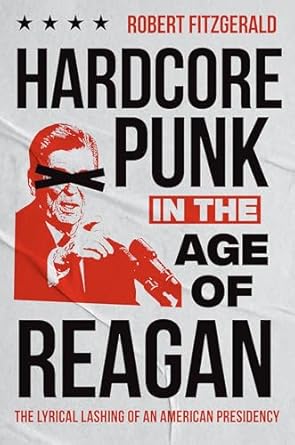
Robert Fitzgerald’s Hardcore Punk in the Age of Reagan: The Lyrical Lashing of an American Presidency (2025) provokes readers to analyze lyrics from a variety of punk bands across the U.S. and consider how those bands challenge the Reagan administration, making this book a time capsule fitting of punks living through the Trump Era.
Fitzgerald’s lyrical analysis about punk culture in the 1980s are contextualized by concurrent political events which is also the lens through which readers can take their favorite stanzas from their favorite band’s songs and turn them into mini history lessons about the infamous Reagan Era. The lyrical analysis in this book is intellectually rigorous by way of the call and response style of each chapter—opening with an important historical moment in the Reagan presidency followed by the ways different punk bands expressed their distain. From critiquing policing, religion, war time etc., this book creates a public facing and accessible history for the general public, punk fans, and scholars of punk history.
As a queer Chicana and oral history punk scholar, I have noted that books about punk history are often obsessed with origin. While there is no one singular origin that fits all, there is no excuse, especially now, to disregard women of color and LGBTQIA+ contributors within punk life and culture. The singular origin story of punk tends to satisfy white male authors where New York is the epicenter with The Ramones, or other curated genealogies starting with white male artists which encourages punk as homogenous and synonymous with maleness. The ongoing excuse within these male-driven archives is that women were allegedly “not around” or women were “not in bands” in specific eras. Yet – according to my research – women have always been musicians, band managers, fans, girlfriends, “groupies” or casual lovers, merch handlers, roadies, writers, landlords, and benefactors. This misnomer of women not being present within punk life means that there is a disregard to women’s labor in these categories. Labor that went unpaid much like how the cult of domesticity is often pegged to women’s gender roles for nothing in return. If this erasure is grounded in white women’s experiences, then I task white punk male authors to urgently look within themselves, as writers of U.S. punk life and culture, why women of color are at the bottom rung of their expertise.
Additionally, when speaking to the use of homophobic terms by hardcore bands in the 80s, the unearned straight privilege to say homophobic things is still respected. But when frontman H.R. of the D.C. band Bad Brains has one song touching on homophobia, he is labeled homophobic for life. There is a color line and a gendered one that creates the conditions through which straight white men can tease saying and doing homophobic and racist things for their art in a way that artists of color, in doing the same thing, get disproportionally reprimanded. Echoing the phrase “when it’s white, its right.”
I argue that while punk doesn’t age gracefully overtime, it’s less a question of “are these songs listenable today”—it’s that white straight men within punk continued to make a profit and reinforce a rubric of cool premised on the shock value of homophobia that guaranteed popular notoriety after the 1980s. The band FEAR is frankly the penultimate example of this. Similarly, regarding race and whiteness explored in Chapter Seven, “Guilty of Being White,” white privilege, in fact, creates the veil of marginalization without the material consequence of anti-black racism. The author is correct in that, no matter what, punk isn’t excused for being racist, homophobic etc., but let us not forget that the longevity of these bands and songs is because punk archives and fandom still uphold sexism and anti-blackness. These pillars by which punk is reinforced allows for the mainstream acceptance that white men in punk can keep “pushing boundaries” or rather get away with being problematic, especially using the strictly in-community N-word. It’s not a question of sensitivity, it’s a question of nostalgia for a time before cancel culture when women, gays, and black people could be enveloped within white critiques of their own “white guilt.”
Being fans and passionate historians of punk culture, whether we were there or not for the punk scenes we so revere and want to archive, must contend with push back. We’ll never truly get it right, and just like this book speaks to the importance of hardcore punk within the Reagan administration, so must the rest of us make use of what we have and remember for others to push back on and appreciate. It’s the punk rock thing to do.
About the Reviewer
Dr. Marlén Ríos-Hernández (she/hers/ella) is Xicana Punk Musicologist and Associate Professor of Chicana and Chicano Studies at California State University, Fullerton. She is also a former 2019-2022 UC President’s UCLA Postdoctoral Fellow from UCLA. Trained in Ethnic Studies and Musicology, her research investigates the genealogies between policing and SoCal punk communities as told by queer Black, Chicana, Latina punk women and femmes in the aftermath of the counterintelligence programs (COINTELPRO). She is a founding member of PunkCon–– a biannual conference celebrating punk scholars, activists, artists, musicians, and communities. Research interests include Chicanx Studies, Gender and Sexuality Studies, Cultural Studies with an emphasis on Film, Critical Ethnographies, Sound Studies, Hemispheric Punk Movements and Policing “Post”-COINTELPRO, Feminist Musicology, Punk Pedagogy and Archival Research Methods.
0