
The Book
Metropolitan Latinidad: Transforming American Urban History
The Author(s)
A. K. Sandoval-Strausz

Nuestra America es historia americana. Our America is American history.
—Vicki Ruiz
In Metropolitan Latinidad: Transforming American Urban History, historian A.K. Sandoval-Strausz presents a collection of twelve essays that, collectively, reposition the places and practices of Latin Americans in North American cities. Far from treating Latin Americans as supporting actors in urbanization processes, each contribution challenges U.S. urban historiography by showing Latin immigration as fundamental to the social, political, and economic construction of U.S. urban space.
U.S. urban history has long focused on industrialization as a magnet drawing large numbers of peasants and farmers into the cities from both sides of the North Atlantic. Segregation and systematic marginalization of African Americans were important counterpoints in a story of urbanization that culminates with the urban insurrections of the 1960s, the emergence of blacks as a new political force, and the election of black mayors. Latin Americans and Asians have been secondary figures in this account rather than indispensable agents whose activities have been equally necessary to understand U.S. urban development fully.
Sandoval-Strausz, a professor at Penn State University and author of important works such as Hotel: An American History (2007) and Barrio America: How Latino Immigrants Saved the American City (2019), has worked for many years at the intersection of urban, migration, and Latino history. His new book is a thought-provoking, multi-interpretative collection presenting the work of a diverse group of scholars working in history, sociology, cultural studies, and urban planning—Llana Barber, Mauricio Castro, Eduardo Contreras, Sandra I. Enríquez, Monika Gosin, Felipe Hinojosa, Michael D. Innis-Jiménez, Max Krochmal, Becky M. Nicolaides, Pedro A. Regalado, Iliana Yamileth Rodriguez, Cecilia Sánchez Hill, Thomas J. Sugrue. Their work together demonstrates, each chapter in its own way, how Latinos (re)defined the U.S. city by being the starting point for cities that are “multicultural and multiracial.”
The book is divided into three sections—Metropolis, Neighborhood, and Hemisphere—which correspond to different analytical and spatial scales of Latino presence and action. The structure is designed to show that Latinidad has not been restricted within ghettos, but extends out of local neighborhoods to make transnational cities, whose structures and possibilities transcend binary divisions between “white” and “non-white.”
“Metropolis,” which opens the book, focuses on how Latinos in recent decades have occupied and transformed urban rather than rural spaces. Pedro A. Regalado analyzes the challenges of peaceful protests by Puerto Ricans and Mexicans in cities such as Chicago and New York in the 1960s and 1970s, when, similar to many African Americans, they faced marginalization and severe police repression. Iliana Yamileth Rodriguez reconstructs the experiences of Mexicans in Georgia in the 1990s, including during the Olympics. At that time, Mexicans were considered “hard workers” rather than modernizing agents with rights and histories. Thomas J. Sugrue examines the challenges faced by Puerto Ricans in the suburbs of cities like New York, demonstrating the racial dynamics, economic inequalities, and housing problems that began in the 1940s, when they began to migrate in increasingly larger numbers into U.S. urban centers. Becky M. Nicolaides, in turn, explores the concept of ethnoburbs, exploring how Latin American and Asian immigration reconfigured suburban space. A more diverse population introduce a wider range of cultural nuances, economic strategies, and spatial mobility that transcend stereotypes that associate immigrant communities with marginality and poverty.
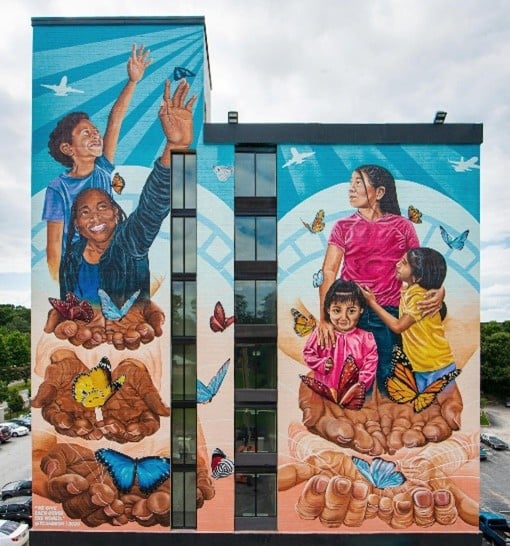
“We Give Each Other the World” is inspired by the stories and experiences of people who live in Hapeville, Ga. (Courtesy of Yehimi Cambrón / Hector Amador)
The “Neighborhood” section reveals the everyday dimension of urban life and the redefinition of its boundaries. Sandra I. Enríquez analyzes how, through intense political struggle, the Latino community in El Paso reinvented the use of abandoned spaces by building creatively designed adobe housing. These dwellings express the urban dignity of Latinos as well as the influence of indigenous architectural traditions based in a deep knowledge of how to live comfortably but efficiently in a hot and dry region. Felipe Hinojosa’s study of Acción Cívica Evangélica explores how Latino evangelical churches in New York in the 1960s and 1970s became centers for social activism, combating poverty, discrimination, and crime among both believers and atheists. Hinojosa also considers the role played by the Catholic Church, which in those years sought to empower the Latino community in cities like New York, Chicago, and Los Angeles.
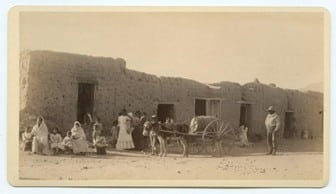
Date Circa 1882-1895. The location is estimated to be either in El Paso, Texas or Ciudad de Juarez, Mexico. Sourced from SMU Library Archives.
Llana Barber offers a critical analysis of Puerto Rican migration, which increased significantly after World War II due to the lack of work in Puerto Rico’s colonial economy. She demonstrates how Puerto Rican immigrants confronted a broad range of exclusionary and discriminatory challenges when they arrived in North American urban centers. Puerto Ricans are not North American, nor did they integrate with other Latino/Hispanic Americans. “Puerto Rican exceptionalism, ” the idea that Puerto Ricans are in fact “legitimate Latinos” in the U.S. because Puerto Rico “belongs” to the U.S., did not allow, according to Barber’s argument, for either social mobility or recognition of their rights as U.S. citizens. Max Krochmal and Cecilia Sánchez Hill propose the concept of the Latinx palimpsest to show how Latinx communities have rewritten urban space, layer by layer, over older racial and political structures in Fort Worth, Texas. The rapid expansion over recent decades of migration from Mexico into Fort Worth undermined “Juan Crow,” the system of racial segregation in the city as applied to Mexicans. New community organizations formed in the Mexican community that expanded Mexican political engagement, leading to projects for improving decaying neighborhoods, such as New Poly, by providing social and economic opportunities for its residents. The chapter highlights the role the Café Campesino restaurant in the immigrant community’s fight for rights and recognition. Michael D. Innis-Jiménez concludes the section with a particularly interesting study of Mexican restaurants in Chicago. He shows how, since the beginning of the twentieth century, efforts to provide typical food and a comfortable atmosphere for customers generated pride in identity in sites that also encouraged interaction between the many cultures found in the city.
The concluding part, “Hemisphere,” investigates how Latino urban experiences are expressions of transnational movements. Eduardo Contreras focuses on the unusual connections the presence of Latin Americans bring about to other places and spaces. New Orleans, for example, is often seen as city whose character is defined by the confluence of French and American colonization. Contreras argues for the importance of broader interaction with the Caribbean world (Haiti, Cuba, Nicaragua, Mexico, etc.) for understanding the process of creolization occurring in cities like New Orleans. He turns to San Francisco for another example. Since its Gold Rush origins, a wide range of Latino workers, Chileans and Central Americans even more than Mexicans, have a been critical to the city’s development. Mauricio Castro investigates the effects of U.S. imperialism on the increase in immigration from various parts of Latin America to U.S. cities. During the Cold War, Salvadorans, Nicaraguans, Colombians, and many others created communities of exiles as well as of refugees from the civil wars U.S. foreign policy fomented. Finally, Monika Gosin offers a difficult reading of the histories of Afro-Cubans in the United States, highlighting how racial exclusions work within Latinidad itself. Many Black Cubans who came to the United States in search of freedom and opportunity, fleeing Cuban communism, encountered discrimination from white Cubans in Miami and Mexicans in Los Angeles, who considered them “less,” regardless of their skills or knowledge. Gosin challenges unifying narratives of Latinidad to introduce complexity to the analysis of Latino identity. Marked by internal differences, struggles over belonging, and racial hierarchies originating in the colonial era but continuing into independence, Latinidad has never been homogeneous.
Methodologically, the collection stands out for its recurrent use of oral history as a tool for producing historical knowledge, exposing the many silences in academic analysis regarding the importance of Latinos for North American urban history. Personal narratives in this collection are not simply peripheral illustrations, but function often as the springboards for showing how restaurants in Chicago or the construction of creative housing in El Paso argument reveal how to present the spatial, affective, and political logics at play in urban communities. Listening to what community actors have to say recognizes Latinos not only as subjects of history, but as authors of their own interpretations of the cities in which they build and live.
By positioning oral history as a methodological axis, Metropolitan Latinidad participates in a broader epistemological shift. It is an urban history that values everyday life, popular culture, collective memory, and situated knowledge. This shift redistributes the authority of those who can tell the stories of cities. In a field traditionally dominated by documentary sources and official records (urban planning and legal documents, census data), the choice to include oral sources from Latin Americans as a primary source of information represents a critical and political intervention in how urban history can be narrated, by whom it should be narrated, and for what purposes. This book’s commitment to orality is therefore not limited to collecting testimonies to add to the archives. It articulates a conception of history as a shared practice, where the production of knowledge involves listening to the other in their complexity, ambivalence, and agency. Oral history in this book operates as a tool for active listening and reconstructing life trajectories, as well as creating new archives. Orality allows scholars to capture what is usually unsaid in traditional archives, invisible everyday practices and preferences, conflicting subjectivities, patterns of resistance, and the world-making projects Latinos inside the United States have launched even in a context of structural marginalization if not always exclusion.
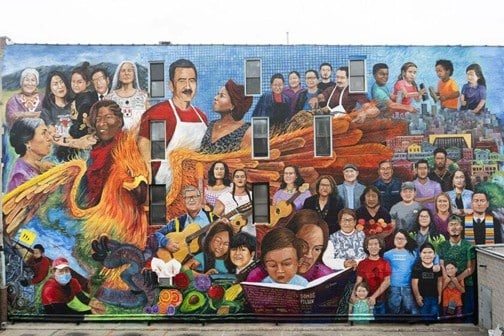
SERANO, Pablo; ZAPATA, Mateo. Somos Pilsen (“We Are Pilsen“)[Mural]. Carnitas Don Pedro, Pilsen neighborhood, Chicago, IL, U.S.A, 2021. Urban community mural representing members of Chicago’s Pilsen neighborhood rising in resistance to gentrification.
The work clearly demonstrates how Latin Americans have not only survived in American cities: they have rescued, rebuilt, and redefined them—despite racist policies of gentrification and the criminalization of poverty. In this sense, Metropolitan Latinidad encompasses a set of scholarly initiatives that challenge neoliberal conceptions of citizenship, belonging, and urban progress by generating mutual interest and enabling transformation.
Exploring a range of urban experiences, evangelical faith, culinary practices, suburbanization, political activism on many issues, this book highlights the urgency of rewriting urban history by rewriting the history of the Latino metropolis in the United States, based on previously marginalized. Metropolitan Latinidad offers, among its many virtues, a way of imagining who has the right to narrate the U.S. city. This is no small feat when we consider its publication coincides with the current administration of President Donald Trump, whose deportation policies have led to military invasion and surveillance of many U.S. cities, whose vision is a society rebuilt around displacement and precarity.
“Aunque el gobierno no nos quiera, estamos bien.”
“Even if the government doesn’t like us, we’re doing just great.”
(Bad Bunny, “Estamos Bien”)
About the Reviewer
Priscila Dorella is an Associate Professor of History of America and History of Latin-america at the Universidade de Viçosa in Brazil. Dorella is the author of Octavio Paz: Estratégias de Reconhecimento, Polémicas Politicas e Debates Midiáticos no México (São Paulo: Alameda, 2013). She wrote the note Susan Sontag uma intelectual pública to the projet Trans Atlantic Culture (2021) and served as a Visiting Scholar at the Department of History at Berkeley (2018) and at Universidade Federal Fluminense and La Rochelle Université (2024). Currently, she coordinates the construction of the first Oral History laboratory at the university where she works.
(translation by Richard Cándida Smith)
0